So~ After 2.5 weeks of wonderful math discussions with Amie and Charles, I finished my winter vacation and got back to Princeton! (and back to my normal blogging Sundays ^^)
One thing I would like to shear here is that we (me and Charles) finally got an answer to the following question that’s been haunting me for a while:
Question: Given Jordan curve 


Is it true that for all 


i.e. Is the projection map from the space of parametrized Jordan curves (with the uniform metric) to the space of unparametrized Jordan curves (with metric given by taking uniform distance between the canonical Riemann maps) continuous?
First, I think the development and problem-solving process for this one is quite interesting and worth mentioning (skip this if you just want to see math):
—Begin story—
The problem was initially of interest because I stated a lemma on our Jordan curves paper which asserts the above projection map is continuous at smooth curves. To my surprise, I was unable to prove this seemingly-direct lemma. I turned to Charles for help, after a day or so of thinking he proved it for smooth curves (via a very clever usage of cross-cuts as in the proof of Carathedory’s theorem) and asked back whether the map is actually continuous at all points.
This seemed to be such a natural question but we couldn’t find it in the literature. For a day or so we were both feeling negative about this since the cross-cut method fails when the Jordan curve has positive measure, which “should” happen a lot. In any case, I posted a question on mathoverflow to see if there is a standard theorem out there implying this. Almost right after I posted the question, during a wonderful lunch-conversation with Charles, I got this wonderful idea of applying extremal length techniques not to the semi-circular crosscut but only to the ‘feet’ of it. Which later that day turned out to be a proof of the continuity.
The next morning, after confirming the steps of the proof and made sure it works, I was thrilled to find that Thurston responded to the post and explained his intuition that the answer is positive. Although having solved the problem already, I am still amazed by his insights ^^ (It’s the second question I asked there, he left an comment again! It just feels great to have your idol giving you ideas, isn’t it? :-P)
Later on, McMullen pointed out to us that in fact a book by Pommerenke contains the result. Nevertheless, it was great fun proving this, hence I decided to sketch the proof here ^^
—End story—
Ingredients of the proof: We quote the following well-known but weaker theorem (one can find this in, for example Goluzin’s classical book, p228)
Theorem: If the Jordan domains converge (in the sense that parametrizations of the boundaries converge uniformly) then the Riemann maps converge uniformly on compact sets.
We also use the following topological lemma:
Lemma: Given Jordan curve 


where 

The proof of the lemma is left as an exercise
Proof of the Theorem:
Given 


By compactness of 



By extremal length, we can choose the cross-cuts 



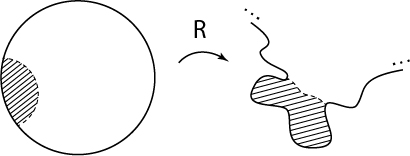
Let 

Let 
Choose 


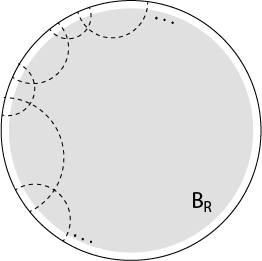
By the above theorem in Goluzin, since 



Fix a 


Claim: 
First note that assuming the theorem in Goluzin, it suffice to show 
For any 

![[f_1, f_1+d/10] \times [0,\sigma]](https://s0.wp.com/latex.php?latex=%5Bf_1%2C+f_1%2Bd%2F10%5D+%5Ctimes+%5B0%2C%5Csigma%5D&bg=ffffff&fg=5e5e5e&s=0&c=20201002)
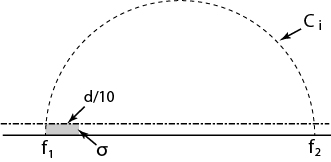
We conclude there exists ![e_1 \in [f_1, f_1+d/10]](https://s0.wp.com/latex.php?latex=e_1+%5Cin+%5Bf_1%2C+f_1%2Bd%2F10%5D&bg=ffffff&fg=5e5e5e&s=0&c=20201002)
![s_1 = \{e_1\} \times [0, \sigma]](https://s0.wp.com/latex.php?latex=s_1+%3D+%5C%7Be_1%5C%7D+%5Ctimes+%5B0%2C+%5Csigma%5D&bg=ffffff&fg=5e5e5e&s=0&c=20201002)
![\ell(R'(s_1)) \leq 2 \sigma (d/10) m_2(R'([f_1, f_1+d/10] \times [0,\sigma]))](https://s0.wp.com/latex.php?latex=%5Cell%28R%27%28s_1%29%29+%5Cleq+2+%5Csigma+%28d%2F10%29+m_2%28R%27%28%5Bf_1%2C+f_1%2Bd%2F10%5D+%5Ctimes+%5B0%2C%5Csigma%5D%29%29&bg=ffffff&fg=5e5e5e&s=0&c=20201002)
Since ![m_2(R'([f_1, f_1+d/10] \times [0,\sigma])) \leq 1](https://s0.wp.com/latex.php?latex=m_2%28R%27%28%5Bf_1%2C+f_1%2Bd%2F10%5D+%5Ctimes+%5B0%2C%5Csigma%5D%29%29+%5Cleq+1&bg=ffffff&fg=5e5e5e&s=0&c=20201002)


Similarly, find ![e_2 \in [f_2 - d/10, f_2]](https://s0.wp.com/latex.php?latex=e_2+%5Cin+%5Bf_2+-+d%2F10%2C+f_2%5D&bg=ffffff&fg=5e5e5e&s=0&c=20201002)

Connect 


By construction, 
Hence for all 


Since inside 


Hence 
By construction, 


Since 


The arc connecting 



Length of the arcs 

Hence 


Hence altogether the we have 
We deduce 
Q.E.D.


 , the distortion of
  is defined as
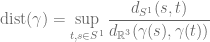 .
. , define the distortion of
 where
where  ?
? surfaces, for simplicity of notation I would focus only on torus knots)
 , we have
 in
in  (say the surface obtained by rotating the unit circle centered at
  around the
  -axis:
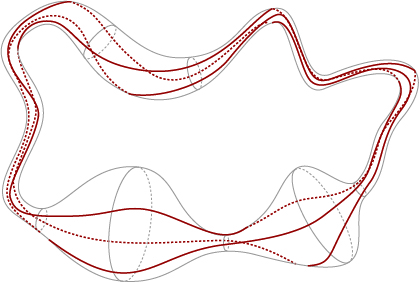
 knot looks like:
 that carries the standard
 by
by  by
by  , w.l.o.g. we also suppose
  .
.  is inessential if it contains no homotopically non-trivial loop on
  times. (hence the same holds for the embedded copy
  ).
). (they have at least
  intersections with
![C = U \times [z_1, z_2]](https://s0.wp.com/latex.php?latex=C+%3D+U+%5Ctimes+%5Bz_1%2C+z_2%5D&bg=ffffff&fg=5e5e5e&s=0&c=20201002) where
where  is in the
  -plane, let
  we have:


 , we find an embedding
  .
. , let
, let  is inessential
 as the smallest radius around
  so that the whole ‘genus’ of
  .
. is a positive Lipschitz function on
  where
where  is at the origin and
  .
. (and note distortion is invariant under scaling), we have

![R \in [1, \frac{11}{10}]](https://s0.wp.com/latex.php?latex=R+%5Cin+%5B1%2C+%5Cfrac%7B11%7D%7B10%7D%5D&bg=ffffff&fg=5e5e5e&s=0&c=20201002) where the intersection number is less or equal to the average. i.e.
where the intersection number is less or equal to the average. i.e. 
 .
.![C_z = B(\bar{0},R) \cap \{z \in [-\frac{1}{10}, \frac{1}{10}] \}](https://s0.wp.com/latex.php?latex=C_z+%3D+B%28%5Cbar%7B0%7D%2CR%29+%5Ccap+%5C%7Bz+%5Cin+%5B-%5Cfrac%7B1%7D%7B10%7D%2C+%5Cfrac%7B1%7D%7B10%7D%5D+%5C%7D&bg=ffffff&fg=5e5e5e&s=0&c=20201002) , since
, since
![z_0 \in [-\frac{1}{10}, \frac{1}{10}]](https://s0.wp.com/latex.php?latex=z_0+%5Cin+%5B-%5Cfrac%7B1%7D%7B10%7D%2C+%5Cfrac%7B1%7D%7B10%7D%5D&bg=ffffff&fg=5e5e5e&s=0&c=20201002) s.t.
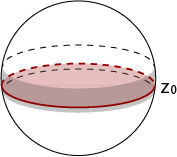
s.t.  . As in the pervious post, we call
  a ‘neck’ and the solid upper and lower ‘hemispheres’ separated by the neck are
  .
. 
 is inessential.
 of the sphere
  :
: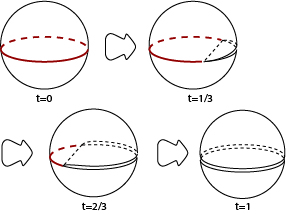
 is a sphere; at
  it splits to two spheres. (the space between the upper and lower halves is only there for easier visualization)
 is monotonically increasing. Since
  , it increases no more than
  .
. is inessential then
  is also inessential. (to ‘cut through the genus’ requires at least
  many interesections)
 is disconnected, the ‘genus’ can only lie in one of the spheres, we have one of
  direction, i.e.cutting the hemisphere in half in
  direction, then the
  -direction:
 many intersections, hence has inessential complement.
 ball with each side having length at most
  , this shape certainly lies inside some ball of radius
  .
.
 is inessential. i.e.
 be a simply connected Jordan domain in
  .
.  is a conformal factor on
  is a Lebesgue measurable function inducing a metric on
 (
( is an interval) with
  , we have the length of
  .
.  on
on  .
. of rectifiable curves in
  ), each comes with a unit speed parametrization. Consider the “
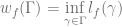 .
. be the set of conformal factors
  norm
norm  (i.e. having the total volume of
 instead of
  since it’s called a “length”…but since the standard notion is to sup over all
  bi-holomorphic, then for any set of normalized curves
  after renormalizing curves in
  we have:
 the length might blow up when the curve approach
  this case should be treated with more care)
 by having
 (merely change of variables).
 for any rectifiable curve.
  .
. is a bijection from
  to
to  , deducing
 ,
, ![\{0\} \times [0, 1/w]](https://s0.wp.com/latex.php?latex=%5C%7B0%5C%7D+%5Ctimes+%5B0%2C+1%2Fw%5D&bg=ffffff&fg=5e5e5e&s=0&c=20201002) , ending on
, ending on ![\{1\} \times [0, 1/w]](https://s0.wp.com/latex.php?latex=%5C%7B1%5C%7D+%5Ctimes+%5B0%2C+1%2Fw%5D&bg=ffffff&fg=5e5e5e&s=0&c=20201002) with finite length. Then
with finite length. Then  and the Euclidean metric
  is an extremal metric.
 has at least one horizontal line segment
 ![\gamma_y = [0,w] \times \{y\}](https://s0.wp.com/latex.php?latex=%5Cgamma_y+%3D+%5B0%2Cw%5D+%5Ctimes+%5C%7By%5C%7D&bg=ffffff&fg=5e5e5e&s=0&c=20201002) with
with  . (Because if so,
  and we know
  for the Euclidean length)
 over
over 



 be a finite planar graph with vertex set
  and edges
  . For each vertex
  we assign a simply connected domain
  .
. so that
  form a packing (i.e. are disjoint) and the contact graph of
  . (i.e.
  iff
iff  .
. .
. be a Riemannian metric on the torus with total volume
  s.t. each level set of
  , then by taking
 . A typically bad set would ‘span’ a long range in all directions with small area, it can contain ‘holes’ and being not connected:
 . Look at the measure
  in the middle of
  (i.e. a measure 1 set
 ![[a,b] \cap \pi_y(U)](https://s0.wp.com/latex.php?latex=%5Ba%2Cb%5D+%5Ccap+%5Cpi_y%28U%29&bg=ffffff&fg=5e5e5e&s=0&c=20201002) with the property
with the property ![m_1(\pi_y(U) \cap [0,a]) = m_1(\pi_y(U) \cap [b, \infty]](https://s0.wp.com/latex.php?latex=m_1%28%5Cpi_y%28U%29+%5Ccap+%5B0%2Ca%5D%29+%3D+m_1%28%5Cpi_y%28U%29+%5Ccap+%5Bb%2C+%5Cinfty%5D&bg=ffffff&fg=5e5e5e&s=0&c=20201002) )
)
 is at most
  with
with  :
: where for each
  . (we will call this pink region a ‘neck’ of the set for it has small width and is roughly in the middle)
 that straches the neck to fit in a long thin tube (note that in general
 so that
  sends the vertical foliation of
  to the following foliation in
 , we repeat the above process t the chunks. i.e. Finding a neck in the middle measure
  steps. The final
 between
  .
. .
. intersects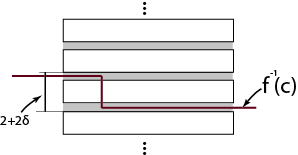
 is less than
  (length of
  (length of
  both less than
  , we conclude
  .
. . T he argument generalizes by looking at the middle set length
  set of each chunk.
 where
where  and a function
  s.t.
s.t.  is isometric to
  is the flat metric. Hence we only need to find a map on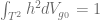
 is
is .
.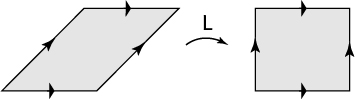
 be a piece-wise isometry that “folds” the rectangle:
 , pre-image of typical horizontal and vertical lines in the small rectangle are union of two parallel loops:
 Area777