Graph of groups in relation to 3-manifolds

(some images might appear soon)

Somehow I decided to wake up at 6:30 a.m. every Thursday to attend Bruce Kleiner‘s 9:30 course in NYU this semester. So far it’s been fun~

I learned about this thing called graph of groups. If you have been reading posts on this blog regarding any geometric group theory stuff (especially those posts related to Kleiner), then warning: this ‘graph’ has nothing to do with the Cayley graph. It’s not much about geometry but a rather ‘category-theoretical’ thing. Well, at this point you may think that you hate those algebra prople and is ready to leave…just don’t do that yet, because I hated them too, and now I finally got a tiny bit of understanding and appreciation on what those abstract non-sense was all about! :-P

So how do we connect cool 3-manifold stuff (incompressible surfaces, loops, embedded discs Heegaard splittings etc.) to groups?

Well, one handy thing is of course the Dehn’s lemma:

Theorem: For 3-manifold M with boundary, if the inclusion map i: \pi_1(\partial(M)) \rightarrow \pi_1(M) is not injective, then there exists a simple non-trivial loop in \partial M bounding an embedded disc in M.

Note: Dehn’s theorem was proved by Papakyriakopoulos, I talked about it in this pervious post, although not exactly stated in this form, we can see that Dehn’s lemma follows easily from the loop theorem.

This means we can say things about the 3-manifold by only looking solely at maps between groups!

That’s cool, but sometimes we find groups and just one map between two groups are not enough, and that’s when graph of groups comes in:

Definition: A graph of groups is a graph with vertice set V, edge set E, to each vertex v we associate a group G_v and to each edge e (say connecting v_1, v_2) we also associate a group G_e, together with a pair of injective homomorphisms f_1: G_e \rightarrow G_{v_1}, f_2: G_e \rightarrow G_{v_2}.

In our context, we should think of this as gluing together a bunch of spaces and take the fundamental group of those spaces, along with their pairwise intersections, as our vertice and edge groups. Just note that we need to have injections from the edge group to vertice groups. For simplicity one may first restrict oneself to the case where all edge groups are trivial (say spaces glued along contractible spaces).

There is something called the fundamental group of a graph of groups which is essentially the fundamental group of the resulting space after you glued spaces according to the given graph of groups. Note that the injection associated to edges takes into account how gluing of different pairs interact with each other (that is to say, for example, on a homotopy level it knows about triple intersections, etc.)

Let’s look at an application in this paper of Kleiner and Kapovich which I also talked about in an earlier post. Continue from that pervious post, now we know that

Theorem: Any hyperbolic group (plus obvious conditions, namely torsion free and does not split over a finite cyclic group) with 1-dimensional boundary has \partial_\infty G homeomorphic to \mathbb{S}^1, the Sierpinski carpet or the Menger curve.

When \partial_\infty G = \mathbb{S}^1, my wonderful advisor Dave Gabai proved that G would act discrete and cocompactly on \mathbb{H}^2 by isometries. (i.e. it’s almost the fundamental group of some hyperbolic surface except for possible finite order elements which make the action not properly discontinuous.)

Now the next step is of course figuring out when does groups act on \mathbb{H}^3, we have:

Cannon’s conjecture: If hyperbolic group G has boundary \mathbb{S}^2, then G acts discretely and cocompactly on \mathbb{H}^3 by isometries.

This conjecture was also mentioned another pervious post. Turns our we do not know much about groups with \mathbb{S}^2 boundary. However, using graph of groups, they were able to show:

Theorem: If Cannon’s conjecture is true, then those hyperbolic groups with Sierpinski carpet boundary are fundamental groups of hyperbolic 3-manifolds with totally geodesic boundary.

i.e. the idea is to ‘extend’ the group with Sierpinski carpet boundary to a group having sphere boundary. Of course as sets we can embed the carpet into a sphere and start to ‘reflect it along the boundary of the ‘holes’, continue the process and eventually the union of all copies of the carpets is the entire \mathbb{S}^2. The problem is how to ‘reflect’ a group?

First, since the boundary is homeomorphic to the carpet, there are countably many well-defined ‘boundary circles’, the group G acts on the set of boundary circles. They showed this action has only finitely many different orbits. (those orbits of boundary circles will eventually correspond to those totally geodesic boundary components of our resulting 3-manifold). We pick one boundary circle from each orbit and denote their stabilizers H_1, \cdots, H_k each H_i < G.

Define a graph of groups \mathcal{G} with two vertices both labeled G, with k edges, all going from one vertex to the other. Let the edge groups be H_1, \cdots, H_k.

Now we can start to 'unfold' the graph: Let X_G be a 2-complex associated to a set of generators and relations for G and X_i be 2-complexes associated to H_i. The inclusion map induces cellular maps h_i: X_i \rightarrow X_G. Hence we have

\displaystyle h: \sqcup_{i=1}^n X_i \rightarrow X_G

Let X be the mapping cylinder of h. i.e. X has boundary components \sqcup_{i=1}^n X_i and X_G.

Let DX be the complex obtained by gluing together two copies of X along \sqcup_{i=1}^n X_i, take it’s universal cover \widetilde{DX}. Now the fundemental group \hat{G} of DX is, in some sense, the group obtained by doubling G along each H_i. i.e. \hat{G} is the fundamental group of the graph graph of groups \mathcal{G}.

Now by studying the 1-skeleton of the complex \widetilde{DX}, one is able to conclude that \hat{G} is Gromov hyperbolic with \mathbb{S}^2 boundary, as expected.

Hence from groups with Sierpinski carpet boundary we are able to produce groups with sphere boundary. Now if Cannon’s conjecture is true, \hat{G} is fundamental group of some hyperbolic 3-manifold, together with Gabai’s result that H_i are fundamental groups of hyperbolic surfaces, we would have that G is the fundamental group of a hyperbolic 3-manifold with n totally geodesic boundary components.

Well, since now we don’t have Cannon’s conjecture, there is still something we can conclude:

Definition: A n-dimensional Poincare duality group is a group which has group cohomology satisfying n-dimensional Poincare duality.

Those should be thought of as fundamental groups of manifolds in the level of homology. Well, I know nothing about group cohomologies, luckily we have:

Theorem: (Bestvina-Mess)

\Gamma is a n-dimensional Poincare duality group iff it’s torsion free and \partial \Gamma has integral Cech cohomology of \mathbb{S}^{n-1}

Great! In our case \partial \hat{G} IS the sphere! So it’s a 3-dimensional Poincare duality group~ Now we have a splitting of \hat{G} over a bunch of 2-dimensional Poincare duality groups (namely H_i) it follows that (G; H_1, \cdots, H_n) is a Poincare duality pair.

It is not known whether all such pairs can be realized as fundamental groups of 3-manifolds with boundary. If so, then by Thurston’s geometrization we can also obtain what we derived assuming Cannon’s conjecture.

A Bosuk-Ulam-kind theorem for simplexes

This little note came out of a lunch discussion with NYU grad student Alfredo Hubard earlier this week. I think the problem-solving process was quite amusing hence worth shearing.

Back in kindergarten, we all learned this theorem called ‘at any given time, there are two opposite places on Earth having exactly the same temperature and air pressure’. Yes that’s the Bosuk-Ulam theorem. I remember at some point I came across a much less famous theorem in some kind of discrete/combinatorial geometry, saying:

Theorem: Any map from a n-dimensional simplex to \mathbb{R}^{n-1} must have a pair of intersecting opposite faces.

Note: each k-dimensional face of the n-dimensional simplex has a unique, well-defined (n-1)-k dimensional opposite face, as shown:

Some examples of maps from the 3-simplex to \mathbb{R}^2:

i.e. in general they can be quite a mess. I think it can be proved by Thurston’s simplex straightening argument. (haven’t checked carefully)

To me this is like Bosuk-Ulam except for instead of considering a large amount of antipodal pairs, we consider only finitely many such pairs. Hence a discrete analoge.

However, one should note that although they are of the same nature, neither follows from the other.

So somehow this theorem came up during the lunch and Alfredo mentioned to me that professor Guth wondered whether the theorem can be proved for mappings from the simplex to lower dimensional simplicial complexes (instead of \mathbb{R}^n). i.e.

Question: Given f: \Delta^{n+1} \rightarrow S where \Delta^{n+1} denote the (n+1)-dimensional simplex and S is a n-dimensional simplicical complex. Then must there be a pair of opposite faces with intersecting image?

So we started to throw out random ideas.

First of all, although only boundary faces of the simplex has non-empty opposite faces (hence can possibly be intersecting pair), it is important that f: \Delta^n \rightarrow S is defined on the solid simplex. (i.e. if one just map the boundary, then we may let S be topologically a sphere and make the map a homeomorphism!) So the moral is, we kind of need to ‘claps’ the simplex to a simply connected lower dimensional thing first, then map it to our S, hence S having non-trivial topology won’t be of much help. Looks almost like the \mathbb{R}^n case, doesn’t it?

Perhaps the image on S can be complicated and has non-trivial topology, but this is merely ‘wrapping’ a contractible, n-dimensional thing around. But wrapping around can only cause more overlapping hence making the faces intersecting more, not less.

The above line of thoughts give an immediate proof in the case when S is a surface and n=2: Lift the map to the universal cover and apply the theorem for \mathbb{R}^2. (It’s a little more tricky when the surface is \mathbb{S}^2 but you can work it out~ the map restricted to \partial \Delta must be of even degree) Note this won’t generalize to higher dimensions (even for manifolds) since universal covers are no longer that similar to \mathbb{R}^n.

So what’s the main difference between complexes and manifolds? well, one can have more than two n dimensional faces attached to the same n-1 dimensional face. I decided to first think of whether Bosuk-Ulam is still true if we further assume that the map extends to the solid ball (as seen above, it is true in the surface case).

After trying to generalize that ‘lifting’ proof for a while, we realized the Bosuk-Ulam does not work for simplicial complexes in all dimensions! For very simple reason, i.e. if we map the n-sphere to \mathbb{R}^n by projecting down, the pre-image of the center point is the only pair of antipodal points that’s mapped together. Hence if instead of \mathbb{R}^n we have three n-simplicies attached along a single (n-1)-simplex (think of it as a piece of \mathbb{R}^n with a vertical simplex attached in the middle):

Now we can still project to that piece of \mathbb{R}^n, with the image of antipodal point lying on the middle (n-1) simplex, all we need to do is to separate this pair while not creating new pairs! But this is easy, just ‘drug’ the upper sheet into the third n-simplex a little bit:

(the region outside of the red neibourhood is unchanged) It’s easy to see that no new antipodal pair is moved together.

So now we turned back to the simplex and realized it’s even easier to argue: project in orthogonal direction to a n-face, originally the only intersecting pair of opposite faces was the vertex and that n-face. Now if we lift the vertex int the third sheet, nothing can intersect~

OK~ perhaps not a useful answer but problem solved!

So far I do not know the answer to the following:

Questions:

1. Is this intersecting faces theorem true for mapping n-simplexes to n-dimensional manifolds?

2. Is the Bosuk-Ulam true if we consider maps from spheres to n-dimensional manifolds which extends to the ball?

The later might be well-known. But so far I can only find a theorem by Conner and Floyd, stating that any map from S^n to a lower dimensional manifold must have a pair of antipodal points mapped together.

Stable isoperimetric inequality

Eric Carlen from Rutgers gave a colloquium last week in which he bought up some curious questions and facts regarding the ‘stability’ of standard geometric inequalities such as the isoperimetric and Brunn-Minkowski inequality. To prevent myself from forgetting it, I’m dropping a short note on this matter here. Interestingly I was unable to locate any reference to this nor did I take any notes, hence this post is completely based on my recollection of a lunch five days ago.

–Many thanks to Marco Barchies, serval very high-quality references are located now. It turns out that starting with Fusco-Maggi-Pratelli ’06  which contains a full proof of the sharp bound, there has been a collective progress on shorter/different proofs and variations of the theorem made. See comments below!

As we all know, for sets in \mathbb{R}^n, the isoperimetric inequality is sharp only when the set is a round ball. Now what if it’s ‘almost sharp’? Do we always have to have a set that’s ‘close’ to a round sphere? What’s the appropriate sense of ‘closeness’ to use?

One might first attempt to use the Hausdorff distance:

D(S, B_1(\bar{0})) = \inf_{t \in \mathbb{R}^n}\{D_H(S+t, B_1(\bar{0})).

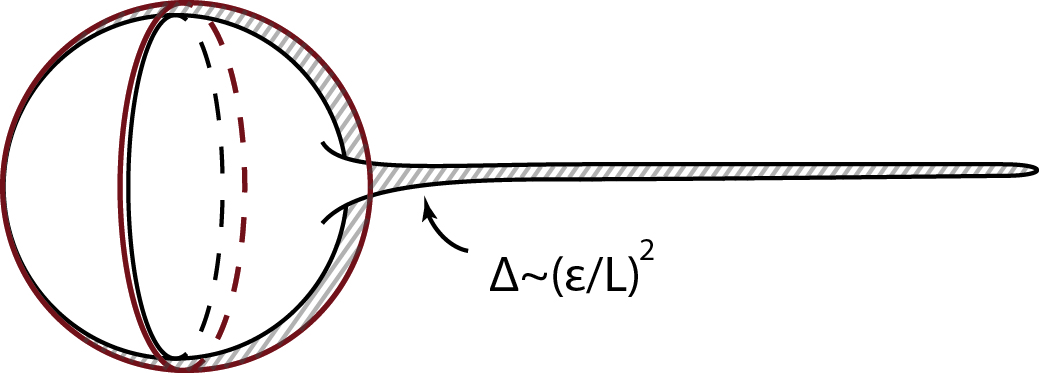
However, we can easily see that, in dimension 3 or higher, a ball of radius slightly small than 1 with a long and thin finger sticking out would have volume 1, surface volume \varepsilon larger than that of the unit ball, but huge Hausdorff distance:

In the plane, however it’s a classical theorem that any region S of area \pi and perimeter m_1(\partial S) \leq 2\pi +\varepsilon as D(S, B_1(\bar{0})) \leq  f(\varepsilon) where f(\varepsilon) \rightarrow 0 as \varepsilon \rightarrow 0 (well, that f is because I forgot the exact bound, but should be linear in \varepsilon).

So what distance should we consider in higher dimensions? Turns out the nature thing is the L^1 norm:

D(S, B_1(\bar{0})) = \inf_{t\in \mathbb{R}^n} \mbox{vol}((S+t)\Delta B_1(\bar{0}))

where \Delta is the symmetric difference.

First we can see that this clearly solves our problem with the thin finger:

To simplify notation, let’s normalize our set S \subseteq \mathbb{R}^n to have volume 1. Let B_n denote the ball with n-dimensional volume 1 in \mathbb{R}^n (note: not the unit ball). p_n = \mbox{vol}_{n-1}(\partial B_n) be the (n-1 dimensional) measure of the boundary of B_n.

Now we have a relation D(S, B_n)^2 \leq C_n (\mbox{vol}_{n-1}(\partial S) - p_n)

As said in the talk (and I can’t find any source to verify), there was a result in the 90’s that D(S, B_n)^4 \leq C_n (\mbox{vol}_{n-1}(\partial S) - p_n) and the square one is fairly recent. The sharp constant C_n is still unknown (not that I care much about the actual constant).

At the first glance I find the square quite curious (I thought it should depend on the dimension maybe like n/(n-1) or something, since we are comparing some n-dimensional volume with (n-1) dimensional volume), let’s see why we should expect square here:

Take the simplest case, if we have a n-dimensional unit cube C_n, how does the left and right hand side change when we perturbe it to a rectangle with small eccentricity?

As we can see, D(R_\varepsilon, C_n) is roughly p_n \varepsilon. The new boundary consists of two faces with measure 1+\varepsilon, two faces of measure 1-\varepsilon and 2 \times (n-2) faces with volume 1-\epsilon^2. Hence the linear term cancels out and we are left with a change in the order of \varepsilon^2! (well, actually to keep the volume 1, we need to have 1-\varepsilon/(1+\varepsilon) instead of 1-\varepsilon, but it would still give \varepsilon^2)

It’s not hard to see that ellipses with small eccentricity behaves like rectangles.

Hence the square here is actually sharp. One can check that no matter how many of the n side-length you perturbe, as long as the volume stay the same (up to O(\varepsilon^2)) the linear term of the change in boundary measure always cancels out.

There is an analoge of this stability theorem for the Brunn-Minkowski inequality, i.e. Given two sets of volume V_1, V_2, if the sum set has volume only a little bit larger than that of two round balls with those volumes, are the sets L^1 close to round balls? I believe it’s said this is only known under some restrictions on the sets (such as convex), which is strange to me since non-convex sets would only make the inequality worse (meaning the sum set has larger volume), don’t they?
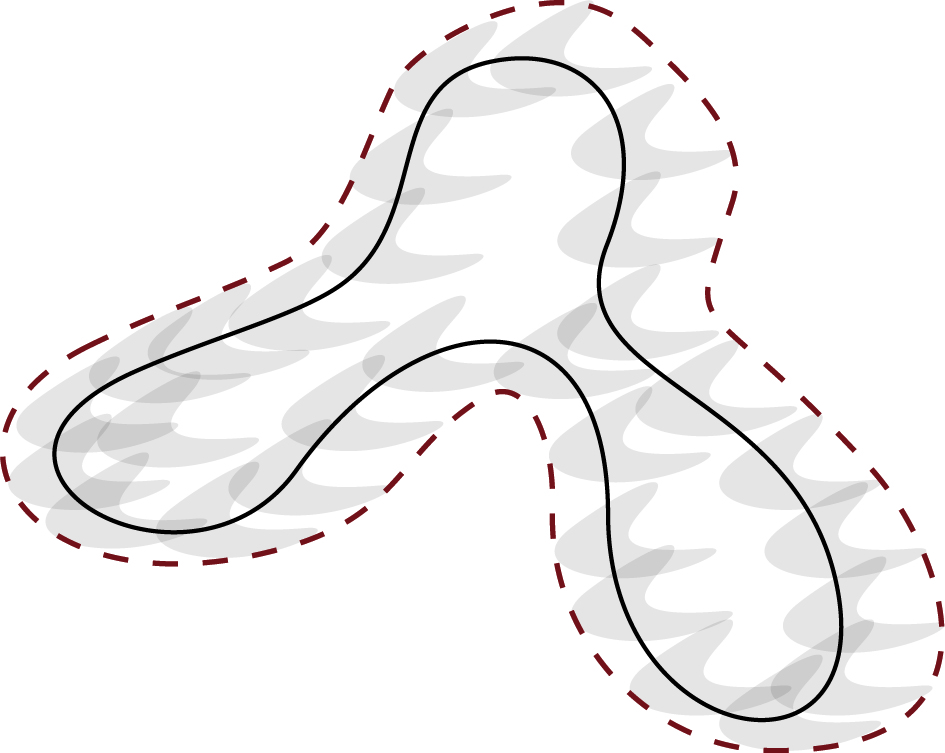
I just can’t think of what could possibly go wrong for non-convex sets…(Really hope to find some reference on that!)

Anyways, speaking of sum sets, the following question recently caught my imagination (pointed out to me by Percy Wong, thank him~ and I shall quote him ‘this might sound like probability, but it’s really geometry!’):

Given a set T \subseteq l^2 (or \mathbb{R}^n), we define two quantities:

G(T)=\mathbb{E}(\sup_{p \in T} \Sigma p_i g_i) and

B(T) = \mathbb{E}(\sup_{p \in T} \Sigma p_i \epsilon_i)

where \mathbb{E} is the expected value, \{g_i\} are independent random variables with a standard normal distribution (mean 0, variance 1) and \{\epsilon_i\} are independent Bernoulli random variables.

Question: Given any T, can we always find T' such that

T \subseteq T' + B_{l^1}(\bar{0}, c B(T)) and

G(T') \leq c B(T)

To find out more about the question, see Chapter 4 of this book. By the way, I should mention that there is a $5000 prize for this :-P

Kissing numbers of sphere packings

Enough of the ‘trying to understand recent big theorems’ on this blog, let’s do something light and fun this week!

As I was browsing the ArXiv one day, one thing led to anther and I eventually arrived in a very short and cute paper of Greg Kuperberg and Oded Schramm.

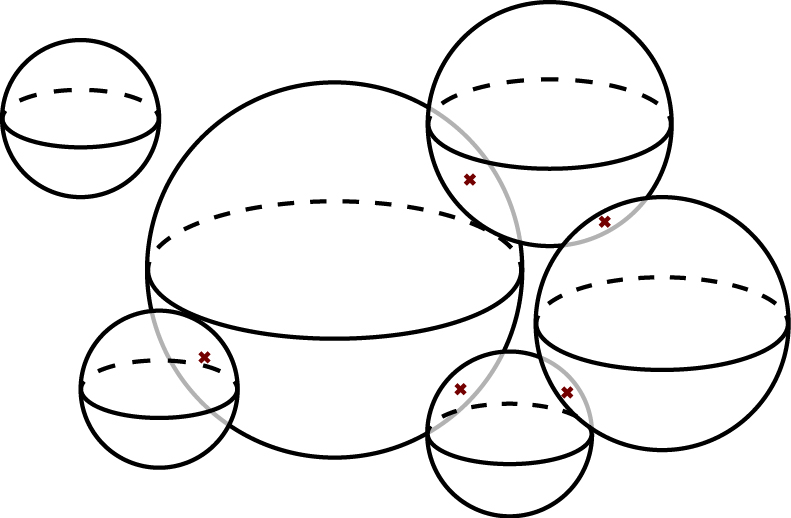
So, we have sphere packings, which is simply a bunch of spheres (say in \mathbb{R}^3) with disjoint interiors, some of them might be tangent to others, in which case we say the two sphere ‘kiss‘, like this: (points of tangency are marked with a red cross)
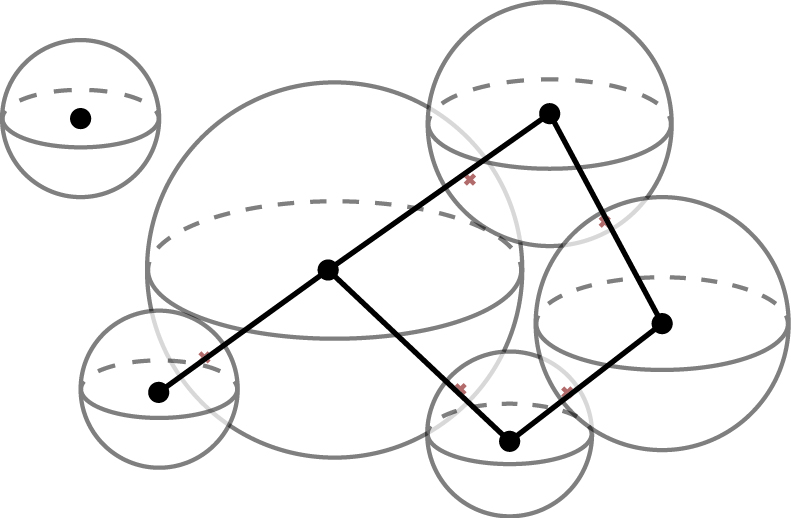
We can associate a graph to a sphere packing with vertices representing spheres and join two vertices with an edge if two sphere kisses:

Question: What kind of graph can appear this way?

Now if we go back to two-dimensions, it’s a classical theorem that any planar graph can appear as the nerve of a circle packing. (In fact, as mentioned at the end of this earlier post, something much stronger is true. i.e. it’s a theorem of Schramm that one can ‘kiss’ pretty much any given set of planar objects with a given nerve.)

In light of this, it’s nature to wonder whether every graph can be realized as a nerve of some sphere packing (since all graph embeds in some oriented surface which then embeds in \mathbb{R}^3). Turns out, no.

However I would imagine it’s not easy to show things such as a given graph cannot be realized. In the paper they came up with what’s perhaps the first restriction that shows not all graphs can be realized in such packing, namely:

The average kissing number is, as one might expect, in average how many kisses does each sphere get, i.e.

2 * number of tangency points / number of balls = 2|E|/|V|

If one thinks about it, how might one attempt to construct a packing with super large average kissing number? Well, perhaps we start with a single sphere, put a huge amount of small spheres around it (because one cannot fit many large spheres), then this middle one does get a lot of kisses, but what about the smaller ones? If they are equal sized then all the small spheres only gets roughly 7 kisses…now we need to put even smaller spheres around each of those…If we stop at any stage, there would be more smallers spheres that’s not taken care of than the larger ones with lots of kisses, so it’s not clear at all if the average can blow up.

As usual, things are much simpler in two dimensions: Since the Euler characteristic of any planar graph is 2 (|V|+|F|-|E|=2), and |F| \leq 2|E|/3 (any face needs at least 3 edges around them, precisely two faces share an edge) we have

|V| \geq |E|/3+2, hence 2|E|/|V| \leq 6 - 12/|V| < 6

On the other hand, for our all-time favorite hexagonal packing of congruent circles, if we take more and more layers, the number of balls with six kisses grow like n^2, the number of balls on the boundary (hence with less than six kisses) is like n. Hence by adding enough layers we can make the average as close to 6 as we want~
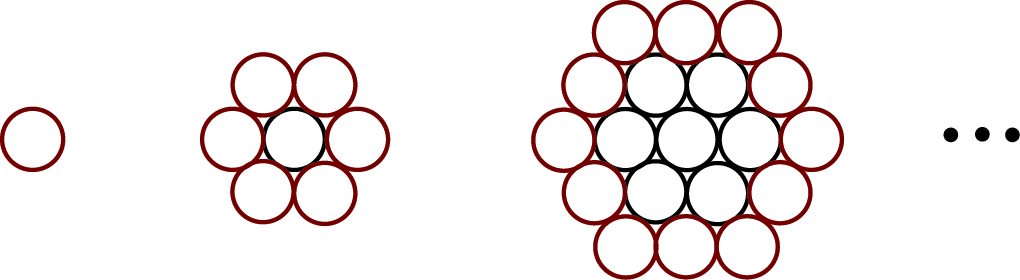
Hexagonals are the best, as expected~

Now comes what’s in the paper: they showed that for any sphere packing, the average kissing number is less than 8+4\sqrt{3}. Hence any graph with average degree larger than 15 cannot be realized. They also provided an example of sphere packings with average kissing number larger than 12.

For simplicity I’ll only reproduce the ‘warm-up case’ in the paper which proves the kissing number is no more than 24. (well, since our goal here is only to say that not all graphs can be realized.) I find this observation (due to Schramm) is very simple, cute, and works in any dimensions.

Let’s first define some numbers:

k_c(n) = the maximum number of congruent sphere kissing one sphere (i.e. how many unit spheres we can place around a unit sphere) k_c can be easily computed, for example k_c(2) = 6 and k_c(3)=12, etc.

Let k(n) = \sup \{ average kissing number of sphere packings in dimension n \}. As we have seen k(2) = k_c(2) = 6 and we are interested in giving upper bounds to k(3).

Theorem: k(n) \leq 2 k_c(n).

Given a sphere packing P, let E be the set of kissing pairs and V be the set of spheres.

Define map f: E \rightarrow V where f maps each pair to the sphere in the pair with smaller radius (if the two spheres has the same radius, then just randomly choose one).

Since each sphere can only be surrounded by k_c(n) spheres of its size (of course larger than its size would give us fewer), we conclude that f is at most k_c to 1. Therefore, we have

|E| \leq k_c(n) |V|, i.e. k = 2|E|/|V| \leq 2k_c(n)

How simple!

Now going from 24 to 8+4\sqrt{3} requires some estimates relying on us being in 3-dimensions. Essentially, given any sphere in the packing, if we enlarge it by a ratio \lambda w.r.t its center, then this ‘shell’ intersect some other spheres in disjoint circles. Those circles of course cuts out a fraction of the area that’s < 1 on the shell. Summing this fraction over all \lambda shells results a number that’s less than |V|.

Now if we look at each pair of balls, say take pair (V_1, V_2), it turns out that if they kiss, the fraction of shell around V_1 that’s cut out by V_2 plus the fraction of shell around V_2 cut out by V_1 is a constant depending only on \lambda.

Hence we get a relation |V| \geq c(\lambda) \times |E|. Choose an optimum \lambda gives 8+4 \sqrt{3} which is a bit less than 15.

So we know k(3) \leq 8+4 \sqrt{3} but larger than 12, the problem of finding the exact value of k(3) remains open, so is the problem of giving other restrictions on the graph for being the nerve of a sphere packing.

Ultrametrics and the nonlinear Dvoretzky problem

Hi guys~ The school year here at Princeton is finally (gradually) starting. So I’m back to this blog :-P

In this past week before anything has started, Assaf Naor came here and gave a couple rather interesting talks, which I decided to make a note about. For the complete content of the talk please refer to this paper by Naor and Mendel. As usual, I make no attempt on covering what was written on the paper nor what was presented in the talk, just some random pieces and bits which I found interesting.

A long time ago, Grothendieck conjectured what is now known as Dvoretzky’s theorem:

Theorem: For any D>1, for any k \in \mathbb{N}, there exists N depending only on k, D such that any normed vector space of dimension N or larger has a k-dimensional linear subspace that embeds (via a linear transformation) with distorsion at most D into the Hilbert space.

i.e. this says in the case where D is close to 1 (let’s write D = 1+\varepsilon) for any given k, *any* norm on a vector space of sufficiently high dimension will have a k dimensional subspace that looks almost Eculidean (meaning unit ball is round up to a multiple 1+\varepsilon).

Well, that’s pretty cool, but linear. As we all know, general metric spaces can be much worse than normed vector spaces. So here comes a nonlinear version of the above, posted by Terrence Tao:

Nonlinear Dvoretzky problem: Given \kappa>0, D>1, does there exist a \alpha so that every metric space of Hausdorff dimension \geq \alpha has a subset S of Hausdorff dimension \kappa that embeds into the Hilbert space with distorsion D?

Indeed, we should expect this to be a lot more general and much harder than the linear version, since we know literally nothing about the space except for having large Hausdorff dimension and as we know metric spaces can be pretty bizarre. That why we should find the this new result of theirs amazing:

Theorem 1 (Mendel-Naor): There is a constant C such that for any \lambda \in (0,1), every compact metric space with dimension \alpha has a closed subset S of dimension at least (1-\lambda) \alpha that admits an embedding into Hilbert space with distorsion C/ \lambda.

Note that, in the original linear problem, N = N(k, D) of course blows up to infinity whenever k \rightarrow \infty or D \rightarrow 1. (whenever we need a huge dimensional space with fixed ‘flatness’ or a fixed dimension but ‘super-flat’ subspace). That is, when we are looking for subspaces inside a random space with fixed (large) dimension N, the larger dimension we need, the less flat (more distorsion) we can expect it to be. i.e.

k \rightarrow N necessarily forces D \rightarrow \infty and
D \rightarrow 1 forces k \rightarrow 0.

We can see that this nonlinear theorem is great when we need large dimensional subspaces (when \lambda is close to 0), but not so great when we want small distorsion (it does not apply when distorsion is smaller than C, and blows up when it gets close to C).

In the original statement of the problem this gives not only that a large \alpha exists, but \alpha(\kappa, D) \leq \frac{D}{D-C} \kappa! In fact, when we are allowing relatively large distorsion (compare to constant C) this theorem is sharp:

Theorem 2 (Mendel-Naor): There exists constant C' and a family of metric spaces \{ X_\alpha \ | \ \alpha \in \mathbb{R}^+ \} such that for any small \varepsilon, no subset of X_\alpha with dimension \geq (1-\varepsilon)\alpha embeds into Hilbert space with distorsion \leq C'/\varepsilon.

This construction makes use of our all-time favorite: expander graphs! (see pervious post for definitions)

So what if D is small? Turns out, unlike in the linear case when D<2, there is no \alpha(\kappa, D), in the paper they also produced spaces X_\alpha for each \alpha where the only subset that embeds with distorsion < 2 are of Hausdorff dimension 0!

In his words, the proof of theorem 1 (i.e. the paper) takes five hours to explain, hence I will not do that. But among many neat things appeared in the proof, instead of embedding into the Hilbert space directly they embedded it into an ultrametric space with distorsion D, and then make use of the fact that any such space sits in the Hilbert space isometrically.

Definition: An ultrametric on space X is a metric with the additional property that for any three points x, y, z \in X, we have the so-called strong triangle inequality, i.e.

d(x, y) \leq \max \{ d(x, z), d(y,z) \}

If one pause and think a bit, this is a quite weird condition: for example, all triangles in an ultrametric space are isosceles with the two same length edge both longer than the third edge; every point is the center of the ball, etc.

Exercise: Come up with an example of an ultrametric that’s not the discrete metric, on an infinite space.

Not so easy, hum? My guess: the first one you came up with is the space of all words in 2-element alphabet \Sigma_2, with the dictionary metric (two points are distance 2^{-n} apart where n is the first digit they differ), right?

In fact in some sense all ultrametrics look like that. (i.e. they are represented by an infinite tree with weights assigned to vertices, in the above case a 2-regular tree with equal weights on same level) Topologically our \Sigma_2 is a Cantor set and sits isometrically in l_2. It’s not hard to see in fact all such space embeds isometrically in l_2.

I just want to say that this operation of first construct an ultrametric space according to our given metric space, embed, and then embed the ultrametric metric space into the Hilbert space somehow reminds me of when we want to construct a measure satisfying a certain property, we first construct it on a Cantor set, then divide up the space and use the values on parts of the Cantor set for parts of the space…On this vein the whole problem gets translated to producing a tree that gives the ultrametric and work with the tree (by no means simple, though).

Finally, let’s see a cute statement which can be proved by applying this result:

Urbanski’s conjecture: Any compact metric space of Hausdorff dimension > n can be mapped surjectively [thanks to Tushar Das for pointing out the typo] onto the unit ball B_1^n by a Lipschitz map.

(note strictly larger is important for our theorem to apply…since we need to subtract an \varepsilon) and hence another cute statement that’s still not known:

Question: Does any compact metric space with positive Hausdorff n-dimensional measure maps Lipschitzly onto B_1^n?