To commemorate passing the French exam earlier this week (without knowing any French) and also to test this program ‘latex to wordpress‘, I decided to post my French-translation assignment here.
Last year, I went to Paris and heard a French talk by Crovisier. Strangely enough, although I can’t understand a single word he says, just by looking at the slides and pictures, I liked the talk. That’s why when being asked the question ‘so are there any French papers you wanted to look at?’, I immediately came up with this one which the talk was based on.
Here is a translation of selected parts (selected according to my interest) in section 1.2 taken from the paper `Récurrence et Généricité‘ ( Inventiones Mathematicae 158 (2004), 33-104 ) by C. Bonatti and S. Crovisier. In which they proved a connecting lemma for pseudo-orbits.
Interestingly, just in this short section they referred to two results I have discussed in earlier posts of this blog: Conley’s fundamental theorem of dynamical systems and the closing lemma. In any case, I think it’s a cool piece of work to look at! Enjoy~ (Unfortunately, if one wants to see the rest of the paper, one has to read French >.<)
Precise statements of results
1. Statement of the connecting lemma for pseudo-orbits
In all the following work we consider compact manifold  equipped with an arbitrary Riemannian metric and sometimes also with a volume form
  (unrelated to the metric). We write
  for the set of diffeomorphisms of class
  on with the topology and
  the subset preserving volume form .
Recall that, in any complete metric space, a set is said to be residual if it contains a countable intersection of open and dense sets. A property is said to be generic if it is satisfied on a residual set. By slight abuse of language, we use the term generic diffeomorphisms: the phase ‘generic diffeomorphisms satisfy property  ‘ means that property is generic.
Let  be a diffeomorphism of
  . For all
  , an
, an  -pseudo-orbit of
  is a sequence (finite or infinite) of points
 such that for all
  ,
,  . We define the following binary relations for pairs of points
  on :
on :
– For all  , we write
  if there exists an -pseudo-orbit
  where
where  and
and  for some
  .
.
– We write  if
if  for all
  . We sometimes write
  to specify the dynamical system in consideration.
– We write  (or
(or  ) if for all neighborhoods
  of
of  and
and  , respectively, there exists
  such that
  intersects
  .
.
Here are a few elementary properties of these relations.
1. The relations  and
and  are, by construction, transitive. The chain recurrent set
  is the set of points in
  such that
  .
.
2. The relation is not a-priori transitive. The non-wandering set  is the set of points in such that
  .
.
Marie-Claude Arnaud has shown in [Ar] that the relation  is transitive for generic diffeomorphisms. By using similar methods we show:
Theorem 1: There exists a residual set  in
in  (or in
  ) such that for all diffeomorphisms
  in and all pair of points
  in we have:

This theorem is a consequence of the following general perturbation result:
Theorem 2: Let be a diffeomorphism on compact manifold , satisfying one of the following two hypotheses:
1. all periodic orbits of are hyperbolic,
2. is a compact surface and all periodic orbits are either hyperbolic or elliptic with irrational rotation number (its derivative has complex eigenvalues, all of modulus  , but are not powers of roots of unity).
Let  be a
be a  -neighborhood of in (or in , if preserves volume form
  ). Then for all pairs of points
  in such that , there exists a diffeomorphism
  in and an integer
  such that
  .
.
Remark: In Theorem 2 above, if the diffeomorphism if of class  with
with  , then the -perturbation can also be chosen in class . Indeed the diffeomorphism is obtained thanks to a finite number of -perturbations given by the connecting lemma (Theorem 2.1), each of these perturbations is itself of class .
Here are a few consequences of these results:
Corollary: There exists a residual set in such that for all diffeomorphism in , the chain recurrent set coincides with the non-wandering set .
Corollary: Suppose is connected, then there exists a residual set in such that if  satisfies
  then it is transitive. Furthermore, is the unique homoclinic class for .
For volume preserving diffeomorphism , the set always coincide with the whole manifold . We therefore find the analogue of this corollary in the conservative case (see section 1.2.4).
2. Dynamical decomposition of generic diffeomorphisms into elementary pieces
Consider the symmetrized relation  of defined by
  if and
  . This relation then induces an equivalence relation on , where the equivalence classes are called chain recurrence classes.
We say a compact -invariant set  is weakly transitive if for all
  , we have . A set is maximally weakly transitive if it is maximal under the partial order
  among the collection of weakly transitive sets.
Since the closure of increasing union of weakly transitive sets is weakly transitive, Zorn’s lemma implies any weakly transitive set is contained in a maximally weakly transitive set. In the case where the relation  is transitive (which is a generic property), the maximally weakly transitive sets are the equivalence classes of the symmetrized relation induced by on the set . Hence we obtain, for generic diffeomorphisms:
Corollary: There exists residual set in such that for all the chain recurrence classesare exactly the maximally weakly transitive sets of .
The result of Conley (see posts on fundamental theorem of dynamical systems) on the decomposition of into chain recurrence classes will therefore apply (for generic diffeomorphisms) to the decomposition of into maximally weakly transitive sets.

3. Chain recurrence classes and periodic orbits
Recall that after the establishment of closing lemma by C. Pugh (see the closing lemma post), it is known that periodic points are dense in for generic diffeomorphisms, we would like to use these periodic orbits to better understand the dynamics of chain recurrence classes.
Recall the homoclinic class  of a hyperbolic periodic point
  is the closure of all transversal crossing points of its stable and unstable manifolds. This set is by construction transitive, as we have seen in section 1.2, the results of [CMP] imply that, for generic diffeomorphisms any homoclinic class is maximally weakly transitive. By applying corollary 1.4, we see that:
Remark: For generic diffeomorphisms homoclinic classes are also chain recurrence classes.
However, for generic diffeomorphisms, there are chain recurrence classes which are not homoclinic classes, therefore contains no periodic orbit, we call such chain recurrence class with no periodic points aperiodic class.
Corollary: There exists residual set in such that for all , any connected component with empty interior of  is periodic and its orbit is a homoclinic class.
The closing lemma of Pugh and Remark 5 show:
Remark: For generic , any isolated chain recurrence class in  is a homoclinic class. In particular this applies to classes that are topological attractors or repellers.
For non-isolated classes, a recent work (see [Cr]) specifies how a chain recurrence class is approximated by periodic orbits:
Theorem: There exists residual set  in such that for all , all maximally weakly transitive sets of are Hausdorff limits of sequences of periodic orbits.
More general chain recurrence classes satisfy the upper semi-continuity property: if  is a sequence of points converging to a point then for large enough
  , the class of
  is contained in an arbitrary small neighborhood of the class of .
40.343599
-74.651774




















![M=[0,1]^n](https://s0.wp.com/latex.php?latex=M%3D%5B0%2C1%5D%5En&bg=ffffff&fg=5e5e5e&s=0&c=20201002)


![M = [0, L_1] \times [0, L_2] \times \cdots \times [0, L_n]](https://s0.wp.com/latex.php?latex=M+%3D+%5B0%2C+L_1%5D+%5Ctimes+%5B0%2C+L_2%5D+%5Ctimes+%5Ccdots+%5Ctimes+%5B0%2C+L_n%5D&bg=ffffff&fg=5e5e5e&s=0&c=20201002)







 extends continuously to
  and the image
  is homotopically non-trivial in
  . Then in any neighborhood
  we can find embedded disc
  such that
  is still homotopically non-trivial in
 has
has  then
then  , consider
  , boundary of
  .
. be a loop homotopic to
 and any loop in
  . Hence the inclusion map
  is surjective.
 be the little loop winding around
 generates
  . Hence there exists
  in
in  ,
,  is homotopically trivial in
  .
.

 hence
hence  be the unit disc. Given any family
  of arcs with endpoints on
  and
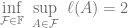
and  , then how short can the logest arc in
  be the collection of all possible such foliations
  ?
? .
. where
where  ,
,  be its fixed points,
  be the two arcs in
  connecting
  .
.
 then one of
  , say it’s
  .
. .
. has a fixed point
  in
in  .
. in
in  , the fibre must have length
 .
. then both
  gets mapped into themselves orientation-reversingly, hence fixed points still exists.
 (except two points) must have the largest circle being longer than the equator.
 having non-zero degree, there is
  where
where  is larger than the equator.
 . However before we do that I would like to highlight some intergal geometry machineries that are new to me but seemingly constantly used in proving those kinds of estimates. We shall get some idea of the method by showing:
 be equipped with the round metric.
  be a ‘flat’
  in the same
  must have volume at least as large as
  be the set of all
  -planes in
  on
on  be the Haar measure on
  , fix some
  .
. , we set
 .
. . ( not
 ![[z] = [p]](https://s0.wp.com/latex.php?latex=%5Bz%5D+%3D+%5Bp%5D&bg=ffffff&fg=5e5e5e&s=0&c=20201002) in
in  , for almost all
  ,
,  intersects
  .
. ,
, .
. . We won’t work out the details here.
 , the expectation
  .
. .
. where
where  carries the round metric with total volume
  map
map  carries the standard round metric, there exists some
  with
with
 is the
  s.t.
s.t.  implies
 , which is obtained from applying intergal geometry methods)
 extension – See
  volume preserving diffeomorphism on the disc. Some time later
  with connected complement, for any function
  satisfying the Whitney condition with all candidate derivatives having determent
  .
. be the countable union of segments:
![K = \{0, 1, 1/2, 1/3, \cdots \} \times [0,1]](https://s0.wp.com/latex.php?latex=K+%3D+%5C%7B0%2C+1%2C+1%2F2%2C+1%2F3%2C+%5Ccdots+%5C%7D+%5Ctimes+%5B0%2C1%5D&bg=ffffff&fg=5e5e5e&s=0&c=20201002)

 be the map that sends the vertical segment above
  to the vertical segment above
  , preserves the
  -coordinate and fixes the segment
 ![\{0\} \times [0,1]](https://s0.wp.com/latex.php?latex=%5C%7B0%5C%7D+%5Ctimes+%5B0%2C1%5D&bg=ffffff&fg=5e5e5e&s=0&c=20201002) :
:
 .
. s.t.
s.t. is the identity on
 for
for 

![[1/n, 1/(n-1)]](https://s0.wp.com/latex.php?latex=%5B1%2Fn%2C+1%2F%28n-1%29%5D&bg=ffffff&fg=5e5e5e&s=0&c=20201002) with derivative no less than
with derivative no less than  and the one sided derivative at the endpoints being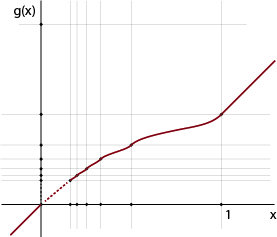
 , we deduce
  ,
,  satisfies the Whitney condition for extending to
  as above has derivative being the identity matrix at all points of
  , the determent of candidate derivatives are uniformly
![R_n = [1/n, 1/(n-1)] \times [0,1]](https://s0.wp.com/latex.php?latex=R_n+%3D+%5B1%2Fn%2C+1%2F%28n-1%29%5D+%5Ctimes+%5B0%2C1%5D&bg=ffffff&fg=5e5e5e&s=0&c=20201002) . We have
. We have


 to have the same area as
  , the image of the two segments
![s_{n,0} = [1/n, 1/(n-1)] \times \{ 0\}](https://s0.wp.com/latex.php?latex=s_%7Bn%2C0%7D+%3D+%5B1%2Fn%2C+1%2F%28n-1%29%5D+%5Ctimes+%5C%7B+0%5C%7D&bg=ffffff&fg=5e5e5e&s=0&c=20201002) and
and![s_{n,1}= [1/n, 1/(n-1)] \times \{ 1\}](https://s0.wp.com/latex.php?latex=s_%7Bn%2C1%7D%3D+%5B1%2Fn%2C+1%2F%28n-1%29%5D+%5Ctimes+%5C%7B+1%5C%7D&bg=ffffff&fg=5e5e5e&s=0&c=20201002)
 outside of the rectangle
  .
. , while the length of the original segments is
  .
.

 converging to either
  or
or  where
where .
. on the best possible Holder exponent.
 Area777