I have recently went through professor Gabai’s wonderful paper that gives a proof of the tameness conjecture. (This one is a simplified version of the argument given in Gabai and Calegari, where everything is done in the smooth category instead of PL). It’s been a quite exciting reading with many amazing ideas, hence I decided to write a summary from my childish viewpoint (as someone who knew nothing about the subject beforehand).
We say a manifold is tame if it an be embedded in a compact manifold s.t. the closure of the embedding is the whole compact manifold.
To motivate the concept, let’s look at surfaces: Any compact surface is, of course, tame. However, if we “shoot out” a few points of the surface to infinity, as the figure below, it become non-compact but still tame, as we can embed the infinite tube to a disk without a point.

Of course, we can also make a surface non-compact by shooting any closed subset to infinity (e.g. a Cantor set), but such construction will always result in a tame surface. (This can be realized using similar embeddings as above, we may embed the resulting surface into the original surface with image being the original surface subtract the closed set. If the closed set has interior, we further contract each interior components.)
On the other hand, any surface with infinite genus would be non-tame since if there is an embedding into a compact set, the image of ‘genesis’ would have limit points, which will force the compact space fail to be a manifold at that point.

Hence in spirit, being tame means that although the manifold may not be compact itself, but all topology happens in bounded regions (we can think of a complete embedding of the manifold into some 
As usual, life gets more complicated for three-manifolds.
Tameness conjecture: Every complete hyperbolic 3-manifold with finitely generated fundamental group is tame.
A bubble chart for capturing the structure of the proof:

A few highlights of the proof: The key idea here is shrinkwrapping, very roughly speaking, to prove an geometrically infinite end is tame one needs to find a sequence of simplicial hyperbolic surfaces exiting at the end. Bonahon’s theorem gives us a sequence of closed geodesics exiting the end. By various pervious results, one is able to produce (topological) surfaces that are ‘in between’ those geodesics. Shrinkwrapping takes the given surface and shrinks it until it’s ‘tightly wrapped’ around the given sequence of geodesics. The fact that each of the curve the surface is wrapping around is a geodesic guarantees the resulting surface simplicial hyperbolic. (think of this as folding a piece of paper along a curve would effect its curvature, but alone a straight line would not; geodesics are like straight lines).
Once we have that, the remaining part would be showing the position of the surfaces are under control so that they would exit the end. Since simplicial hyperbolic surfaces has curvature 
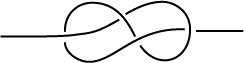
Remark: Note that in general, unlike in two dimensions, a three manifold with finitely generated fundamental group does not need to be tame as the Whitehead manifold is homotopic to 
 as a Euclidean open ball, then the boundary of such a disc is a Peano curve that covers the whole 2-sphere bounding
  ):
):
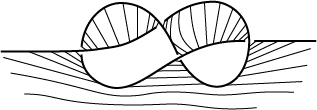
![\varphi: S \times [0,1] \rightarrow \mathbb{S}^3 \backslash K](https://s0.wp.com/latex.php?latex=%5Cvarphi%3A+S+%5Ctimes+%5B0%2C1%5D+%5Crightarrow+%5Cmathbb%7BS%7D%5E3+%5Cbackslash+K&bg=ffffff&fg=5e5e5e&s=0&c=20201002) which restricts to a bijection from
which restricts to a bijection from  to
to  and
and  .
.
 ), we only need to produce a homotopy that sends
  to the symmetric Seifert surface in the upper half plane. I was not able to find one. (I’m still curious if there is such homotopy, if so, then there are more than one way the knot complement can fiber)


 on
on  , we say
  (denoted
  if for
  ,
,
 , the volume of the ball behaves more and more like
  , but no further restriction on the rate it approaches
  and a partition
  ,
, ,
,  denotes the set
  containing
  i.e. pulling back the partition by
  , note that
  is itself a partition of
  .
. , let
, let  denote the smallest common refinement of
  .
.
 as
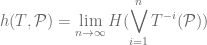
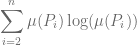
as  gets small, as we would expect, the entropy measures how ‘fine’ the partition is. The smaller the parts gets, the larger the entropy; To get a sense of the rate of growth as partition gets finer: if one bisects each set in the partition to form a new partition, the entropy would increase by
  .
.
 and this is as large as it can get.
 –as remarked above,
  . i.e. we have
  is at most
  .
. , the smaller the entropy gets. When
  just permutes the
  s, entropy is, of course,
 and ‘evenly mixes’
  , for points in
  …I’m not sure if it suffices to require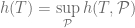
 to intersect each
  . Hence one should believe that
  is (at least normally) finite.
 . Let
. Let  . i.e. exact dimension exists for each such measure.
 to obtain the entropy.
 has exact dimension?
 can be contained in the discontinuity set of a Lipschitz function
  . I found the following unbelievable at the first glance: Given a cone
  in
in  ), the
  is, roughly speaking, the
  of lengths of
  where
where  is a Lipschitz curve going only in directions in
  can be decomposed into two sets
  and
and  that
that ![C= [0, \pi/2]](https://s0.wp.com/latex.php?latex=C%3D+%5B0%2C+%5Cpi%2F2%5D&bg=ffffff&fg=5e5e5e&s=0&c=20201002) and
and  -width
 ![C' = [\pi/2, \pi]](https://s0.wp.com/latex.php?latex=C%27+%3D+%5B%5Cpi%2F2%2C+%5Cpi%5D&bg=ffffff&fg=5e5e5e&s=0&c=20201002) .
. in length
  be a domain.
  ,
,  .
. as
as  )
)
 is area-minimizing then
 of
of  of
of  where
where  . i.e.
![= \int_D \{ [ (1 + f_x^2 + f_y^2)^{-\frac{1}{2}} f_x ] \delta f_x](https://s0.wp.com/latex.php?latex=%3D+%5Cint_D+%5C%7B+%5B+%281+%2B+f_x%5E2+%2B+f_y%5E2%29%5E%7B-%5Cfrac%7B1%7D%7B2%7D%7D+f_x+%5D+%5Cdelta+f_x+&bg=ffffff&fg=5e5e5e&s=0&c=20201002)
![+ [ (1 + f_x^2 + f_y^2)^{-\frac{1}{2}} f_y ] \delta f_y \}dxdy =0](https://s0.wp.com/latex.php?latex=%2B++%5B+%281+%2B+f_x%5E2+%2B+f_y%5E2%29%5E%7B-%5Cfrac%7B1%7D%7B2%7D%7D+f_y+%5D+%5Cdelta+f_y+%5C%7Ddxdy+%3D0&bg=ffffff&fg=5e5e5e&s=0&c=20201002)
![G(f) = - \frac{\partial}{\partial x}[ (1 + f_x^2 + f_y^2)^{-\frac{1}{2}} f_x ] - \frac{\partial}{\partial y}[ (1 + f_x^2 + f_y^2)^{-\frac{1}{2}} f_y ]](https://s0.wp.com/latex.php?latex=G%28f%29+%3D+-+%5Cfrac%7B%5Cpartial%7D%7B%5Cpartial+x%7D%5B+%281+%2B+f_x%5E2+%2B+f_y%5E2%29%5E%7B-%5Cfrac%7B1%7D%7B2%7D%7D+f_x+%5D+-+%5Cfrac%7B%5Cpartial%7D%7B%5Cpartial+y%7D%5B+%281+%2B+f_x%5E2+%2B+f_y%5E2%29%5E%7B-%5Cfrac%7B1%7D%7B2%7D%7D+f_y+%5D&bg=ffffff&fg=5e5e5e&s=0&c=20201002)

![- 2f_x f_y f_{xy}+(1+f_x^2)f_{yy}]](https://s0.wp.com/latex.php?latex=-+2f_x+f_y+f_%7Bxy%7D%2B%281%2Bf_x%5E2%29f_%7Byy%7D%5D&bg=ffffff&fg=5e5e5e&s=0&c=20201002)
 , the constant term vanishes, we have:
 for all
  , hence
  . i.e.
 convex, any
  be 2-form in
  and
and  . i.e.
  for all
  in the unit tangent bundle of
  be the two-form
 ,
,  , we have
  ,
,  when the plane spanned by
  is tangent to the graph of
  .
.
 whenever the plane spanned by
  , we have
 with smaller area than that of
  cannot be area-minimizing (by projecting to the cylinder). Hence we may assume
  (So that
  bounds a 3-chain,
 hence
hence  .
. . i.e.
  with
with 
 i.e. if two chains are close together, they would almost bound a 3-chain with small volume, hence the difference has small norm.
 and
and  , for any chain
  inside the grid of mesh
  where
where  (hence the area of
  is totally bounded under the flat norm
  .
. of rectifiable chains with boundary
 large enough s.t.
  . Project
  radially onto
  the projection does not increase area.
 for all
  . i.e.
  and
and  .
. is compact, there exists subsequence
  converging to a rectifiable chain
  .
.  under the flat norm).
 (lower-semicontinuity of area under the flat norm).
 Area777