On C^1 closing lemma

Let f: M \rightarrow M be a diffeomorphism. A point p is non-wandering if for all neighborhood U of p, there is increasing sequence (n_k) \subseteq \mathbb{N} where U \cap f^{n_k}(U) \neq \phi. We write p \in \mathcal{NW}(f).

Closing lemma: For any diffeomorphism f: M \rightarrow M, for any p \in \mathcal{NW}(f). For all \varepsilon>0 there exists diffeomorphism g s.t. ||f-g||_{C^1} < \varepsilon and g^N(p) = p for some N \in \mathbb{N}.

Suppose p \in \mathcal{NW}(f), \overline{\mathcal{O}(p)} is compact, then for any \varepsilon>0, there exists x_0 \in B(p, \varepsilon), k \in \mathbb{N} s.t. f^k(x) \in B(p, \varepsilon).

First we apply a selection process to pick an appropriate almost-orbit for the closing. Set x_i = f^i(x_0), \ 0 \leq i \leq k.

If there exists 0 < j < k where

\min \{ d(x_0, x_j), d(x_j, x_k) \} < \sqrt{\frac{2}{3}}d(x_0, x_k)

then we replace the origional finite sequence by (x_0, x_1, \cdots, x_j) or (x_j, \cdots, x_k). Iterate the above process. since the sequence is at least one term shorter after each shortening, the process stops in finite time. We obtain final sequence (p_0, \cdots, p_n) s.t. for all 0 < i < n,

\min \{ d(p_0, p_i), d(p_i, p_n) \} \geq \sqrt{\frac{2}{3}}d(p_0, p_n).

Since the process is applied at most k times, x_0, x_k \in B(p, \varepsilon), after the first shortening, d(p, x_{i_1}) \leq \max \{d(p, x_0), d(p, x_k) \} + \sqrt{\frac{2}{3}}d(x_0, x_k) \leq \varepsilon +  2 \sqrt{\frac{2}{3}} \varepsilon.

i.e. both initial and final term of the sequence is at most (\frac{1}{2}+ \sqrt{\frac{2}{3}}) 2 \varepsilon. Along the same line, we have, at the i-th shortening, the distance between the initial and final sequence and p is at most (\frac{1}{2} + \sqrt{\frac{2}{3}} + (\sqrt{\frac{2}{3}})^2 + \cdots (\sqrt{\frac{2}{3}})^i) 2 \varepsilon. Hence for the final sequence p_0, p_n \in B(p, 1+2 \sqrt{\frac{2}{3}}/(1-\sqrt{\frac{2}{3}}) \varepsilon) \subseteq B(p, 10 \varepsilon).

There is a rectangle R \subseteq M where p_0, p_n \in \sqrt{\frac{3}{4}}R
(i.e. shrunk R by a factor of \sqrt{\frac{3}{4}} w.r.t. the center) and for all 0 < i < n, \ p_i \notin R.

Next, we perturb f in R i.e. find h: M \rightarrow M with ||h||_{C^1} < \delta and h|_{M \backslash R} = id. Hence ||h \circ f - f ||_{C^1} < \delta.

Suppose R = I_1 \times I_2; L_1, L_2 are the lengths of I_1, I_2, L_1 < L_2.
By main value theorem, for all x \in M, \ d(x, h(x)) < \delta L_1.
On the other hand, since p_0 \in \sqrt{\frac{3}{4}}R, it's at least \frac{1}{2}(1-\sqrt{\frac{3}{4}})L_1 away from the boundary of R. i.e. there exists bump function h satisfying the above condition and d(p_0, h(p_0)) > \frac{\delta}{8}(1-\sqrt{\frac{3}{4}})L_1.

Hence in order to move a point by a distance L_1, we need about 1/ \delta such bump functions, to move a distance L_2, we need about \frac{L_2}{\delta L_1} bumps.

For simplicity, we now suppose M is a surface. By starting with an \varepsilon (and hence R) very small, we have for all 0 \leq i \leq N+M, \ f^i(R) is contained in a small neighbourhood of p_i. Hence on f^i(B), f^i is C^1 close to the linear map p_i + Df^i(p_0)(x-p_0). Hence mod some details we may reduce to the case where f is linear in a neighborhood of \mathcal{O}(p_0).

By choosing appropiate coordinate system in R, we can have f preserving the horizontal and vertical foliations and the horizontal vectors eventually grow more rapidly than the vertical vectors.

It turns out to be possible to choose R to be long and thin such that for all i \leq 40 / \delta, f^i(R) has height greater than width. (note that M = \lfloor 40/ \delta \rfloor bumps will be able to move the point by a distance equal to the width of the original rectangle R. Since horizontal vectors eventually grow more rapidly than the vertical vectors, there exists N s.t. for all N \leq i \leq N+M, f^i(R) has width greater than its height.
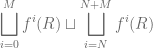
For small enough \epsilon, the boxes f^i(R) are disjoint for 0 \leq i \leq N+40/ \delta. Construct h to be identity outside of

\displaystyle \bigsqcup_{i=0}^M f^i(R) \sqcup \bigsqcup_{i=N}^{N + M} f^i(R)

For the first M boxes, we let h preserve the horizontal foliation and move along the width so that g = h \circ f has the property that g^M(p_n) lies on the same vertical fiber as f^M(p_0).

On the boxes f^{N+i}(R), \ 0 \leq i \leq M, we let h pushes along the vertical direction so that

g^{N+M}(p_n) = f^{N+M}(p_0)

Since iterates of the rectangle are disjoint, for N+M \leq i \leq n, \ h(p_i) = p_i, g(p_i) = f(p_i).

Hence g^n(p_n) = g^{n-(N+M)} \circ g^{N+M}(p_n) = g^{n-(N+M)} f^{N+M}(p_0) = g^{n-(N+M)} (p_{N+M}) = p_n.

Therefore we have obtained a periodic point p_n of g.

Since p_n \in B(p, 10 \varepsilon), we may further perturb g to move p_n to p. This takes care of the linear case on surfaces.

On compact extensions

This is again a note on my talk in the Szemerédi’s theorem seminar, going through Furstenberg’s book. In this round, my part is to introduce compact extension.
Let \Gamma be an abelian group of measure preserving transformations on (X, \mathcal{B}, \mu), \alpha: (X, \mathcal{B}, \mu, \Gamma) \rightarrow ( Y, \mathcal{D}, \nu, \Gamma') be an extension map.
i.e. \alpha: X \rightarrow Y s.t. \alpha^{-1} sends \nu-0 sets to \mu-0 sets;

\gamma'\circ \alpha (x) = \alpha \circ \gamma (x)

Definition: A sequence of subsets (I_k) of \Gamma is a Folner sequence if |I_k| \rightarrow \infty and for any \gamma \in \Gamma,

\frac{| \gamma I_k \Delta I_k|}{|I_k|} \rightarrow 0

Proposition: For any Folner sequence I = (I_k) of \Gamma, for any f \in L^1(X), \displaystyle \frac{1}{|I_k|} \sum_{\gamma \in I_k} \gamma f converges weakly to the orthogonal projection of f onto the subspace of \Gamma-invariant functions. (Denoted P(f) where P: L^2(X) \rightarrow L^2_{inv}(X).

Proof: Let \mathcal{H}_0 = P^{-1}(\bar{0}) = (L^2_{inv}(X))^\bot
For all \gamma \in \Gamma,

\gamma (L^2_{inv}(X)) \subseteq L^2_{inv}(X)

Since \Gamma is \mu-preserving, \gamma is unitary on L^2(X). Therefore we also have \gamma( \mathcal{H}_0) \subseteq \mathcal{H}_0.

For f \in \mathcal{H}_0, suppose there is subsequence (n_k) where \displaystyle \frac{1}{|I_{n_k}|} \sum_{\gamma \in I_{n_k}} \gamma (f) converges weakly to some g \in L^2(X).

By the property that \frac{| \gamma I_k \Delta I_k|}{|I_k|} \rightarrow 0, we have for each \gamma \in \Gamma, \gamma(g) = g, \ g is \Gamma-invariant. i.e. g \in (\mathcal{H}_0)^\bot

However, since f \in \mathcal{H}_0 hence all \gamma(f) are in \mathcal{H}_0 hence g \in  \mathcal{H}_0. Therefore g \in \mathcal{H}_0 \cap (\mathcal{H}_0)^\bot, g=\bar{0}

Recall: 1)X \times_Y X := \{ (x_1, x_2) \ | \ \alpha(x_1) = \alpha(x_2) \}.

i.e. fibred product w.r.t. the extension map \alpha: X \rightarrow Y.

2)For H \in L^2(X \times_Y X), \ f \in L^2(X),

(H \ast f)(x) = \int H(x_1, x_2) f(x_2) d  \mu_{\alpha(x_1)}(x_2)

Definition: A function f \in L^2(X) is said to be almost periodic if for all \varepsilon > 0, there exists g_1, \cdots g_k \in L^2(X) s.t. for all \gamma \in \Gamma and almost every y \in Y,

\displaystyle \min_{1 \leq i \leq k} || \gamma (f) - g_i||_y < \varepsilon

Proposition: Linear combination of almost periodic functions are almost periodic.

Proof: Immediate by taking all possible tuples of g_i for each almost periodic function in the linear combination corresponding to smaller \varepsilonl.

Definition: \alpha: (X, \mathcal{B}, \mu, \Gamma) \rightarrow ( Y, \mathcal{D}, \nu, \Gamma') is a compact extension if:

C1: \{ H \ast f \ | \ H \in L^\infty (X \times_Y X) \cap \Gamma_{inv} (X \times_Y X), f \in L^2(X) \} contains a basis of L^2(X).

C2: The set of almost periodic functions is dense in L^2(X)

C3: For all f \in L^2(X), \ \varepsilon, \delta > 0, there exists D \subseteq Y, \ \nu(D) > 1- \delta, \  g_1, \cdots, g_k \in L^2(X) s.t. for any \gamma \in \Gamma and almost every y \in Y, we have

\displaystyle \min_{1 \leq i \leq k} || \gamma (f)|_{f^{-1}(D)} - g_i||_y < \varepsilon

C4: For all f \in L^2(X), \ \varepsilon, \delta > 0, there exists g_1, \cdots, g_k \in L^2(X) s.t. for any \gamma \in \Gamma, there is a set D \subseteq Y, \ \nu(D) > 1- \delta, for all y \in D

\displaystyle \min_{1 \leq i \leq k} || \gamma (f) - g_i||_y < \varepsilon

C5: For all f \in L^2(X), let \bar{f} \in L^1(X \times_Y X) where

\bar{f}: (x_1, x_2) \mapsto f(x_1) \cdot f(x_2)

Let I=(I_k) be a Folner sequence, then \bar{f}=\bar{0} iff P \bar{f} = \bar{0}.

Theorem: All five definitions are equivalent.

Proof: “C1 \Rightarrow C2″

Since almost periodic functions are closed under linear combination, it suffice to show any element in a set of basis is approximated arbitrarily well by almost periodic functions.

Let our basis be as given in C1.

For all H \in L^\infty (X \times_Y X) \cap \Gamma_{inv} (X \times_Y X), the associated linear operator \varphi_H: L^2(X) \rightarrow L^2(X) where \varphi_H: f \mapsto H \ast f is bounded. Hence it suffice to check H \ast f for a dense set of f \in L^2(X). We consider the set of all fiberwise bounded f i.e. for all y \in Y, ||f||_y \leq M_y.

For all \delta > 0, we perturb H \ast f by multiplying it by the characteristic function of a set of measure at least 1- \delta to get an almost periodic function.

“C2 \Rightarrow C3″:

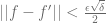
For any f \in L^2(X), there exists f' almost periodic, with ||f-f'||< \frac{\epsilon \sqrt{\delta}}{2} . Let \{ g_1, g_2, \cdots, g_{k-1} \} be the functions obtained from the almost periodicity of f' with constant \varepsilon/2, g_k = \bar{0}.

Let D = \{ y \ | \ ||f-f'||_y < \varepsilon/2 \}, since

|| f - f'||^2 = \int ||f-f'||_y^2 d \nu(y)

Hence ||f-f'||< \frac{\varepsilon \sqrt{\delta}}{2} \ \Rightarrow \ ||f-f'||^2 < \frac{\varepsilon^2 \delta}{4}, \{ y \ | \ ||f-f'||_y > \varepsilon/2 \} has measure at most \delta/2, therefore \nu(D) > 1- \delta.

For all \gamma \in \Gamma, ify \in \gamma^{-1}(D) then

|| \gamma f|_{\alpha^{-1}(D)} - \gamma f'||_y  = ||f|_{\alpha^{-1}(D)} - f'||_{\gamma(y)} < \varepsilon /2

Hence \displaystyle \min_{1 \leq i \leq k-1} ||\gamma f|_{\alpha^{-1}(D)} - g_i||_y < \varepsilon /2 + \varepsilon /2 = \varepsilon

If y \notin \gamma^{-1}(D) then f|_{\alpha^{-1}(D)} vanishes on \alpha^{-1}(\gamma y) so that || \gamma f|_{\alpha^{-1}(D)} - g_i||_y = 0 < \varepsilon.

Hence \alpha satisfies C3.

“C3 \Rightarrow C4″:

This is immediate since for all y \in \gamma^{-1}(D), we have \gamma f = \gamma f|_{\alpha^{-1}(D)} on \alpha^{-1}(y) hence

\displaystyle \min_{1 \leq i \leq k} ||\gamma f - g_i||_y < \min_{1 \leq i \leq k-1} ||\gamma f_{\alpha^{-1}(D)} - g_i||_y < \varepsilon

\nu(\gamma^{-1}(D)) = \nu(D) > 1-\delta. Hence \alpha satisfies C4.

“C4 \Rightarrow C5″:

For all f \in L^2(X), \ \varepsilon, \delta > 0, by C4, there exists g_1, \cdots, g_k \in L^2(X) s.t. for any \gamma \in \Gamma, there is a set D \subseteq Y, \ \nu(D) > 1- \delta, for all y \in D

\displaystyle \min_{1 \leq i \leq k} || \gamma (f) - g_i||_y < \varepsilon

W.L.O.G. we may suppose all g_i are bounded since by making \delta slighter larger we can modify the unbounded parts to be bounded.

\bar{g_j} \otimes g_j \in L^\infty(X \times_Y X), suppose P(\bar{f}) = 0.

Recall in C5 we have \bar{f}: (x_1, x_2) \mapsto f(x_1) \cdot f(x_2), and \displaystyle P_I \bar{f}(x_1, x_2) = \lim_{k \rightarrow \infty} \frac{1}{|I_k|} \sum_{\gamma \in I+k} f(\gamma x_1) \bar{ f(\gamma x_2)}.

For each 1 \leq j \leq k, we have \int (\bar{g_j} \otimes g_j) \cdot P \bar{f} d(\mu \times_Y \mu) = 0

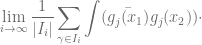
Hence we have \displaystyle \lim_{i \rightarrow \infty} \frac{1}{|I_i|} \sum_{\gamma \in I_i} \int (\bar{g_j(x_1)} g_j(x_2)) \cdot \gamma f(x_1) \bar{\gamma f(x_2)} d\mu \times_Y \mu(x_1, x_2) = 0

\Rightarrow \displaystyle \lim_{i \rightarrow \infty} \frac{1}{|I_i|} \sum_{\gamma \in I_i} \int | \int \bar{g_j(x)} \gamma f(x) d\mu_y(x)|^2 d \nu(y) = 0

\Rightarrow \displaystyle \lim_{i \rightarrow \infty} \frac{1}{|I_i|} \sum_{\gamma \in I_i} \{ \sum_{j=1}^k \int | \int \bar{g_j(x)} \gamma f(x) d\mu_y(x)|^2 d \nu(y) \} = 0

Hence for large enough i, there exists \gamma \in I_i s.t. \sum_{j=1}^k \int | \int \bar{g_j(x)} \gamma f(x) d\mu_y(x)|^2 d \nu(y) is as small as we want.

We may find D' \subseteq Y with \nu(D) > 1-\delta s.t. for all y \in D' and for all j, we have

| \int \bar{g_j(x)} \gamma f(x) d\mu_y(x)|^2 < \varepsilon^2

On the other hand, by construction there is j with || \gamma f - g_j||^2_y < \varepsilon^2 for all y \in D, with \nu(D) > 1-\delta .

Hence for y \in D \cap D', \ ||f||_{\gamma'^{-1}(y)}^2 = || \gamma f||_y^2 < 3 \varepsilon^2.

Let \varepsilon \rightarrow 0, \ \delta \rightarrow 0 we get f = \bar{0}. Hence C5 holds.

“C5 \Rightarrow C1″

Let f \in L^2(X) orthogonal to all of such functions. Let (I_k) be a Folner sequence.

Define \displaystyle H(x_1, x_2) := \lim_{i \rightarrow \infty} \frac{1}{|I_i|}\sum_{\gamma \in I_i} \gamma f(x_1) \cdot \gamma f(x_2) = P \bar{f}(x_1, x_2)

Let H_M(x_1, x_2) be equal to H whenever H(x_1, x_2) \leq M and 0 o.w.

H is \Gamma-invariant \Rightarrow \ H_M is \Gamma-invariant and bounded.

Therefore f \bot H_M \ast f, i.e.

\int \bar{f(x_1)} \{ \int H_M(x_1, x_2) d \mu_{\alpha(x_1)}(x_2) \} d \mu(x_1) = 0 <\p>

Since \mu = \int \mu_y d \nu(y), we get

\int \bar{f} \otimes f \cdot H_M d \mu \times_Y \mu = 0 <\p>

Hence H_M \bot (\bar{f} \otimes f). For all \gamma \in \Gamma, \ \gamma (\bar{f} \otimes f) \bot \gamma H_M = H_M.

Since H = P \bar{f} is an average of \gamma (\bar{f} \otimes f), \ \Rightarrow \ H \bot H_M.
0 = \int \bar{H} \cdot H_M = \int |H_M|^2 \ \Rightarrow \ H_M = \bar{0} for all M

Hence H = \bar{0}. By C5, we obtain f = \bar{0}. Hence \{ H \ast f \ | \ H \in L^\infty (X \times_Y X) \cap \Gamma_{inv} (X \times_Y X), f \in L^2(X) \} contain a basis for L^2(X).

Definition: Let H be a subgroup of \Gamma, \alpha: (X, \mathcal{B}, \mu, \Gamma) \rightarrow ( Y, \mathcal{D}, \nu, \Gamma') is said to be compact relative to H if the extension \alpha: (X, \mathcal{B}, \mu, H) \rightarrow ( Y, \mathcal{D}, \nu, H') is compact.

On plaque expansiveness

This note is mostly based on parts of (RH)^2U (2006) and conversations with R. Ures while he was visiting Northwestern.

Let \mathcal{F} be a foliation of the manifold M, for p \in M, a plaque in of \mathcal{F} through p is a small open neighborhood of p in the leaf \mathcal{F}_p that’s pre-image of a disc via a local foliation chart. (i.e. plaques stuck nicely to make open neighborhoods where the foliation chart is defined.) For \varepsilon small enough, whenever the leaves of \mathcal{F} are C^1, the path component of B(p, \varepsilon) containing p is automatically a plaque, we denote this by \mathcal{F}_\varepsilon(p).

Given a partially hyperbolic diffeomorphism f: M \rightarrow M, suppose the center integrates to foliation \mathcal{F}^c.

Definition: An \varepsilon-pseudo orbit w.r.t. \mathcal{F}^c is a sequence (p_n) where for any n \in \mathbb{Z}, f(x_n) \in \mathcal{F}^c_\varepsilon(x_{n+1}).

i.e. p_{n+1} is the f-image of p_n except we are allowed to move along the center plaque for a distance less than \varepsilon.

Definition: f is plaque expansive at \mathcal{F}^c if there exists \varepsilon>0 s.t. for all \varepsilon-pseudo orbits (p_n),  (q_n) w.r.t. \mathcal{F}^c, d(p_i, q_i)<\varepsilon for all i \in \mathbb{Z} then p_0 \in \mathcal{F}^c_\varepsilon(q_0).

i.e. any two pseudo-orbits in different plagues will eventually (under forward or backward iterates) be separated by a distance \varepsilon.

In the book Invariant Manifolds (Hirsch-Pugh-Shub), it’s proven that

Theorem: If a partially hyperbolic system has plaque expansive center foliation, then the center being integrable and plaque expansiveness are stable under perturbation (in the space of diffeos). Furthermore, the center foliation of the perturbed system g is conjugate to the center foliation of the origional system f in the sense that there exists homeomorphism h: M \rightarrow M where

1) h sends leaves of \mathcal{F}^c_f to leaves of \mathcal{F}^c_g i.e. for all p \in M,

h(\mathcal{F}^c_f(p)) = \mathcal{F}^c_g(p)

2) h conjugates the action of f and g on the set of center leaves i.e. for all p \in M,

h \circ f \ (\mathcal{F}^c_f(p)) = g \circ h \ ( \mathcal{F}^c_f(p))

(both sides produce a \mathcal{F}^c_g leaf)

Morally this means plaque expansiveness implies structurally stable in terms of permuting the center leaves.

It’s open whether or not any partially hyperbolic diffeomorphism with integrable center is plaque expansive w.r.t. its center foliation.

Another problem, stated in HPS about plaque expansiveness is:

Question: If f is partially hyperbolic and plaque expansive w.r.t. center foliation \mathcal{F}_c, then is \mathcal{F}_c the
unique f−invariant foliation tangent to E^c?

(RH)^2U has recently gave a series of super cool examples where the 1-dimensional center bundles of a C^1 partially hyperbolic diffeomorphism 1) does not integrate OR 2) integrates to a foliation but leaves through a given point is not unique (there is other curves through the point that’s everywhere tangent to the bundle). I will say a few words about the examples without spoil the paper (which is still under construction).

Start with the cat map on the 2-torus (matrix with entries ( 2, 1, 1, 1), take the direct product with the source-sink map on the circle, we obtain a diffeo on the 3 torus. For the purpose of our map, we make the expansion in the source-sink map weaker than that of the cat map and the contraction stronger.

Then we perturb the map by adding appropriate small rotations to the system, the perturbation vanish on the \mathbb{t}^2 fibers corresponding to the two fixed points in the source-sink map. This will make our system partially hyperbolic, with center bundles as shown below:

To construct a non-integrable center, we make a perturbation that gives center boundle (inside the unstable direction of the cat map times the circle):

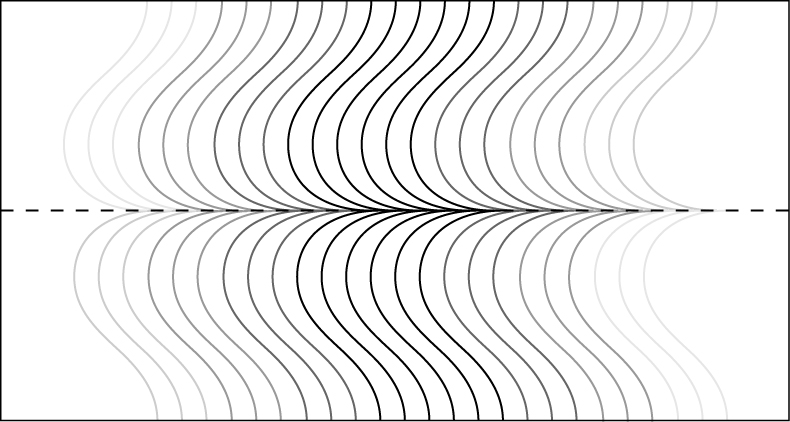
For intergrable but have non-unique center leaves, we simply rotate the upper and bottom half in opposite directions and obtain:

Note that in this case, all center leaves are merely copies of S^1. The example is plaque expansive due to to fact that all centers leaves are compact (and of uniformly bounded length). However, although the curve through any given point tangent to the bundle is non-unique, there is only one possible foliation of the center. Hence this does not give a counter example to the above mentioned question in HPS.

I think there are hopes to modify the example and make one that has similar compact leafs but non-unique center foliation, perhaps by making the unique integrability fail not only on a single line.

A hyperbolic structure on the Whitehead link completement

I’ve been going through Thurston’s book ‘The Geometry and Topology of Three-Manifolds‘ in a reading course with Amie Wilkinson. In Chapter 3, p32, when he’s constructing a hyperbolic structure on the Whitehead link complement, there is a picture on how to glue the 2-cells to the knot, to quite Thurston, ‘the attaching map for the two-cells are indicated by the dotted lines.’ However, for me it’s impossible to see where are the dotted lines going. So I reconstruct it here with some more clear pictures. The construction itself was a cool reading that I wish to share.

First, we have the Whitehead link, looking like the first figure below:

We attach three 1-cells (line segments) as in the second figure, note that the ‘x’ in the middle represents a line segment orthogonal to the screen, connecting the top and bottom line in the figure ‘8’ loop.

Now we will start to attach four 2-cells to the 1-complex above: First, we attach a 2-cell spanning the top part of the figure ‘8’ loop, spanning one side of the middle segment and two sides of the top segment (denote this by cell A):

Do the same with the bottom half (cell B). Note that each cell is attached to three edges, hence they are triangles without vertices in the knot complement with three one-cells attached.

For the other two cells, we attach as follows (cells C and D):

Combining the four 2-cells, we get something like the figure showed below. Note that at the top, cell A is under cell C in the left, intersecting the surface spanned by cells C and D at the edge, and comes above cell D to the right of the edge.

It’s easy to see that the complement of the above 2-complex does not separate \mathbb{R}^3, hence it’s a 3-cell with eight faces (i.e. it has to go through both sides of each 2-cell in order to fill the 3-space) each of its face has three edges. Hence we may glue an octahedron to the 2-complex after the gluing, pairs of faces of the octahedron will be identified groups of four edges will be identified to single edges. Hence to put a hyperbolic structure on the link complement, it suffice to put an hyperbolic structure to the octahedron with vertices deleted.

Since each edge is glued up by four edges of the octahedron, it suffice to find an octahedron (without vertices) in the hyperbolic 3-space that has all adjacent faces intersect in dihedral angle 2 \pi / 4 i.e. all adjecent faces are orthogonal in the hyperbolic space. But this is achieved if we inscribe the regular octahedron into the Klein model (also called projective model of hyperbolic 3-space.

The gluing map for the faces are merely rotations and reflections of the ball which are certainly hyperbolic isometries. Hence this gives a hyperbolic structure to the link complement.

On Alexander horned sphere

As I was drawing pictures for some stuff that should be done a year ago, I found this part would make a cool blog post, so here it is ^^ (well I admit that I mainly just want t show off the picture)

For kids who doesn’t know, let’s first talk a bit about what this ‘sphere’ is:

This is an embedded topological sphere in \mathbb{R}^3 which has non-simply connected exterior. Also, Since the surface is compact, through inversion about any point bounded away from infinity by the surface, we obtain a ‘sphere’ that bounds a non-simply connected region inside. This shows that the topology of the complement of a compact surface depends on the embedding, which is not true for embeddings of  compact 1-dimensional manifolds in \mathbb{R}^2. (i.e. all Jordan curves separates the plane into two simply connected open sets, via the Jordan curve theorem)

The construction, as shown in the beautiful 2 page article by Alexander, goes as follows:

Take an ordinary sphere (stage 0), stretch and bend it like a banana so that the two ‘end caps’ are supported on a pair of parallel circles such that one lies vertically on top of the other (state 1). Next, on each cap we develop a banana shape, the banana shape on the two caps link though each other and again has their caps supported on a pair of parallel circles (stage 2).  Continue the process to add successively smaller bananas on the caps produced in the immediate preceding stage.

Claim: The limit is a topological sphere.

To see this, we build homeomorphisms from S^2 to each sphere in the intermediate stages. i.e. let

h_n: S^2 \rightarrow S^2_n

be a homeomorphism where S^2_n \subseteq \mathbb{R}^3 is the embedded sphere at stage n.

We may take h_n s.t. h_n^{-1} restricting to the complement of the (n-1)th stage caps (denoted by C_{n-1}) agree with h_{n-1}^{-1}. Hence union the maps h_n|_{C_{n-1}} gives a continuous map on the complement of a Cantor set on the sphere. (Since C_n is increasing and the caps gets smaller) This map can be extended continuously to the whole sphere because any neighborhood of points in the Cantor set contains pre-image of some sufficiently small cap.

The extension h is injective since any two points in the Cantor set will be separated by a pair of disjoint pre-image of small caps. Since the sphere is compact, we conclude h is a homeomorphism. i.e. the limiting surface is a topological sphere.

The exterior of the surface is not simply connected as a loop just outside the ‘equator’ can’t be contracted to a point. In fact, it’s also easy to show that the fundamental group of the exterior is not finately generated.

For some reason, Charles and I wanted to create a diffeotopy of from the standard sphere to an Alexander horned sphere. (with differentiability failing only at time one, and this is necessary since there can be no diffeomorphism from the sphere to the horned sphere, otherwise it would extend to a neighbourhood of the surfaces and hence the whole \mathbb{R}^3, but the exteriors of the two are not homeomorphic.)

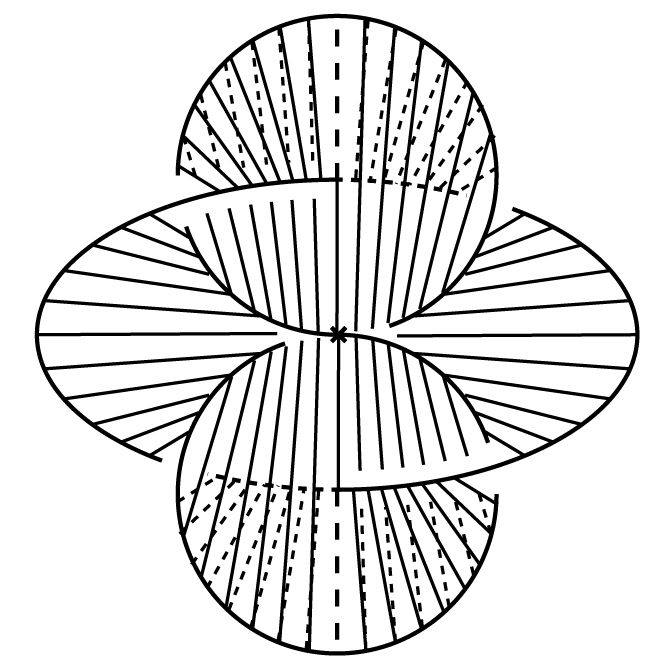
The above figure is in fact a particular kind of Alexander horned sphere we needed. i.e. it has the property that each cap in the (n+1)th stage has diameter less than 1/2 of that in the nth stage, and the distance between the parallel circles is also less than 1/2 of that in the previous stage. Spheres at each stage is differentiable.

This would allow us to construct a diffeotopy that achieves stage n at time 1-1/2^n, the diffeotopy is of bounded speed as all horns are half as large as the pervious stage, hence once we get to the first stage with bounded speed, making all points traveling at that maximum speed would get one to the next stage using 1/2 as much time.

However, we do not know if all horned sphere can be achieved by s diffeotopy from the standard sphere. i.e. does the property of being a ‘diffeotopic sphere’ depend on the embedding in \mathbb{R}^3.

Many thanks to Charles Pugh for forcing me to look at this business. It is indeed very fun~