Now we begin to prove the theorem.
4.Attractor-repeller pairs
Definition: A compact set  is an attractor for
  if there exists
  open,
open,  and
and  . is called a basin of attraction.
For any attractor , be a basin for  , let
, let  is open. By definition,
  and
and  . We also have

Definition: A repeller for is an attractor for  . A basin of repelling for is a basin of attracting for .
Hence  is a repeller for with basin
  .
.
It’s easy to see that is defined independent of the choice of basin for . (Exercise)
We call such a pair  an attracting-repelling pair.
The following two properties of attracting-repelling pairs are going to be important for our proof of the theorem.
Proposition 1: There are at most countably many different attractors for .
Proof: Since  is compact metric, there exists countable basis
  that generates the topology.
For any attractor , any attracting basin  of is a union of sets in
  , i.e.
  latex for some subsequence
  of
of  .
.
Since is compact,  is an open cover of , we have some
  s.t.
s.t.  covers .
Let  hence
hence  . We have

Since  is an attracting basin for , all three sets are equal. Hence
  . i.e. any attractor is intersection of foreward interates of come finite union of sets in . Since is countable, the set of all finite subset of it is coubtable.
Hence there are at most countably many different attractors. This establishes the proposition.
By proposition 1, we let  be a list of all attractors for . Now we are going to relate the arrtactor-repeller pairs to the chain recurrent set and chain transitive components.
Proposition 2:
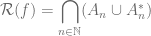
Proof: i) 
This is same as saying for any attractor ,  .
.
For all  , let be a basin of , then there is
  for which
  (recall that
  is the dual basin of for ). Since
  and
and  we conclude

Hence  . Let
. Let  be the smallest integer for which
  . Hence
  . Let
. Let  is also a basin for .
Now we show such  cannot be chain recurrent: Since
  and
and  are compact and disjoint, we may let

Since  , there exists some
  s.t.
s.t.

 so there exists
  s.t.
s.t.

(Here  denotes the ball of radius
  around
  and
and  denotes the -neignbourhood of compact set
  )
)
Now set  , for any
  -chain
  , we have: Since
  and ,
and ,  and
and  . Hence the third term of any such chain must be in
  . Since
  , no -chain starting at
  can reach , in particular, the chain does not come back to . Hence we conclude that is not chain recurrent. ii)
  Suppose not, there is
  and
and  . i.e. for some
  there is no -chain from to itself. Let be the open set consisting all points that can be connected from by an -chain.
We wish to generate an attractor by  , to do this all we need to check is
  :
:
For any  there exists
  with
with  . Since , there is -chain
  which gives rise to -chain
  . Therefore .
Hence 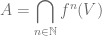 is an attractor with as a basin.
By assumption,  , since
  and there is no -chain from to itself, cannot be in . i.e.
  Take any limit point
  of
of  , since is compact -invariant we have
  . But since we can find
  where
where  ,
,  gives an -chain from to , hence
  .
.
Recall that is a basin of hence  is empty. Contradiction. Establishes proposition 2.
This proposition says that to study the chain recurrent set is the same as studying each attractor-repeller pair of the system. But the dynamics is very simple for each such pair as all points not in the pair will move towards the attractor under foreward iterate. We can see that such property is goint to be of importantce for our purpose since the dynamical for each attractor-repeller pair is like the sourse-sink map.
5. Main ingredient
Here we are going to prove a lemma that’s going to produce for us the ‘building blocks’ of our final construction. Namely a function for each attracting-repelling pair that strickly decreases along the orbits not in the pair. In light of proposition  , we should expect to put those functions together to get our complete Lyapunov function.
Lemma1: For each attractor-repeller pair  there exists continuous function
 ![g: X \rightarrow [0,1]](https://s0.wp.com/latex.php?latex=g%3A+X+%5Crightarrow+%5B0%2C1%5D&bg=ffffff&fg=5e5e5e&s=0&c=20201002) s.t.
s.t.  and
and  for all
  .
.
Proof: First we define ![\varphi: X \rightarrow [0,1]](https://s0.wp.com/latex.php?latex=%5Cvarphi%3A+X+%5Crightarrow+%5B0%2C1%5D&bg=ffffff&fg=5e5e5e&s=0&c=20201002) s.t.
s.t.

Note that  takes value
  only on and
  only on . However, can’t care less about orbits of .
Define  . Hence automatically for all ,
  . Since no points accumulates to under positive iterations, we still have the
  and
and  .
.
We now show that  is continuous:
For and  ,
,  and
and  hence
hence  i.e. is continuous on .
For  we use the fact that is attracting. Let be a basin of . For all
  , for any
  , there is s.t.
  . Therefore for some
  , all
, all  are in
  i.e.
i.e.  hence
hence  . But for some
  and all
  ,
,  . Therefore
  . is continuous on .
Let  , for any
  , since
  , there exists
  s.t. for all
![\varphi(f^n(T))\subseteq [0,r/2]](https://s0.wp.com/latex.php?latex=%5Cvarphi%28f%5En%28T%29%29%5Csubseteq+%5B0%2Cr%2F2%5D&bg=ffffff&fg=5e5e5e&s=0&c=20201002) . i.e.
. i.e.  which is countinous. Since those ‘bands’
  partitions the whole (by taking
  to be
to be  ), hence we have proven is continuous on the whole .
Finally, we define

We check that  is continuous since is. takes values and only on and , respectively. For any ,

therefore  iff
iff  for all
  i.e. is constant on the orbit of . But this cannot be since there is a subsequence of
  converging to some point in , continuity of tells us this constant has to be hence .
Therefore is strictly decreasing along orbits of not in  .
.
Establishes lemma 1.
6.Proof of the main theorem
The proof of the main theorem now follows easily from what we have established so far.
First we restate the fundamental theorem of dynamical systems:
Theorem: Complete Lyapunov function exists for any homeomorphisms on compact metric spaces.
Proof: First we enumerate the countably many attractors as . For each  , we have function
  where
where  is on , on
  and is strictly decreasing on
  .
.
Define  by
by
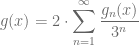
Since each is bounded between and , the sequence of partial sums converge uniformly. Hence the limit function is continuous.
For points  , we have
  for all
  . i.e. $latex \ \forall n \in \N, \ g_n(p) = 0$ or
  . Hence we have

where each  is in
is in  . This is same as saying the base-
 expansion of
  only contains digits and . We conclude
  where
where  is the standard middle-third Cantor set in
 ![[0, 1]](https://s0.wp.com/latex.php?latex=%5B0%2C+1%5D&bg=ffffff&fg=5e5e5e&s=0&c=20201002) . i.e.
. i.e.  is compact and nowhere dense in
  .
.
For  , there exists such that
  , hence
  . This implies since
  for all
  . i.e. is strictly decreasing along orbits that are not chain recurrent.
To show is constant only on the chain-transitive components, we need the following lemma:
Claim:  are in the same chain-transitive component iff there is no attracting-repelling pair where one of
  is in while the other in .
Proof (of claim): ” ” Suppose
  and
and  , for any attractor , if
  and
and  , then
  are both in and we are done. Hence suppose at least one of is in . W.L.O.G. suppose . Let be a basin of . Since
  are closed and disjoint, we may choose
  . By the same arguement as in proposition , there are no
  -chain (with length
  ) from any point in
  to any point in
  . Hence there is also no -chain from any point in to any point in . Hence
  i.e.
i.e.  .
.
” ” Suppose for any attractor , iff . For any , let be the set of all points for which there is an -chain from to , as defined in proposition . We have showed in proposition that is a basin of some attractor
  . Since
  and
and  , hence
  . Hence by our assumption, must be also in . Hence
  i.e. there is an -chain from to . Since the construction is symetric, we may also show there is an -chain from to . i.e.
  .
.
Establishes the claim.
Finally, for  ,
,  means and
  has the same base- expansion in the Cantor set. This is same as saying
  , which is to say there is no for which one of is in
  while the other in
  . Hence by Lemma, we conclude that iff are in the same chain transitive component.
This establishes our theorem.
42.054805
-87.676354
 ,
, , an
, an  is a sequence
  ,
,  where
where  and for all
  ,
,  .
. , an
, an  is a set of points
  s.t.
s.t.  whenever
  are both in
  is chain recurrent if for all
  .
. , we pick
  .
.
 in
in  iff for all
  is reflexive since all points in


 ). Then we prove the family is countable and points in the same chain transitive component are not separated by any partition in the family. Furthermore, each chain-transitive component is uniquely defined by specifying which set does it belong to in each partition. i.e. the smallest common refinement for the family exactly partitions
  is a
is a  -zero set for some integer
  if for every
  , saturating the set
  . In deed this is the case:
 has all
  (Hausdorff dimension), let
  be the Garssmann manifold consisting of all
  ,
,  for almost all
 ,
,  has positive
  .
. of
of  . For any point
  , there exists a small neighborhood in which the foliation is diffeomorphic to the subspace foliation of the Euclidean space. i.e. there exists
  where the leaves of
  ,
,  .
. to be half of the origional
  is the same as
  saturated by parallel
  is the same as dimension of
  , if the inequality is strict, then all projections of
  functions to the disc volume-preservingly. After trying on the board for a while, he laughs out loud when he saw that this may be obtained applying his favorite Whitney’s extension theorem. (I’ll discuss what he did later in the poster)
 in
in  , when can we extend it to a
  function on the whole
  and
and  with
with  (we will denote
  , there is a continuous function
  with the following property:
 ,
,  where
where  as
as  and is uniform in
  .
. are compatible as Taylor coefficients of some
  satisfying the above Taylor condition at all points in $K$. Then there is a
  s.t.
s.t.  and for all
  ,
,  . Furthermore,
  can be taken real analytic on
  .
. , there exists
  where the norm is the
  where
where  is intuitive as we can see in the case of an embedded
  , we may deform the metric (hence the embedding) to make a non-contactable loop as small as we want while keep the volume constant, however when we attempt to make the smallest such loop large when not changing the volume, we can see that we will run into trouble. Hence it’s expected that there is an upper bound for the length of the smallest loop.
 , we have reasons to expect the optimal case fall inside this family. i.e.
 .
. is the optimum case. However, this is not true. Let’s be more careful:
 and
and  , we may normalize and let
 be generators of the fundamental group of
  length of all geodesic loops in class
 ![[\alpha], \ [\beta]](https://s0.wp.com/latex.php?latex=%5B%5Calpha%5D%2C+%5C+%5B%5Cbeta%5D+&bg=ffffff&fg=5e5e5e&s=0&c=20201002) are the side lengths of the parallelepiped i.e.
are the side lengths of the parallelepiped i.e.  . W.L.O.G we suppose
  .
.  has length
  and all geodesics in other classes are at least twice as long as one of the above three.
 . The systole in this case is
  . Hence for any flat torus, we have
 .
. and
and  where
where  is a Riemann surface.
 by a discrete lattice. i.e.
  .
.
 can be represented by a straight loop on the flat torus. The length of such a loop in
  Area777