A remark on a mini-course by Kleiner in Sullivan’s 70th birthday

I spent the last week on Long Island for Dennis Sullivan’s birthday conference. The conference is hosted in the brand new Simons center where great food is served everyday in the cafe (I think life-wise it’s a wonderful choice for doing a post-doc).

Anyways, aside from getting to know this super-cool person named Dennis, the talks there were interesting~ There are many things I found so exciting and can’t help to not say a few words about, however due to my laziness, I can only select one item to give a little stupid remark on:

So Bruce Kleiner gave a 3-lecture mini-course on boundaries of Gromov hyperbolic spaces (see this related post on a piece of his pervious work in the subject)

Cannon’s conjecture: Any Gromov hyperbolic group with \partial_\infty G \approx \mathbb{S}^2 acts discretely and cocompactly by isometries on \mathbb{H}^3.

As we all know, in the theory of Gromov hyperbolic spaces, we have the basic theorem that says if a groups acts on a space discretely and cocompactly by isometries, then the group (equipped with any word metric on its Cayley graph) is quasi-isometric to the space it acts on.

Since I borrowed professor Sullivan as an excuse for writing this post, let’s also state a partial converse of this theorem (which is more in the line of Cannon’s conjecture):

Theorem: (Sullivan, Gromov, Cannon-Swenson)
For G finitely generated, if G is quasi-isometric to \mathbb{H}^n for some n \geq 3, then G acts on \mathbb{H}^n discretely cocompactly by isometries.

This essentially says that due to the strong symmetries and hyperbolicity of \mathbb{H}^n, in this case quasi-isometry is enough to guarantee an action. (Such thing is of course not true in general, for example any finite group is quasi-isometric to any compact metric space, there’s no way such action exists.) In some sense being quasi-isometric is a much stronger condition once the spaces has large growth at infinity.

In light of the above two theorems we know that Cannon’s conjecture is equivalent to saying that any hyperbolic group with boundary \mathbb{S}^2 is quasi-isometric to \mathbb{H}^3.

At first glance this seems striking since knowing only the topology of the boundary and the fact that it’s hyperbolic, we need to conclude what the whole group looks like geometrically. However, the pervious post on one dimensional boundaries perhaps gives us some hint on the boundary can’t be anything we want. In fact it’s rather rigid due to the large symmetries of our hyperbolic group structure.

Having Cannon’s conjecture as a Holy Grail, they developed tools that give raise to some very elegant and inspring proofs of the conjecture in various special cases. For example:

Definition: A metric space M, is said to be Alfors \alpha-regular where \alpha is its Hausdorff dimension, if there exists constant C s.t. for any ball B(p, R) with R \leq \mbox{Diam}(M), we have:

C^{-1}R^\alpha \leq \mu(B(p,R)) \leq C R^\alpha

This is saying it’s of Hausdorff dimension \alpha in a very strong sense. (i.e. the Hausdorff \alpha measure behaves exactly like the regular Eculidean measure everywhere and in all scales).

For two disjoint continua C_1, C_2 in M, let \Gamma(C_1, C_2) denote the set of rectifiable curves connecting C_1 to C_2. For any density function \rho: M \rightarrow \mathbb{R}^+, we define the \rho-distance between C_1, C_2 to be \displaystyle \mbox{dist}_\rho(C_1, C_2) = \inf_{\gamma \in \Gamma(C_1, C_2)} \int_\gamma \rho.

Definition: The \alpha-modulus between C_1, C_2 is

\mbox{Mod}_\alpha(C_1, C_2) = \inf \{ \int_M \rho^\alpha \ | \ \mbox{dist}_\rho(C_1, C_2) \geq 1 \},

OK…I know this is a lot of seemingly random definitions to digest, let’s pause a little bit: Given two continua in our favorite \mathbb{R}^n, new we are of course Hausdorff dimension n, what’s the n-modulus between them?

This is equivalent to asking for a density function for scaling the metric so that the total n-dimensional volume of \mathbb{R}^n is as small as possible but yet the length of any curve connecting C_1, \ C_2 is larger than 1.

So intuitively we want to put large density between the sets whenever they are close together. Since we are integrating the n-th power for volume (suppose n>1, since our set is path connected it’s dimension is at least 1), we would want the density as ‘spread out’ as possible while keeping the arc-length property. Hence one observation is this modulus depends on the pair of closest points and the diameter of the sets.

The relative distance between C_1, C_2 is \displaystyle \Delta (C_1, C_2) = \frac{\inf \{ d(p_1, p_2) \ | \ p_1 \in C_1, \ p_2 \in C_2 \} }{ \min \{ \mbox{Diam}(C_1), \mbox{Diam}(C_2) \} }

We say M is \alpha-Loewner if the \alpha modulus between any two continua is controlled above and below by their relative distance, i.e. there exists increasing functions \phi, \psi: [0, \infty) \rightarrow [0, \infty) s.t. for all C_1, C_2,

\phi(\Delta(C_1, C_2)) \leq \mbox{Mod}_\alpha(C_1, C_2) \leq \psi(\Delta(C_1, C_2))

Those spaces are, in some sense, regular with respect to it’s metric and measure.

Theorem: If \partial_\infty G is Alfors 2-regular and 2-Loewner, homeomorphic to \mathbb{S}^2, then G acts discrete cocompactly on \mathbb{H}^3 by isometries.

Most of the material appeared in the talk can be found in their paper.

There are many other talks I found very interesting, especially that of Kenneth Bromberg, Mario Bonk and Peter Jones. Unfortunately I had to miss Curt McMullen, Yair Minski and Shishikura…

A report from the Workshop in Geometric Topology @ Utah (part 1)

I went to Park City this passed week for the Workshop in Geometric Topology. It was a quite cool place filled with ski-equipment stores, Christmas souvenir shops, galleries and little wooden houses for family winter vacations. Well, as you may have guessed, the place would look very interesting in summer. :-P

As the ‘principal speaker’, Professor Gabai gave three consecutive lectures on his ending lamination space paper (this paper was also mentioned in my last post). I would like to sketch some little pieces of ideas presented in perhaps couple of posts.

Classification of simple closed curves on surfaces

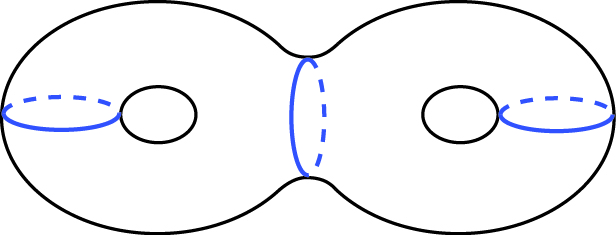
Let S_{g,p} denote the (hyperbolic) surface of genus g and p punchers. There is a unique geodesic loop in each homotopy class. However, given a geodesic loop drew on the surface, how would you describe it to a friend over telephone?

Here we wish to find a canonical way to describe homotopy classes of curves on surfaces. This classical result was originally due to Dehn (unpublished), but discovered independently by Thurston in 1976. For simplicity let’s assume for now that S is a closed surface of genus g.

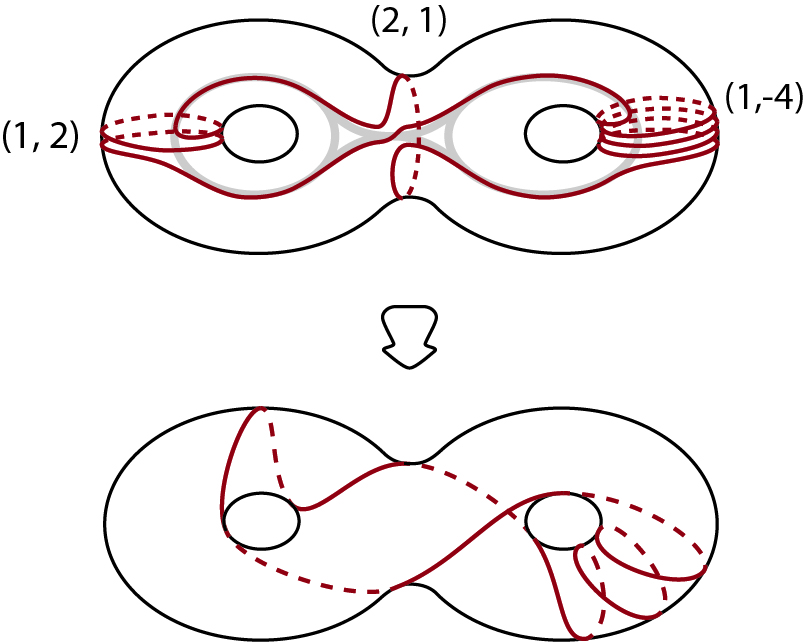
Fix pants decomposition \mathcal{T} of S, \mathcal{T} = \{ \tau_1, \tau_2, \cdots, \tau_{3g-3} \} is a disjoint union of 3g-3 ‘cuffs’.

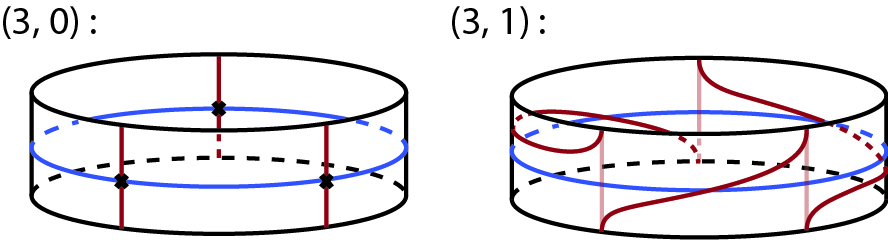
As we can see, any simple closed curve will have an (homology) intersection number with each of the cuffs. Those numbers are non-negative integers:

Around each cuff we may assign an integer twist number, for a cuff with intersection number n and twist number z, we ‘twist’ the curve inside a little neighborhood of the cuff so that all transversal segments to the cuff will have z intersections with the curve.

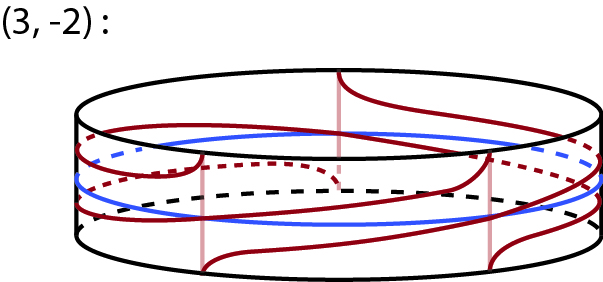
Negative twists merely corresponds to twisting in the other direction:

Theorem: Every simple closed curve is uniquely defined by its intersection number and twisting number w.r.t each of the cuffs.

Conversely, if we consider multi-curves (disjoint union of finitely many simple closed curves) then any element in \mathbb{Z}^{3g-3} \times \mathbb{Z}_{\geq 0}^{3g-3} describes a unique multi-curve.

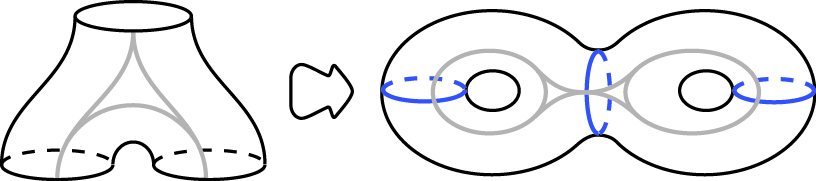
To see this we first assume that the pants decomposition comes with a canonical ‘untwisted’ curve connecting each pairs of cuffs in each pants. (i.e. there is no god given ‘0’ twist curves, hence we have to fix which ones to start with.)

In the example above our curve was homotopic to the curve ((1,2), (2,1), (1,-4)).

In other words, pants decompositions (together with the associated 0-twist arcs) give a natural coordinate chart to the set of homotopy class of (multi) curves on a surface. i.e. they are perimetrized by \mathbb{Z}^{3g-3} \times \mathbb{Z}_{\geq 0}^{3g-3}.

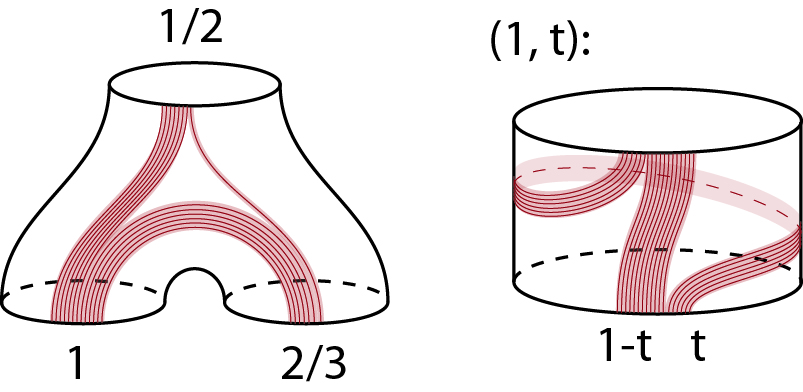
For the converse, we see that any triple of integers can be realized by filling the pants with a unique set of untwisted arcs:

In fact, this kind of parametrization can be generalized from integers to real numbers, in which case we have measured laminations instead of multi-curves and maximal train trucks on each pants instead of canonical untwisted arcs. i.e.

Theorem: (Thurston) The space of measured laminations \mathcal{ML}(S) on a surface S of genus g is parametrized by \mathbb{R}^{3g-3} \times \mathbb{R}_{\geq 0}^{3g-3}. Furthermore, the correspondence is a homeomorphism.

Here the intersection numbers with the cuffs are wrights of the branches of the train track, hence it can be any non-negative real number. The twisting number is now defined on a continuous family of arcs, hence can be any real number, as shown below:

As we can see, just as in the case of multi-curves, any triple of real numbers assigned to the cuffs can be realized as the weights of branches of a train track on the pants.

Gromov boundary of hyperbolic groups

As we have seen in pervious posts, the Cayley graphs of groups equipped with the word metric is a very special class of geodesic metric space – they are graphs that have tons of symmetries. Because of that symmetry, we can’t construct groups with any kind of Gromov boundary we want. In fact, there are only few possibilities and they look funny. In this post I want to introduce a result of Misha Kapovich and Bruce Kleiner that says:

Let G be a hyperbolic group that’s not a semidirect product H \ltimes N where N is finite or virtually cyclic. (In those cases the boundary of G can be obtained from the boundary of H$).

Theorem: When G has 1-dimensional boundary, then the boundary is homeomorphic to either a Sierpinski carpet, a Menger curve or S^1.

OK. So what are those spaces? (don’t worry, I had no clue about what a ‘Menger curve’ is before reading this paper).

The Sierpinski carpet

(I believe most people have seen this one)

Start with the unit square, divide it into nine equal smaller squares, delete the middle one.

Repeat the process to the eight remaining squares.

and repeat…

Of course we then take the infinite intersection to get a space with no interior.

Proposition: The Sierpinski carpet is (covering) 1-dimensional, connected, locally connected, has no local cut point (meaning we cannot make any open subset of it disconnected by removing a point).

Theorem: Any compact metrizable planar space satisfying the above property is a Sierpinski carpet.

The Menger curve

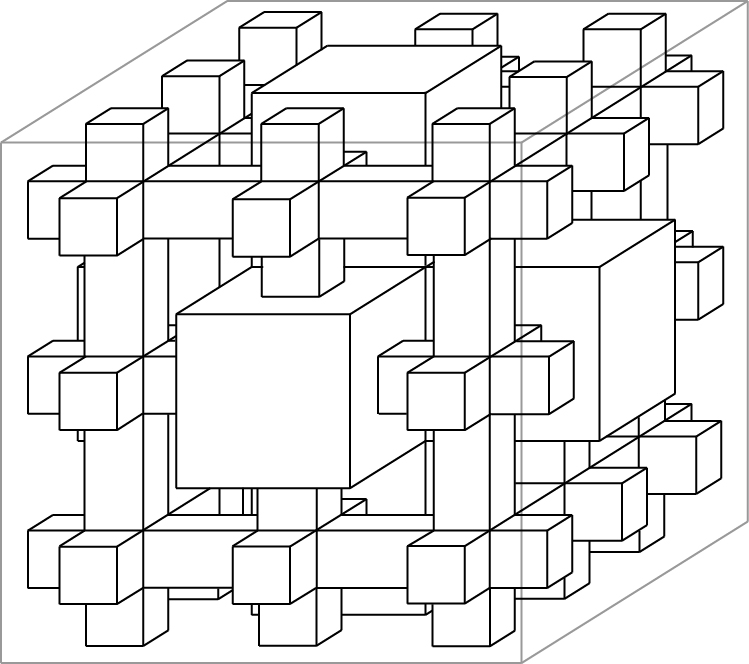
Now we go to \mathbb{R}^3, the Menger curve is the intersection of the Sierpinski carpet times the unit interval, one in each of the x, y, z direction.

Equivalently, we may take the unit cube [0,1]^3, subtract the following seven smaller cubes in the middle:

In the next stage, we delete the middle ‘cross’ from each of the remaining 20 cubes:

Proceed, take intersection.

Proposition: The Menger curve is 1-dimensional, connected, locally connected, has no local cut point.

Note this is one dimensional because we can decompose the ‘curve’ to pieces of arbitrary small diameter by cutting along thin rectangular tubes, meaning if we take those pieces and slightly thicken them there is no triple intersections.

Theorem: Any compact metrizable nowhere planar (meaning no open set of it can be embedded in the plane) space satisfying the above property is a Menger curve.

Now we look at our theorem, infact the proof is merely a translation from the conditions on the group to topological properties of the boundary and then seeing the boundary as a topological space satisfies our universal properties.

A group being Gromov hyperbolic implies the boundary is compact metrizable.

No splitting over finite or virtually cyclic group implies the boundary is connected, locally connected and if it’s not S^1, then it has no local cut point.

Now what remains is to show, for groups, if the boundary is not planar then it’s nowhere planar. This is an easy argument using the fact that the group acts minimally on the boundary.

Please refer to first part of their paper for details and full proof of the theorem.

Remark: When study classical Polish-school topology, I never understood how on earth would one need all those universal properties (i.e. any xxx space is a xxx, usually comes with a long condition include ten or so items >.<). Now I see in fact such thing can be powerful. i.e. sometimes this allows us to actually get a grib on what does some completely unimaginable spaces actually look like!

Another wonderful example of this is the recent work of S. Hensel and P. Przytycki and the even more recent work of David Gabai which shows ending lamination spaces are Nobeling curves.

Stabilization of Heegaard splittings

In the last lecture of a course on Heegaard splittings, professor Gabai sketched an example due to Hass-Thompson-Thurston of two genus g Heegaard splittings of a 3-manifold that requires at least g stabilization to make them equivalent. The argument is, in my opinion, very metric-geometric. The connection is so striking (to me) so that I feel necessary to give a brief sketch of it here.

(Side note: This has been a wonderful class! Although I constantly ask stupid questions and appear to be confused from time to time. But in fact it has been very interesting! I should have talked more about it on this blog…Oh well~)

The following note is mostly based on professor Gabai’s lecture, I looked up some details in the original paper ( Hass-Thompson-Thurston ’09 ).

Recall: (well, I understand that I have not talked about Heegaard splittings and stabilizations here before, hence I’ll *try to* give a one minute definition)

A Heegaard splitting of a 3-manifold M is a decomposition of the manifold as a union of two handlebodies intersecting at the boundary surface. The genus of the Heegaard splitting is the genus of the boundary surface.

All smooth closed 3-manifolds has Heegaard splitting due the mere existence of a triangulation ( by thicken the 1-skeleton of the triangulation one gets a handlebody perhaps of huge genus, it’s easy exercise to see its complement is also a handlebody). However it is of interest to find what’s the minimal genus of a Heegaard splitting of a given manifold.

Two Heegaard splittings are said to be equivlent if there is an isotopy of the manifold sending one splitting to the other (with boundary gluing map commuting, of course).

A stabilization of a Heegaard splitting (H_1, H_2, S) is a surgery on S that adds genus (i.e. cut out two discs in S and glue in a handle). Stabilization will increase the genus of the splitting by 1)

Let M be any closed hyperbolic 3-manifold that fibres over the circle. (i.e. M is F_g \times [0,1] with the two ends identified by some diffeomorphism f: F_g \rightarrow F_g, g\geq 2):

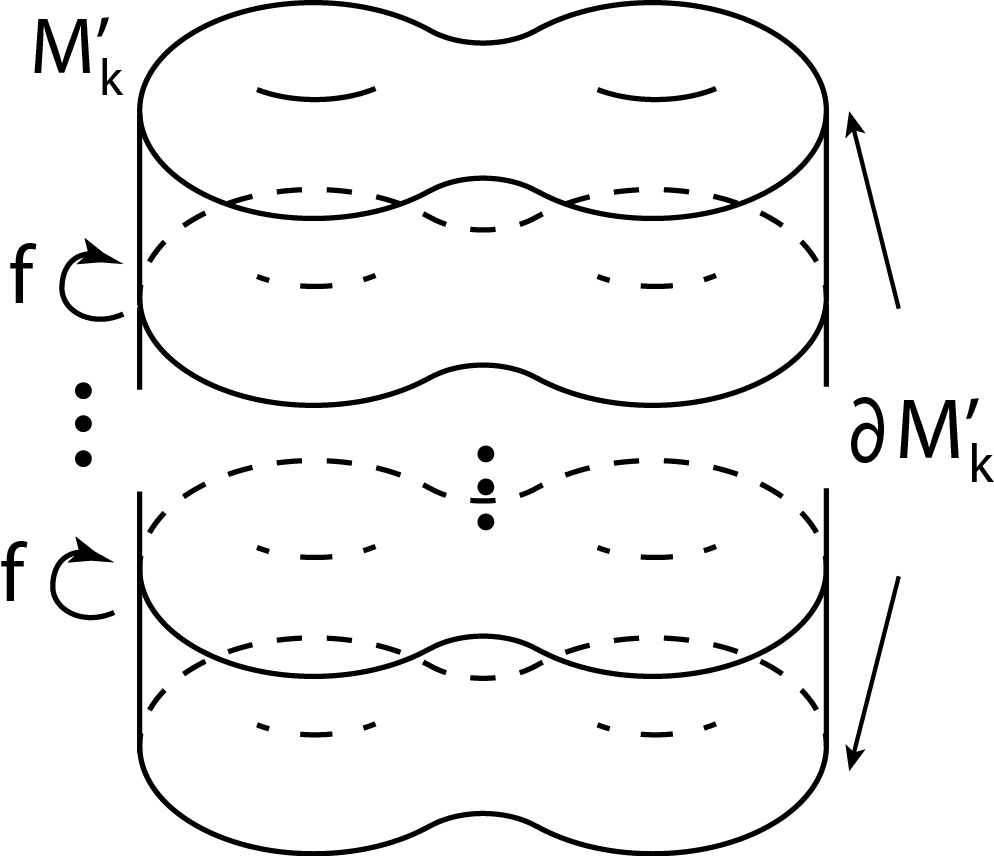
Let M'_k be the k fold cover of M along S^1 (i.e. glue together $k$ copies of F_g \times I all via the map f:

Let M_k be the manifold obtained by cut open M'_k along $F_g$ and glue in two handlebodies H_1, H_2 at the ends:

Since M is hyperbolic, M'_k is hyperbolic. In fact, for any \varepsilon > 0 we can choose a large enough k so that M_k can be equipped with a metric having curvature bounded between 1-\varepsilon and 1+\varepsilon everywhere.

( I’m obviously no in this, however, intuitively it’s believable because once the hyperbolic part M'_k is super large, one should be able to make the metric in M'_k slightly less hyperbolic to make room for fitting in an almost hyperbolic metric at the ends H_1, H_2). For details on this please refer to the original paper. :-P

Now there comes our Heegaard splittings of M_k!

Let k = 2n, let H_L be the union of handlebody H_1 together with the first n copies of M, H_R be H_2 with the last n copies of M. H_L, H_R are genus g handlebodies shearing a common surface S in the ‘middle’ of M_k:

Claim: The Heegaard splitting \mathcal{H}_1 = H_L \cup H_R and \mathcal{H}_2 = H_L \cup H_R cannot be made equivalent by less than g stabilizations.

In other words, first of all one can not isotope this splitting upside down. Furthermore, adding handles make it easier to turn the new higher genus splitting upside down, but in this particular case we cannot get away with adding anything less than g many handles.

Okay, not comes the punchline: How would one possible prove such thing? Well, as one might have imagined, why did we want to make this manifold close to hyperbolic? Yes, minimal surfaces!

Let’s see…Suppose we have a common stabilization of genus 2g-1. That would mean that we can sweep through the manifold by a surface of genus (at most) 2g-1, with 1-skeletons at time 0, 1.

Now comes what professor Gabai calls the ‘harmonic magic’: there is a theorem similar to that of Pitts-Rubinstein

Ingredient #1: (roughly thm 6.1 from the paper) For manifolds with curvature close to -1 everywhere, for any given genus g Heegaard splitting \mathcal{H}, one can isotope the sweep-out so that each surface in the sweep-out having area < 5 \pi (g-1).

I do not know exactly how is this proved. The idea is perhaps try to shrink each surface to a ‘minimal surface’, perhaps creating some singularities harmless in the process.

The ides of the whole arguement is that if we can isotope the Heegaard splittings, we can isotope the whole sweep-out while making the time-t sweep-out harmonic for each t. In particular, at each time there is (at least) a surface in the sweep-out family that divides the volume of M'_n in half. Furthermore, the time 1 half-volume-surface is roughly same as the time 0 surface with two sides switched.

We shall see that the surfaces does not have enough genus or volume to do that. (As we can see, there is a family of genus 2g surface, all having volume less than some constant independent of n that does this; Also if we have ni restriction on area, then even a genus g surface can be turned.)

Ingredient #2: For any constant K, there is n large enough so no surfaces of genus <g and area <K inside the middle fibred manifold with boundary M'_n can divide the volume of M'_n in half.

The prove of this is partially based on our all-time favorite: the isoperimetric inequality:

Each Riemannian metric \lambda on a closed surface has a linear isoperimetric inequality for 1-chains bounding 2-chains, i.e. any homologically trivial 1-chain c bounds a 2 chain z where

\mbox{Vol}_2(z) \leq K_\lambda \mbox{Vol}_1(c).

Fitting things together:

Suppose there is (as described above) a family of genus 2g-1 surfaces, each dividing the volume of M_{2n} in half and flips the two sides of the surface as time goes from 0 to 1.

By ingredient #1, since the family is by construction surfaces from (different) sweep-outs by ‘minimal surfaces’, we have \mbox{Vol}_2(S_t) < 5 \pi (2g-2) for all t.

Now if we take the two component separated by S_t and intersect them with the left-most n copies of M in M'_{2n} (call it M'_L), at some t, S_t must also divide the volume of M'_L in half.

Since S_t divides both M'_2n and M'_L in half, it must do so also in M'_R.

But S_t is of genus 2g-1! So one of S_t \cap M'_L and S_t \cap M'_R has genus < g! (say it's M'_L)

Apply ingredient #2, take K = 5 \pi (2g-2), there is n large enough so that S_t \cap M'_L, which has area less than K and genus less than g, cannot possibly divide M'_L in half.

Contradiction.

A report of my Princeton generals exam

Well, some people might be wondering why I haven’t updated my blog since two weeks ago…Here’s the answer: I have been preparing for this generals exam — perhaps the last exam in my life.

For those who don’t know the game rules: The exam consists of 3 professors (proposed by the kid taking the exam, approved by the department), 5 topics (real, complex, algebra + 2 specialized topics chosen by the student). One of the committee member acts as the chair of the exam.

The exam consists of the three committee members sitting in the chair’s office, the student stands in front of the board. The professors ask questions ranging in those 5 topics for however long they want, the kid is in charge of explaining them on the board.

I was tortured for 4.5 hours (I guess it sets a new record?)
I have perhaps missed some questions in my recollection (it’s hard to remember all 4.5 hours of questions).

Conan Wu’s generals

Commitee: David Gabai (Chair), Larry Guth, John Mather

Topics: Metric Geometry, Dynamical Systems

Real analysis:

Mather: Construct a first category but full measure set.

(I gave the intersection of decreasing balls around the rationals)

Guth: F:S^1 \rightarrow \mathbb{R} 1-Lipschitz, what can one say about its Fourier coefficients.

(Decreasing faster than c*1/n via integration by parts)

Mather: Does integration by parts work for Lipschitz functions?

(Lip imply absolutely continuous then Lebesgue’s differentiation theorem)

Mather: If one only has bounded variation, what can we say?

(f(x) \geq f(0) + \int_0^x f'(t) dt)

Mather: If f:S^1 \rightarrow \mathbb{R} is smooth, what can you say about it’s Fourier coefficients?

(Prove it’s rapidly decreasing)

Mather: Given a smooth g: S^1 \rightarrow \mathbb{R}, given a \alpha \in S^1, when can you find a f: S^1 \rightarrow \mathbb{R} such that
g(\theta) = f(\theta+\alpha)-f(\theta) ?

(A necessary condition is the integral of g needs to vanish,
I had to expand everything in Fourier coefficients, show that if \hat{g}(n) is rapidly decreasing, compute the Diophantine set \alpha should be in to guarantee \hat{f}(n) being rapidly decreasing.

Gabai: Write down a smooth function from f:\mathbb{R}^2 \rightarrow \mathbb{R} with no critical points.

(I wrote f(x,y) = x+y) Draw its level curves (straight lines parallel to x=-y)

Gabai: Can you find a such function with the level curves form a different foliation from this one?

(I think he meant that two foliations are different if there is no homeo on \mathbb{R}^2 carrying one to the other,
After playing around with it for a while, I came up with an example where the level sets form a Reeb foliation, and that’s not same as the lines!)

We moved on to complex.

Complex analysis:

Guth: Given a holomorphic f:\mathbb{D} \rightarrow \mathbb{D}, if f has 50 0s inside the ball B_{1/3}(\bar{0}), what can you say about f(0)?

(with a bunch of hints/suggestions, I finally got f(0) \leq (1/2)^{50} — construct polynomial vanishing at those roots, quotient and maximal modulus)

Guth: State maximal modulus principal.

Gabai: Define the Mobius group and how does it act on \mathbb{H}.

Gabai: What do the Mobius group preserve?

(Poincare metric)

Mather: Write down the Poincare metric, what’s the distance from \bar{0} to 1? (infinity)

(I don’t remember the exact distance form, so I tried to guess the denominator being \sqrt{1-|z|}, but then integrating from 0 to 1 does not “barely diverge”. Turns out it should be (1-|z|^2)^2.)

Gabai: Suppose I have a finite subgroup with the group of Mobius transformations acting on \mathbb{D}, show it has a global fixed point.

(I sketched an argument based on each element having finite order must have a unique fixed point in the interior of \mathbb{D}, if two element has different fixed points, then one can construct a sequence of elements where the fixed point tends to the boundary, so the group can’t be finite.)

I think that’s pretty much all for the complex.

Algebra:

Gabai: State Eisenstein’s criteria

(I stated it with rings and prime ideals, which leaded to a small discussion about for which rings it work)

Gabai: State Sylow’s theorem

(It’s strange that after stating Sylow, he didn’t ask me do anything such as classify finite groups of order xx)

Gabai: What’s a Galois extension? State the fundamental theorem of Galois theory.

(Again, no computing Galois group…)

Gabai: Given a finite abelian group, if it has at most n elements of order divisible by n, prove it’s cyclic.

(classification of abelian groups, induction, each Sylow is cyclic)

Gabai: Prove multiplicative group of a finite field is cyclic.

(It’s embarrassing that I was actually stuck on this for a little bit before being reminded of using the previous question)

Gabai: What’s SL_2(\mathbb{Z})? What are all possible orders of elements of it?

(I said linear automorphisms on the torus. I thought it can only be 1,2,4,\infty, but turns out there is elements of order 6. Then I had to draw the torus as a hexagon and so on…)

Gabai: What’s \pi_3(S^2)?

(\mathbb{Z}, via Hopf fibration)

Gabai: For any closed orientable n-manifold M, why is H_{n-1}(M) torsion free?

(Poincare duality + universal coefficient)

We then moved on to special topics:

Metric Geometry:

Guth: What’s the systolic inequality?

(the term ‘aspherical’ comes up)

Gabai: What’s aspherical? What if the manifold is unbounded?

(I guessed it still works if the manifold is unbounded, Guth ‘seem to’ agree)

Guth: Sketch a proof of the systolic inequality for the n-torus.

(I sketched Gromov’s proof via filling radius)

Guth: Give an isoperimetric inequality for filling loops in the 3-manifold S^2 \times \mathbb{R} where S^2 has the round unit sphere metric.

(My guess is for any 2-chain we should have

\mbox{vol}_1(\partial c) \geq C \mbox{vol}_2(c)

then I tried to prove that using some kind of random cone and grid-pushing argument, but soon realized the method only prove

\mbox{vol}_1(\partial c) \geq C \sqrt{\mbox{vol}_2(c)}.)

Guth: Given two loops of length L_1, L_2, the distance between the closest points on two loops is \geq 1, what’s the maximum linking number?

(it can be as large as c L_1 L_2)

Dynamical Systems:

Mather: Define Anosov diffeomorphisms.

Mather: Prove the definition is independent of the metric.

(Then he asked what properties does Anosov have, I should have said stable/unstable manifolds, and ergodic if it’s more than C^{1+\varepsilon}…or anything I’m familiar with, for some reason the first word I pulled out was structurally stable…well then it leaded to and immediate question)

Mather: Prove structural stability of Anosov diffeomorphisms.

(This is quite long, so I proposed to prove Anosov that’s Lipschitz close to the linear one in \mathbb{R}^n is structurally stable. i.e. the Hartman-Grobman Theorem, using Moser’s method, some details still missing)

Mather: Define Anosov flow, what can you say about geodesic flow for negatively curved manifold?

(They are Anosov, I tried to draw a picture to showing the stable and unstable and finished with some help)

Mather: Define rotation number, what can you say if rotation numbers are irrational?

(They are semi-conjugate to a rotation with a map that perhaps collapse some intervals to points.)

Mather: When are they actually conjugate to the irrational rotation?

(I said when f is C^2, C^1 is not enough. Actually C^1 with derivative having bounded variation suffice)

I do not know why, but at this point he wanted me to talk about the fixed point problem of non-separating plane continua (which I once mentioned in his class).

After that they decided to set me free~ So I wandered in the hallway for a few minutes and the three of them came out to shake my hand.