Well, some people might be wondering why I haven’t updated my blog since two weeks ago…Here’s the answer: I have been preparing for this generals exam — perhaps the last exam in my life.
For those who don’t know the game rules: The exam consists of 3 professors (proposed by the kid taking the exam, approved by the department), 5 topics (real, complex, algebra + 2 specialized topics chosen by the student). One of the committee member acts as the chair of the exam.
The exam consists of the three committee members sitting in the chair’s office, the student stands in front of the board. The professors ask questions ranging in those 5 topics for however long they want, the kid is in charge of explaining them on the board.
I was tortured for 4.5 hours (I guess it sets a new record?)
I have perhaps missed some questions in my recollection (it’s hard to remember all 4.5 hours of questions).
Conan Wu’s generals
Commitee: David Gabai (Chair), Larry Guth, John Mather
Topics: Metric Geometry, Dynamical Systems
Real analysis:
Mather: Construct a first category but full measure set.
(I gave the intersection of decreasing balls around the rationals)
Guth:  1-Lipschitz, what can one say about its Fourier coefficients.
(Decreasing faster than  via integration by parts)
Mather: Does integration by parts work for Lipschitz functions?
(Lip imply absolutely continuous then Lebesgue’s differentiation theorem)
Mather: If one only has bounded variation, what can we say?
( )
)
Mather: If  is smooth, what can you say about it’s Fourier coefficients?
(Prove it’s rapidly decreasing)
Mather: Given a smooth  , given a
  , when can you find a
  such that
 ?
?
(A necessary condition is the integral of  needs to vanish,
I had to expand everything in Fourier coefficients, show that if  is rapidly decreasing, compute the Diophantine set
  should be in to guarantee
  being rapidly decreasing.
Gabai: Write down a smooth function from  with no critical points.
(I wrote  ) Draw its level curves (straight lines parallel to
  )
)
Gabai: Can you find a such function with the level curves form a different foliation from this one?
(I think he meant that two foliations are different if there is no homeo on  carrying one to the other,
After playing around with it for a while, I came up with an example where the level sets form a Reeb foliation, and that’s not same as the lines!)
We moved on to complex.
Complex analysis:
Guth: Given a holomorphic  , if
, if  has
has 
 s inside the ball
  , what can you say about
  ?
?
(with a bunch of hints/suggestions, I finally got  — construct polynomial vanishing at those roots, quotient and maximal modulus)
Guth: State maximal modulus principal.
Gabai: Define the Mobius group and how does it act on  .
.
Gabai: What do the Mobius group preserve?
(Poincare metric)
Mather: Write down the Poincare metric, what’s the distance from  to
to  ? (infinity)
(I don’t remember the exact distance form, so I tried to guess the denominator being  , but then integrating from to does not “barely diverge”. Turns out it should be
  .)
.)
Gabai: Suppose I have a finite subgroup with the group of Mobius transformations acting on  , show it has a global fixed point.
(I sketched an argument based on each element having finite order must have a unique fixed point in the interior of , if two element has different fixed points, then one can construct a sequence of elements where the fixed point tends to the boundary, so the group can’t be finite.)
I think that’s pretty much all for the complex.
Algebra:
Gabai: State Eisenstein’s criteria
(I stated it with rings and prime ideals, which leaded to a small discussion about for which rings it work)
Gabai: State Sylow’s theorem
(It’s strange that after stating Sylow, he didn’t ask me do anything such as classify finite groups of order xx)
Gabai: What’s a Galois extension? State the fundamental theorem of Galois theory.
(Again, no computing Galois group…)
Gabai: Given a finite abelian group, if it has at most  elements of order divisible by , prove it’s cyclic.
(classification of abelian groups, induction, each Sylow is cyclic)
Gabai: Prove multiplicative group of a finite field is cyclic.
(It’s embarrassing that I was actually stuck on this for a little bit before being reminded of using the previous question)
Gabai: What’s  ? What are all possible orders of elements of it?
(I said linear automorphisms on the torus. I thought it can only be  , but turns out there is elements of order
  . Then I had to draw the torus as a hexagon and so on…)
Gabai: What’s  ?
?
( , via Hopf fibration)
Gabai: For any closed orientable -manifold  , why is
  torsion free?
(Poincare duality + universal coefficient)
We then moved on to special topics:
Metric Geometry:
Guth: What’s the systolic inequality?
(the term ‘aspherical’ comes up)
Gabai: What’s aspherical? What if the manifold is unbounded?
(I guessed it still works if the manifold is unbounded, Guth ‘seem to’ agree)
Guth: Sketch a proof of the systolic inequality for the n-torus.
(I sketched Gromov’s proof via filling radius)
Guth: Give an isoperimetric inequality for filling loops in the 3-manifold  where
where  has the round unit sphere metric.
(My guess is for any 2-chain we should have

then I tried to prove that using some kind of random cone and grid-pushing argument, but soon realized the method only prove
 .)
.)
Guth: Given two loops of length  , the distance between the closest points on two loops is
  , what’s the maximum linking number?
(it can be as large as  )
)
Dynamical Systems:
Mather: Define Anosov diffeomorphisms.
Mather: Prove the definition is independent of the metric.
(Then he asked what properties does Anosov have, I should have said stable/unstable manifolds, and ergodic if it’s more than  …or anything I’m familiar with, for some reason the first word I pulled out was structurally stable…well then it leaded to and immediate question)
Mather: Prove structural stability of Anosov diffeomorphisms.
(This is quite long, so I proposed to prove Anosov that’s Lipschitz close to the linear one in  is structurally stable. i.e. the Hartman-Grobman Theorem, using Moser’s method, some details still missing)
Mather: Define Anosov flow, what can you say about geodesic flow for negatively curved manifold?
(They are Anosov, I tried to draw a picture to showing the stable and unstable and finished with some help)
Mather: Define rotation number, what can you say if rotation numbers are irrational?
(They are semi-conjugate to a rotation with a map that perhaps collapse some intervals to points.)
Mather: When are they actually conjugate to the irrational rotation?
(I said when is  ,
,  is not enough. Actually with derivative having bounded variation suffice)
I do not know why, but at this point he wanted me to talk about the fixed point problem of non-separating plane continua (which I once mentioned in his class).
After that they decided to set me free~ So I wandered in the hallway for a few minutes and the three of them came out to shake my hand.
40.343599
-74.651774


![F_g \times [0,1]](https://s0.wp.com/latex.php?latex=F_g+%5Ctimes+%5B0%2C1%5D&bg=ffffff&fg=5e5e5e&s=0&c=20201002)


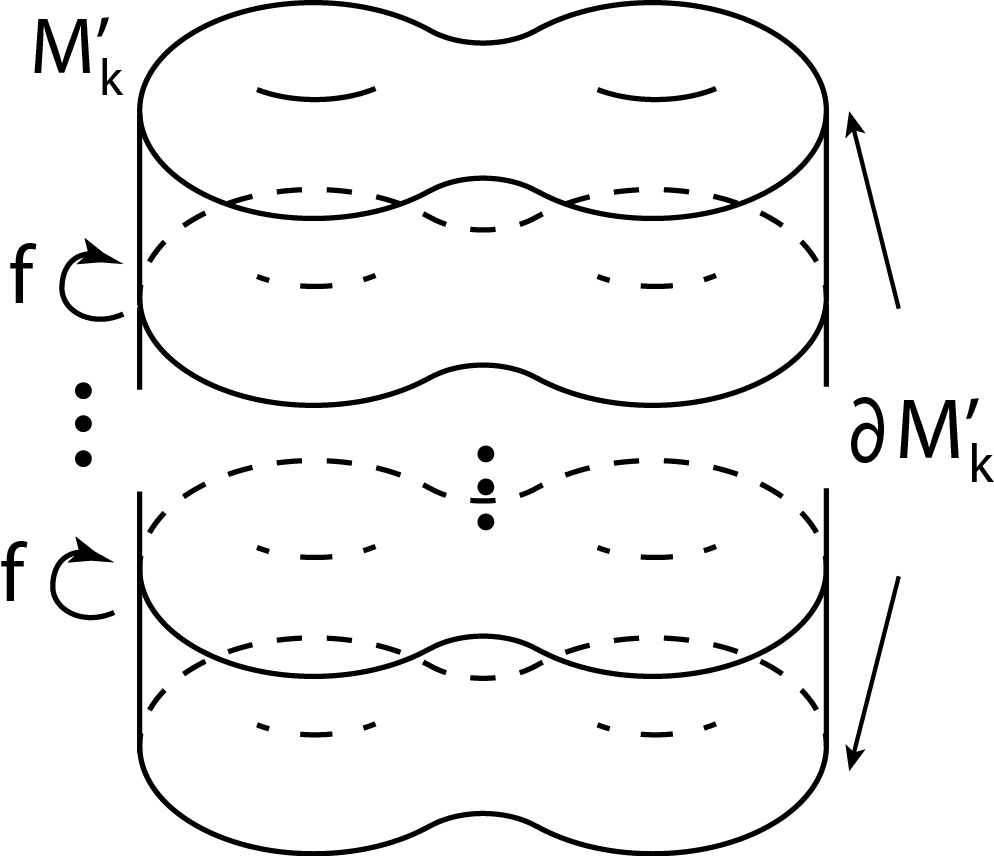











 extends continuously to
  and the image
  is homotopically non-trivial in
  . Then in any neighborhood
  we can find embedded disc
  such that
  is still homotopically non-trivial in
 has
has  then
then  , consider
  , boundary of
  .
. be a loop homotopic to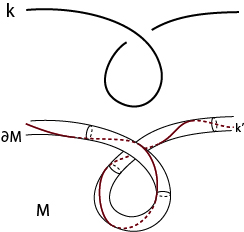
 and any loop in
  . Hence the inclusion map
  is surjective.
 be the little loop winding around
 generates
  . Hence there exists
  in
in  ,
,  is homotopically trivial in
  .
.

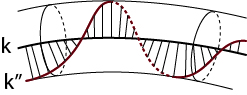
 hence
hence  , the distortion of
  is defined as
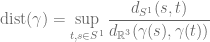 .
. , define the distortion of
 where
where  ?
? , we have
 in
in  (say the surface obtained by rotating the unit circle centered at
  around the
 knot looks like:
 that carries the standard
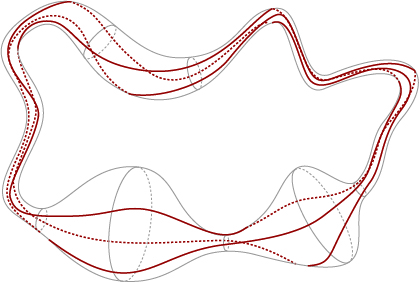
 by
by  by
by  , w.l.o.g. we also suppose
  .
.  is inessential if it contains no homotopically non-trivial loop on
  times. (hence the same holds for the embedded copy
  ).
). (they have at least
  intersections with
![C = U \times [z_1, z_2]](https://s0.wp.com/latex.php?latex=C+%3D+U+%5Ctimes+%5Bz_1%2C+z_2%5D&bg=ffffff&fg=5e5e5e&s=0&c=20201002) where
where  is in the
  -plane, let
  we have:


 , we find an embedding
  .
. , let
, let  is inessential
 as the smallest radius around
  so that the whole ‘genus’ of
  .
. is a positive Lipschitz function on
  where
where  is at the origin and
  .
. (and note distortion is invariant under scaling), we have

![R \in [1, \frac{11}{10}]](https://s0.wp.com/latex.php?latex=R+%5Cin+%5B1%2C+%5Cfrac%7B11%7D%7B10%7D%5D&bg=ffffff&fg=5e5e5e&s=0&c=20201002) where the intersection number is less or equal to the average. i.e.
where the intersection number is less or equal to the average. i.e. 
 .
.![C_z = B(\bar{0},R) \cap \{z \in [-\frac{1}{10}, \frac{1}{10}] \}](https://s0.wp.com/latex.php?latex=C_z+%3D+B%28%5Cbar%7B0%7D%2CR%29+%5Ccap+%5C%7Bz+%5Cin+%5B-%5Cfrac%7B1%7D%7B10%7D%2C+%5Cfrac%7B1%7D%7B10%7D%5D+%5C%7D&bg=ffffff&fg=5e5e5e&s=0&c=20201002) , since
, since
![z_0 \in [-\frac{1}{10}, \frac{1}{10}]](https://s0.wp.com/latex.php?latex=z_0+%5Cin+%5B-%5Cfrac%7B1%7D%7B10%7D%2C+%5Cfrac%7B1%7D%7B10%7D%5D&bg=ffffff&fg=5e5e5e&s=0&c=20201002) s.t.
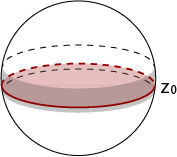
s.t.  . As in the pervious post, we call
  a ‘neck’ and the solid upper and lower ‘hemispheres’ separated by the neck are
  .
. 
 is inessential.
 of the sphere
  :
: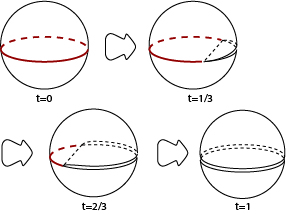
 is a sphere; at
  it splits to two spheres. (the space between the upper and lower halves is only there for easier visualization)
 is monotonically increasing. Since
  , it increases no more than
  .
. is inessential then
  is also inessential. (to ‘cut through the genus’ requires at least
  many interesections)
 is disconnected, the ‘genus’ can only lie in one of the spheres, we have one of
  direction, i.e.cutting the hemisphere in half in
  direction, then the
  -direction:
 many intersections, hence has inessential complement.
 ball with each side having length at most
  , this shape certainly lies inside some ball of radius
  .
.
 is inessential. i.e.
 be a simply connected Jordan domain in
  .
.  is a conformal factor on
 (
( is an interval) with
  , we have the length of
  .
.  on
on  .
. of rectifiable curves in
  ), each comes with a unit speed parametrization. Consider the “
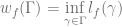 .
. be the set of conformal factors
  norm
norm 
 instead of
  since it’s called a “length”…but since the standard notion is to sup over all
  bi-holomorphic, then for any set of normalized curves
  after renormalizing curves in
  we have:
 the length might blow up when the curve approach
  this case should be treated with more care)
 by having
 (merely change of variables).
 for any rectifiable curve.
  .
. is a bijection from
  to
to  , deducing
 ,
, ![\{0\} \times [0, 1/w]](https://s0.wp.com/latex.php?latex=%5C%7B0%5C%7D+%5Ctimes+%5B0%2C+1%2Fw%5D&bg=ffffff&fg=5e5e5e&s=0&c=20201002) , ending on
, ending on ![\{1\} \times [0, 1/w]](https://s0.wp.com/latex.php?latex=%5C%7B1%5C%7D+%5Ctimes+%5B0%2C+1%2Fw%5D&bg=ffffff&fg=5e5e5e&s=0&c=20201002) with finite length. Then
with finite length. Then  and the Euclidean metric
  is an extremal metric.
 has at least one horizontal line segment
 ![\gamma_y = [0,w] \times \{y\}](https://s0.wp.com/latex.php?latex=%5Cgamma_y+%3D+%5B0%2Cw%5D+%5Ctimes+%5C%7By%5C%7D&bg=ffffff&fg=5e5e5e&s=0&c=20201002) with
with  . (Because if so,
  and we know
  for the Euclidean length)
 over
over 



 be a finite planar graph with vertex set
  and edges
  . For each vertex
  we assign a simply connected domain
  .
. so that
  form a packing (i.e. are disjoint) and the contact graph of
  . (i.e.
  iff
iff  .
. Area777