On Whitehead-type manifolds

As I was trying to understand the Whitehead manifold and related constructions of non-tame manifolds batter, I guess it makes a cool blog post ^^

The Whitehead manifold is an example of a 3-manifold that’s contractable but not homeomorphic to \mathbb{R}^3 i.e. the manifold is homotopically equivalent to a point but not tame. (See the earlier post on tameness for more explanations)

Construction:
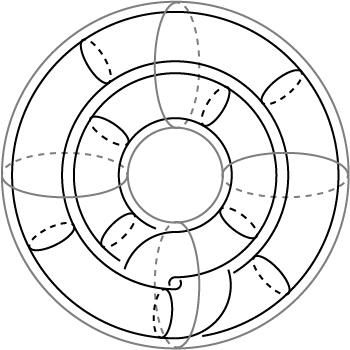
Take a solid torus T_1 \subseteq \mathbb{R}^3, embed a thinner torus T_2 \subseteq T_1 as shown:

Iterate the process: at each step, embed solid torus T_i into T_{i-1} so that T_i “links with itself” inside T_{i-1}:

Let the Whitehead continuum be the intersection of the T_is.

i.e. \displaystyle W=\bigcap_{i=1}^\infty T_i

As some people know, I have a weird hobby of describing strange continua in terms of Cantor sets…So here comes ‘Conan’s translation’ of the Whitehead continuum:

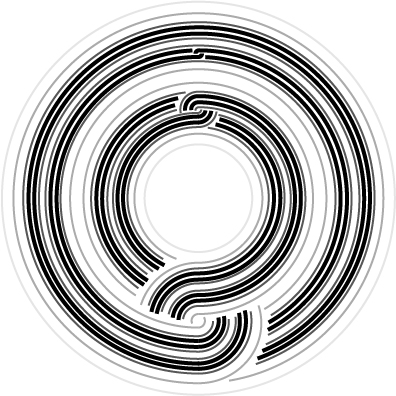
Take two copies of C \times [0,1] where C is the standard middle-third Cantor set. Bend them into Rainbow-shape with the open ends facing each other:

(I think of this as having a width 1 ‘brush’ with ink only on the points of the Cantor set, and use the brush to draw two semicircles)

Now we connect the open ends: take a width 1/3 brush and connect the top pair of ends so that they link with each other, and then a width 1/9 brush for the highest remaining pair, etc. Take the union of all those connecting sets, union a line segment joining the bottom-most pair of points, we get the Whitehead continuum:

The Whitehead manifold is the complement of W in the three-sphere \mathbb{S}^3, equipped with the

What’s the fundamental group of the Whitehead manifold?

Claim: T_i^c is null-homotopic in T_{i+1}^c.

pf: T_1^c is contractible to a loop in T_{i+1}^c, hence it suffice to homotope the red loop to a point without touching the black loop:

Note that for homotopy, the loop is allowed to pass through itself: (in contrast to isotopy)

The loop can now be easily contracted:

Hence we deduce the Whitehead manifold is null-homotopic. (by collapsing each T_1 at some finite time)

In particular, it has trivial fundamental group! (This might seem hard to believe especially when looking at my Cantor-set picture) Infact for this, we can directly see from the picture that all loop can be homotoped to constant:

Since loop is compact, there is a ‘finest gap’ in the Cantor set which the loop passes through, say it’s a gap with width 1/3^i. Now by performing the operation above, we can homotope all parts of the loop that goes through the 1/3^i to segments that goes through 1/3^{i-1}-gaps, by having the segments crossing themselves once. Now we pass to the 1/3^{i-2}-gaps, etc. until the loop lie completely outside the thickened disc which the continua lies in. Once it’s outside the disc, the loop can be contracted.

The manifold is not homeomorphic to \mathbb{R}^3 as we can easily see that, unlike in \mathbb{R}^3, the red loop in picture cannot be isotoped to a trivial loop.

As an alternative point of view, we should note that in fact T_i^c and T_{i+1} form a thickened Whitehead link:

Since the Whitehead link is symmetric, this gives an simpler (but less direct, in my opinion) way of knowing that red loop is homotopically trivial in the complement of the black loop. (As the black loop is obviously homotopically trivial in the complement of the red loop.)

In light of this, one may construct many different non-tame manifolds with finitely generated fundamental group by embedding a handlebody inside another copy of itself and take the complement of the infinite intersection.

Here is an example of embedding a genus 3 handlebody. The resulting manifold (after taking the complement of the intersection) is a homotopy genus 2 handlebody. (As in the whitehead case, T_i^c can be homotoped to a genus 2 handlebody inside T_{i+1}^c. The ‘third loop’ can be unknotted by crossing itself once.) But it’s of coruse not homeomorphic to the genus 2 handlebody.

Proving the tameness conjecture

I have recently went through professor Gabai’s wonderful paper that gives a proof of the tameness conjecture. (This one is a simplified version of the argument given in Gabai and Calegari, where everything is done in the smooth category instead of PL). It’s been a quite exciting reading with many amazing ideas, hence I decided to write a summary from my childish viewpoint (as someone who knew nothing about the subject beforehand).

We say a manifold is tame if it an be embedded in a compact manifold s.t. the closure of the embedding is the whole compact manifold.

To motivate the concept, let’s look at surfaces: Any compact surface is, of course, tame. However, if we “shoot out” a few points of the surface to infinity, as the figure below, it become non-compact but still tame, as we can embed the infinite tube to a disk without a point.

Of course, we can also make a surface non-compact by shooting any closed subset to infinity (e.g. a Cantor set), but such construction will always result in a tame surface. (This can be realized using similar embeddings as above, we may embed the resulting surface into the original surface with image being the original surface subtract the closed set. If the closed set has interior, we further contract each interior components.)

On the other hand, any surface with infinite genus would be non-tame since if there is an embedding into a compact set, the image of ‘genesis’ would have limit points, which will force the compact space fail to be a manifold at that point.

Hence in spirit, being tame means that although the manifold may not be compact itself, but all topology happens in bounded regions (we can think of a complete embedding of the manifold into some \mathbb{R}^N so bounded make sense)

As usual, life gets more complicated for three-manifolds.

Tameness conjecture: Every complete hyperbolic 3-manifold with finitely generated fundamental group is tame.

A bubble chart for capturing the structure of the proof:

A few highlights of the proof: The key idea here is shrinkwrapping, very roughly speaking, to prove an geometrically infinite end is tame one needs to find a sequence of simplicial hyperbolic surfaces exiting at the end. Bonahon’s theorem gives us a sequence of closed geodesics exiting the end. By various pervious results, one is able to produce (topological) surfaces that are ‘in between’ those geodesics. Shrinkwrapping takes the given surface and shrinks it until it’s ‘tightly wrapped’ around the given sequence of geodesics. The fact that each of the curve the surface is wrapping around is a geodesic guarantees the resulting surface simplicial hyperbolic. (think of this as folding a piece of paper along a curve would effect its curvature, but alone a straight line would not; geodesics are like straight lines).

Once we have that, the remaining part would be showing the position of the surfaces are under control so that they would exit the end. Since simplicial hyperbolic surfaces has curvature \leq -1, by Gauss-Bonnet they have uniformly bounded area (given our surfaces also has bounded genus). By passing to a subsequence, we may choose the sequence of geodesics to be separated by some uniform constant, which will guarantee the wrapped surfaces are not too thin in the thick parts of the manifold, hence we have control over the diameter of the surface, from which we can conclude that the surfaces must exit the manifold.

Remark: Note that in general, unlike in two dimensions, a three manifold with finitely generated fundamental group does not need to be tame as the Whitehead manifold is homotopic to \mathbb{R}^3 (hence trivial fundamental group) but is not tame. On the other hand, if we have infinitely generated fundamental group, then the manifold can never be tame. The theorem says all examples of non-tame manifolds with finitely generated fundamental group does not admit hyperbolic structure.

Fibering the figure-8 knot complement over the circle

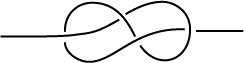
As I was making some false statements about how I think geometrically finite ends of a hyperbolic three manifold would look like, professor Gabai pointed out this super cool fact (proved by Cannon and Thurston, 2007) that the figure-eight knot complement admits a hyperbolic structure and fibers over the circle, but if we lift any fiber (which would be a surface) into the hyperbolic 3-space, the resulting surface would be an embedded topological disc with limit set being the whole limit 2-sphere (!) i.e. if we see \mathbb{H}^3 as a Euclidean open ball, then the boundary of such a disc is a Peano curve that covers the whole 2-sphere bounding \mathbb{H}^3.
I have read about the hyperbolic structure on the figure-8 knot complement in Thurston’s notes (4.3) (A similar construction can be found in my pervious post about hyperbolic structure on the Whitehead link complement), but I didn’t know the fibering over circle part, so I decided to figure out what this fibration would look like.

After playing with chicken wire and playdo for a few days, I am finally able to visualize the fibration. Here I want to point out a few simple points discovered in the process.

Start with the classical position of the figure-8 knot (two ends extends to infinity and meet at the point infinity in \mathbb{S}^3):

To find a fibration over the circle, we need to give a surface that spans the knot (such surface is called a Seifert surface) and a homotopy of the surface \varphi: S \times [0,1] \rightarrow \mathbb{S}^3 \backslash K which restricts to a bijection from S \times [0,1) to \mathbb{S}^3 \backslash K and \varphi(S\times\{1\}) = \varphi(S\times\{0\}).

For quite some time, I tried with the following surface:

Since it’s perfectly symmetric (via a rotation by \pi), we only need to produce a homotopy that sends S to the symmetric Seifert surface in the upper half plane. I was not able to find one. (I’m still curious if there is such homotopy, if so, then there are more than one way the knot complement can fiber)

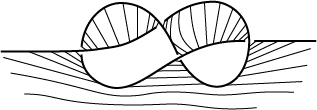
It turns out that there are in fact non-homeomorphic (hence of course non-homotopic) Seifert surfaces spanning the knot, the one I end up using for the fibration is the following surface:

Or equivlently, we may connect the two ends at a finite point.

To see the boundary is indeed the figure-8 knot:

Note that this surface is not homeomorphic to the pervious one because this one is orientable and the pervious is not.

Now I’ll leave it as a brain exercise to see the homotopy. (well…this is largely because it takes forever to draw enough pictures for expressing that) A hint on how the it goes: think of the homotopy as a continuous family of disjoint Seifert surfaces that ‘swipes through’ the whole \mathbb{S}^3 \backslash K and returns to the initial one. As in the picture above, our surface is like a disc with two intertwined stripe handles on it, each handle is two twists in it. The major step is to see that one can ‘pass’ the disc through a double-twisted handle by making the interior of the old disc to become the interior of the new handle. i.e. we can homotope the bowl from under the strap to above the strap with a family of disjoint surfaces with same boundary.

In in figure-8 knot case, the disc would need to pass through both straps and return to itself.