On C^1 closing lemma

Let f: M \rightarrow M be a diffeomorphism. A point p is non-wandering if for all neighborhood U of p, there is increasing sequence (n_k) \subseteq \mathbb{N} where U \cap f^{n_k}(U) \neq \phi. We write p \in \mathcal{NW}(f).

Closing lemma: For any diffeomorphism f: M \rightarrow M, for any p \in \mathcal{NW}(f). For all \varepsilon>0 there exists diffeomorphism g s.t. ||f-g||_{C^1} < \varepsilon and g^N(p) = p for some N \in \mathbb{N}.

Suppose p \in \mathcal{NW}(f), \overline{\mathcal{O}(p)} is compact, then for any \varepsilon>0, there exists x_0 \in B(p, \varepsilon), k \in \mathbb{N} s.t. f^k(x) \in B(p, \varepsilon).

First we apply a selection process to pick an appropriate almost-orbit for the closing. Set x_i = f^i(x_0), \ 0 \leq i \leq k.

If there exists 0 < j < k where

\min \{ d(x_0, x_j), d(x_j, x_k) \} < \sqrt{\frac{2}{3}}d(x_0, x_k)

then we replace the origional finite sequence by (x_0, x_1, \cdots, x_j) or (x_j, \cdots, x_k). Iterate the above process. since the sequence is at least one term shorter after each shortening, the process stops in finite time. We obtain final sequence (p_0, \cdots, p_n) s.t. for all 0 < i < n,

\min \{ d(p_0, p_i), d(p_i, p_n) \} \geq \sqrt{\frac{2}{3}}d(p_0, p_n).

Since the process is applied at most k times, x_0, x_k \in B(p, \varepsilon), after the first shortening, d(p, x_{i_1}) \leq \max \{d(p, x_0), d(p, x_k) \} + \sqrt{\frac{2}{3}}d(x_0, x_k) \leq \varepsilon +  2 \sqrt{\frac{2}{3}} \varepsilon.

i.e. both initial and final term of the sequence is at most (\frac{1}{2}+ \sqrt{\frac{2}{3}}) 2 \varepsilon. Along the same line, we have, at the i-th shortening, the distance between the initial and final sequence and p is at most (\frac{1}{2} + \sqrt{\frac{2}{3}} + (\sqrt{\frac{2}{3}})^2 + \cdots (\sqrt{\frac{2}{3}})^i) 2 \varepsilon. Hence for the final sequence p_0, p_n \in B(p, 1+2 \sqrt{\frac{2}{3}}/(1-\sqrt{\frac{2}{3}}) \varepsilon) \subseteq B(p, 10 \varepsilon).

There is a rectangle R \subseteq M where p_0, p_n \in \sqrt{\frac{3}{4}}R
(i.e. shrunk R by a factor of \sqrt{\frac{3}{4}} w.r.t. the center) and for all 0 < i < n, \ p_i \notin R.

Next, we perturb f in R i.e. find h: M \rightarrow M with ||h||_{C^1} < \delta and h|_{M \backslash R} = id. Hence ||h \circ f - f ||_{C^1} < \delta.

Suppose R = I_1 \times I_2; L_1, L_2 are the lengths of I_1, I_2, L_1 < L_2.
By main value theorem, for all x \in M, \ d(x, h(x)) < \delta L_1.
On the other hand, since p_0 \in \sqrt{\frac{3}{4}}R, it's at least \frac{1}{2}(1-\sqrt{\frac{3}{4}})L_1 away from the boundary of R. i.e. there exists bump function h satisfying the above condition and d(p_0, h(p_0)) > \frac{\delta}{8}(1-\sqrt{\frac{3}{4}})L_1.

Hence in order to move a point by a distance L_1, we need about 1/ \delta such bump functions, to move a distance L_2, we need about \frac{L_2}{\delta L_1} bumps.

For simplicity, we now suppose M is a surface. By starting with an \varepsilon (and hence R) very small, we have for all 0 \leq i \leq N+M, \ f^i(R) is contained in a small neighbourhood of p_i. Hence on f^i(B), f^i is C^1 close to the linear map p_i + Df^i(p_0)(x-p_0). Hence mod some details we may reduce to the case where f is linear in a neighborhood of \mathcal{O}(p_0).

By choosing appropiate coordinate system in R, we can have f preserving the horizontal and vertical foliations and the horizontal vectors eventually grow more rapidly than the vertical vectors.

It turns out to be possible to choose R to be long and thin such that for all i \leq 40 / \delta, f^i(R) has height greater than width. (note that M = \lfloor 40/ \delta \rfloor bumps will be able to move the point by a distance equal to the width of the original rectangle R. Since horizontal vectors eventually grow more rapidly than the vertical vectors, there exists N s.t. for all N \leq i \leq N+M, f^i(R) has width greater than its height.
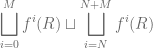
For small enough \epsilon, the boxes f^i(R) are disjoint for 0 \leq i \leq N+40/ \delta. Construct h to be identity outside of

\displaystyle \bigsqcup_{i=0}^M f^i(R) \sqcup \bigsqcup_{i=N}^{N + M} f^i(R)

For the first M boxes, we let h preserve the horizontal foliation and move along the width so that g = h \circ f has the property that g^M(p_n) lies on the same vertical fiber as f^M(p_0).

On the boxes f^{N+i}(R), \ 0 \leq i \leq M, we let h pushes along the vertical direction so that

g^{N+M}(p_n) = f^{N+M}(p_0)

Since iterates of the rectangle are disjoint, for N+M \leq i \leq n, \ h(p_i) = p_i, g(p_i) = f(p_i).

Hence g^n(p_n) = g^{n-(N+M)} \circ g^{N+M}(p_n) = g^{n-(N+M)} f^{N+M}(p_0) = g^{n-(N+M)} (p_{N+M}) = p_n.

Therefore we have obtained a periodic point p_n of g.

Since p_n \in B(p, 10 \varepsilon), we may further perturb g to move p_n to p. This takes care of the linear case on surfaces.

On compact extensions

This is again a note on my talk in the Szemerédi’s theorem seminar, going through Furstenberg’s book. In this round, my part is to introduce compact extension.
Let \Gamma be an abelian group of measure preserving transformations on (X, \mathcal{B}, \mu), \alpha: (X, \mathcal{B}, \mu, \Gamma) \rightarrow ( Y, \mathcal{D}, \nu, \Gamma') be an extension map.
i.e. \alpha: X \rightarrow Y s.t. \alpha^{-1} sends \nu-0 sets to \mu-0 sets;

\gamma'\circ \alpha (x) = \alpha \circ \gamma (x)

Definition: A sequence of subsets (I_k) of \Gamma is a Folner sequence if |I_k| \rightarrow \infty and for any \gamma \in \Gamma,

\frac{| \gamma I_k \Delta I_k|}{|I_k|} \rightarrow 0

Proposition: For any Folner sequence I = (I_k) of \Gamma, for any f \in L^1(X), \displaystyle \frac{1}{|I_k|} \sum_{\gamma \in I_k} \gamma f converges weakly to the orthogonal projection of f onto the subspace of \Gamma-invariant functions. (Denoted P(f) where P: L^2(X) \rightarrow L^2_{inv}(X).

Proof: Let \mathcal{H}_0 = P^{-1}(\bar{0}) = (L^2_{inv}(X))^\bot
For all \gamma \in \Gamma,

\gamma (L^2_{inv}(X)) \subseteq L^2_{inv}(X)

Since \Gamma is \mu-preserving, \gamma is unitary on L^2(X). Therefore we also have \gamma( \mathcal{H}_0) \subseteq \mathcal{H}_0.

For f \in \mathcal{H}_0, suppose there is subsequence (n_k) where \displaystyle \frac{1}{|I_{n_k}|} \sum_{\gamma \in I_{n_k}} \gamma (f) converges weakly to some g \in L^2(X).

By the property that \frac{| \gamma I_k \Delta I_k|}{|I_k|} \rightarrow 0, we have for each \gamma \in \Gamma, \gamma(g) = g, \ g is \Gamma-invariant. i.e. g \in (\mathcal{H}_0)^\bot

However, since f \in \mathcal{H}_0 hence all \gamma(f) are in \mathcal{H}_0 hence g \in  \mathcal{H}_0. Therefore g \in \mathcal{H}_0 \cap (\mathcal{H}_0)^\bot, g=\bar{0}

Recall: 1)X \times_Y X := \{ (x_1, x_2) \ | \ \alpha(x_1) = \alpha(x_2) \}.

i.e. fibred product w.r.t. the extension map \alpha: X \rightarrow Y.

2)For H \in L^2(X \times_Y X), \ f \in L^2(X),

(H \ast f)(x) = \int H(x_1, x_2) f(x_2) d  \mu_{\alpha(x_1)}(x_2)

Definition: A function f \in L^2(X) is said to be almost periodic if for all \varepsilon > 0, there exists g_1, \cdots g_k \in L^2(X) s.t. for all \gamma \in \Gamma and almost every y \in Y,

\displaystyle \min_{1 \leq i \leq k} || \gamma (f) - g_i||_y < \varepsilon

Proposition: Linear combination of almost periodic functions are almost periodic.

Proof: Immediate by taking all possible tuples of g_i for each almost periodic function in the linear combination corresponding to smaller \varepsilonl.

Definition: \alpha: (X, \mathcal{B}, \mu, \Gamma) \rightarrow ( Y, \mathcal{D}, \nu, \Gamma') is a compact extension if:

C1: \{ H \ast f \ | \ H \in L^\infty (X \times_Y X) \cap \Gamma_{inv} (X \times_Y X), f \in L^2(X) \} contains a basis of L^2(X).

C2: The set of almost periodic functions is dense in L^2(X)

C3: For all f \in L^2(X), \ \varepsilon, \delta > 0, there exists D \subseteq Y, \ \nu(D) > 1- \delta, \  g_1, \cdots, g_k \in L^2(X) s.t. for any \gamma \in \Gamma and almost every y \in Y, we have

\displaystyle \min_{1 \leq i \leq k} || \gamma (f)|_{f^{-1}(D)} - g_i||_y < \varepsilon

C4: For all f \in L^2(X), \ \varepsilon, \delta > 0, there exists g_1, \cdots, g_k \in L^2(X) s.t. for any \gamma \in \Gamma, there is a set D \subseteq Y, \ \nu(D) > 1- \delta, for all y \in D

\displaystyle \min_{1 \leq i \leq k} || \gamma (f) - g_i||_y < \varepsilon

C5: For all f \in L^2(X), let \bar{f} \in L^1(X \times_Y X) where

\bar{f}: (x_1, x_2) \mapsto f(x_1) \cdot f(x_2)

Let I=(I_k) be a Folner sequence, then \bar{f}=\bar{0} iff P \bar{f} = \bar{0}.

Theorem: All five definitions are equivalent.

Proof: “C1 \Rightarrow C2″

Since almost periodic functions are closed under linear combination, it suffice to show any element in a set of basis is approximated arbitrarily well by almost periodic functions.

Let our basis be as given in C1.

For all H \in L^\infty (X \times_Y X) \cap \Gamma_{inv} (X \times_Y X), the associated linear operator \varphi_H: L^2(X) \rightarrow L^2(X) where \varphi_H: f \mapsto H \ast f is bounded. Hence it suffice to check H \ast f for a dense set of f \in L^2(X). We consider the set of all fiberwise bounded f i.e. for all y \in Y, ||f||_y \leq M_y.

For all \delta > 0, we perturb H \ast f by multiplying it by the characteristic function of a set of measure at least 1- \delta to get an almost periodic function.

“C2 \Rightarrow C3″:

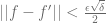
For any f \in L^2(X), there exists f' almost periodic, with ||f-f'||< \frac{\epsilon \sqrt{\delta}}{2} . Let \{ g_1, g_2, \cdots, g_{k-1} \} be the functions obtained from the almost periodicity of f' with constant \varepsilon/2, g_k = \bar{0}.

Let D = \{ y \ | \ ||f-f'||_y < \varepsilon/2 \}, since

|| f - f'||^2 = \int ||f-f'||_y^2 d \nu(y)

Hence ||f-f'||< \frac{\varepsilon \sqrt{\delta}}{2} \ \Rightarrow \ ||f-f'||^2 < \frac{\varepsilon^2 \delta}{4}, \{ y \ | \ ||f-f'||_y > \varepsilon/2 \} has measure at most \delta/2, therefore \nu(D) > 1- \delta.

For all \gamma \in \Gamma, ify \in \gamma^{-1}(D) then

|| \gamma f|_{\alpha^{-1}(D)} - \gamma f'||_y  = ||f|_{\alpha^{-1}(D)} - f'||_{\gamma(y)} < \varepsilon /2

Hence \displaystyle \min_{1 \leq i \leq k-1} ||\gamma f|_{\alpha^{-1}(D)} - g_i||_y < \varepsilon /2 + \varepsilon /2 = \varepsilon

If y \notin \gamma^{-1}(D) then f|_{\alpha^{-1}(D)} vanishes on \alpha^{-1}(\gamma y) so that || \gamma f|_{\alpha^{-1}(D)} - g_i||_y = 0 < \varepsilon.

Hence \alpha satisfies C3.

“C3 \Rightarrow C4″:

This is immediate since for all y \in \gamma^{-1}(D), we have \gamma f = \gamma f|_{\alpha^{-1}(D)} on \alpha^{-1}(y) hence

\displaystyle \min_{1 \leq i \leq k} ||\gamma f - g_i||_y < \min_{1 \leq i \leq k-1} ||\gamma f_{\alpha^{-1}(D)} - g_i||_y < \varepsilon

\nu(\gamma^{-1}(D)) = \nu(D) > 1-\delta. Hence \alpha satisfies C4.

“C4 \Rightarrow C5″:

For all f \in L^2(X), \ \varepsilon, \delta > 0, by C4, there exists g_1, \cdots, g_k \in L^2(X) s.t. for any \gamma \in \Gamma, there is a set D \subseteq Y, \ \nu(D) > 1- \delta, for all y \in D

\displaystyle \min_{1 \leq i \leq k} || \gamma (f) - g_i||_y < \varepsilon

W.L.O.G. we may suppose all g_i are bounded since by making \delta slighter larger we can modify the unbounded parts to be bounded.

\bar{g_j} \otimes g_j \in L^\infty(X \times_Y X), suppose P(\bar{f}) = 0.

Recall in C5 we have \bar{f}: (x_1, x_2) \mapsto f(x_1) \cdot f(x_2), and \displaystyle P_I \bar{f}(x_1, x_2) = \lim_{k \rightarrow \infty} \frac{1}{|I_k|} \sum_{\gamma \in I+k} f(\gamma x_1) \bar{ f(\gamma x_2)}.

For each 1 \leq j \leq k, we have \int (\bar{g_j} \otimes g_j) \cdot P \bar{f} d(\mu \times_Y \mu) = 0

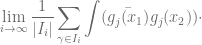
Hence we have \displaystyle \lim_{i \rightarrow \infty} \frac{1}{|I_i|} \sum_{\gamma \in I_i} \int (\bar{g_j(x_1)} g_j(x_2)) \cdot \gamma f(x_1) \bar{\gamma f(x_2)} d\mu \times_Y \mu(x_1, x_2) = 0

\Rightarrow \displaystyle \lim_{i \rightarrow \infty} \frac{1}{|I_i|} \sum_{\gamma \in I_i} \int | \int \bar{g_j(x)} \gamma f(x) d\mu_y(x)|^2 d \nu(y) = 0

\Rightarrow \displaystyle \lim_{i \rightarrow \infty} \frac{1}{|I_i|} \sum_{\gamma \in I_i} \{ \sum_{j=1}^k \int | \int \bar{g_j(x)} \gamma f(x) d\mu_y(x)|^2 d \nu(y) \} = 0

Hence for large enough i, there exists \gamma \in I_i s.t. \sum_{j=1}^k \int | \int \bar{g_j(x)} \gamma f(x) d\mu_y(x)|^2 d \nu(y) is as small as we want.

We may find D' \subseteq Y with \nu(D) > 1-\delta s.t. for all y \in D' and for all j, we have

| \int \bar{g_j(x)} \gamma f(x) d\mu_y(x)|^2 < \varepsilon^2

On the other hand, by construction there is j with || \gamma f - g_j||^2_y < \varepsilon^2 for all y \in D, with \nu(D) > 1-\delta .

Hence for y \in D \cap D', \ ||f||_{\gamma'^{-1}(y)}^2 = || \gamma f||_y^2 < 3 \varepsilon^2.

Let \varepsilon \rightarrow 0, \ \delta \rightarrow 0 we get f = \bar{0}. Hence C5 holds.

“C5 \Rightarrow C1″

Let f \in L^2(X) orthogonal to all of such functions. Let (I_k) be a Folner sequence.

Define \displaystyle H(x_1, x_2) := \lim_{i \rightarrow \infty} \frac{1}{|I_i|}\sum_{\gamma \in I_i} \gamma f(x_1) \cdot \gamma f(x_2) = P \bar{f}(x_1, x_2)

Let H_M(x_1, x_2) be equal to H whenever H(x_1, x_2) \leq M and 0 o.w.

H is \Gamma-invariant \Rightarrow \ H_M is \Gamma-invariant and bounded.

Therefore f \bot H_M \ast f, i.e.

\int \bar{f(x_1)} \{ \int H_M(x_1, x_2) d \mu_{\alpha(x_1)}(x_2) \} d \mu(x_1) = 0 <\p>

Since \mu = \int \mu_y d \nu(y), we get

\int \bar{f} \otimes f \cdot H_M d \mu \times_Y \mu = 0 <\p>

Hence H_M \bot (\bar{f} \otimes f). For all \gamma \in \Gamma, \ \gamma (\bar{f} \otimes f) \bot \gamma H_M = H_M.

Since H = P \bar{f} is an average of \gamma (\bar{f} \otimes f), \ \Rightarrow \ H \bot H_M.
0 = \int \bar{H} \cdot H_M = \int |H_M|^2 \ \Rightarrow \ H_M = \bar{0} for all M

Hence H = \bar{0}. By C5, we obtain f = \bar{0}. Hence \{ H \ast f \ | \ H \in L^\infty (X \times_Y X) \cap \Gamma_{inv} (X \times_Y X), f \in L^2(X) \} contain a basis for L^2(X).

Definition: Let H be a subgroup of \Gamma, \alpha: (X, \mathcal{B}, \mu, \Gamma) \rightarrow ( Y, \mathcal{D}, \nu, \Gamma') is said to be compact relative to H if the extension \alpha: (X, \mathcal{B}, \mu, H) \rightarrow ( Y, \mathcal{D}, \nu, H') is compact.

On plaque expansiveness

This note is mostly based on parts of (RH)^2U (2006) and conversations with R. Ures while he was visiting Northwestern.

Let \mathcal{F} be a foliation of the manifold M, for p \in M, a plaque in of \mathcal{F} through p is a small open neighborhood of p in the leaf \mathcal{F}_p that’s pre-image of a disc via a local foliation chart. (i.e. plaques stuck nicely to make open neighborhoods where the foliation chart is defined.) For \varepsilon small enough, whenever the leaves of \mathcal{F} are C^1, the path component of B(p, \varepsilon) containing p is automatically a plaque, we denote this by \mathcal{F}_\varepsilon(p).

Given a partially hyperbolic diffeomorphism f: M \rightarrow M, suppose the center integrates to foliation \mathcal{F}^c.

Definition: An \varepsilon-pseudo orbit w.r.t. \mathcal{F}^c is a sequence (p_n) where for any n \in \mathbb{Z}, f(x_n) \in \mathcal{F}^c_\varepsilon(x_{n+1}).

i.e. p_{n+1} is the f-image of p_n except we are allowed to move along the center plaque for a distance less than \varepsilon.

Definition: f is plaque expansive at \mathcal{F}^c if there exists \varepsilon>0 s.t. for all \varepsilon-pseudo orbits (p_n),  (q_n) w.r.t. \mathcal{F}^c, d(p_i, q_i)<\varepsilon for all i \in \mathbb{Z} then p_0 \in \mathcal{F}^c_\varepsilon(q_0).

i.e. any two pseudo-orbits in different plagues will eventually (under forward or backward iterates) be separated by a distance \varepsilon.

In the book Invariant Manifolds (Hirsch-Pugh-Shub), it’s proven that

Theorem: If a partially hyperbolic system has plaque expansive center foliation, then the center being integrable and plaque expansiveness are stable under perturbation (in the space of diffeos). Furthermore, the center foliation of the perturbed system g is conjugate to the center foliation of the origional system f in the sense that there exists homeomorphism h: M \rightarrow M where

1) h sends leaves of \mathcal{F}^c_f to leaves of \mathcal{F}^c_g i.e. for all p \in M,

h(\mathcal{F}^c_f(p)) = \mathcal{F}^c_g(p)

2) h conjugates the action of f and g on the set of center leaves i.e. for all p \in M,

h \circ f \ (\mathcal{F}^c_f(p)) = g \circ h \ ( \mathcal{F}^c_f(p))

(both sides produce a \mathcal{F}^c_g leaf)

Morally this means plaque expansiveness implies structurally stable in terms of permuting the center leaves.

It’s open whether or not any partially hyperbolic diffeomorphism with integrable center is plaque expansive w.r.t. its center foliation.

Another problem, stated in HPS about plaque expansiveness is:

Question: If f is partially hyperbolic and plaque expansive w.r.t. center foliation \mathcal{F}_c, then is \mathcal{F}_c the
unique f−invariant foliation tangent to E^c?

(RH)^2U has recently gave a series of super cool examples where the 1-dimensional center bundles of a C^1 partially hyperbolic diffeomorphism 1) does not integrate OR 2) integrates to a foliation but leaves through a given point is not unique (there is other curves through the point that’s everywhere tangent to the bundle). I will say a few words about the examples without spoil the paper (which is still under construction).

Start with the cat map on the 2-torus (matrix with entries ( 2, 1, 1, 1), take the direct product with the source-sink map on the circle, we obtain a diffeo on the 3 torus. For the purpose of our map, we make the expansion in the source-sink map weaker than that of the cat map and the contraction stronger.

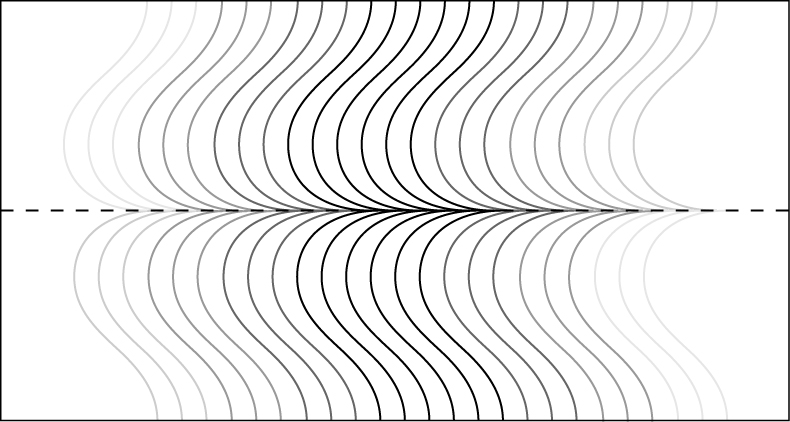
Then we perturb the map by adding appropriate small rotations to the system, the perturbation vanish on the \mathbb{t}^2 fibers corresponding to the two fixed points in the source-sink map. This will make our system partially hyperbolic, with center bundles as shown below:

To construct a non-integrable center, we make a perturbation that gives center boundle (inside the unstable direction of the cat map times the circle):

For intergrable but have non-unique center leaves, we simply rotate the upper and bottom half in opposite directions and obtain:

Note that in this case, all center leaves are merely copies of S^1. The example is plaque expansive due to to fact that all centers leaves are compact (and of uniformly bounded length). However, although the curve through any given point tangent to the bundle is non-unique, there is only one possible foliation of the center. Hence this does not give a counter example to the above mentioned question in HPS.

I think there are hopes to modify the example and make one that has similar compact leafs but non-unique center foliation, perhaps by making the unique integrability fail not only on a single line.

Fundemental Theorem of Dynamical Systems (Part 2)

Now we begin to prove the theorem.

    4.Attractor-repeller pairs

Definition: A compact set A \subseteq X is an attractor for f if there exists U open, f(\bar U) \subseteq U and \displaystyle \bigcup_{i=0}^\infty f^i(U) = A. U is called a basin of attraction.

For any attractor A \subseteq X, U be a basin for A, let U^\ast = X \backslash \bar U, \ U^\ast is open. By definition, f(A) = A and f(A^\ast) = A^\ast. We also have

f^{-1}(\overline{U^\ast}) = f^{-1}(\bar{X \backslash \bar U}) \subseteq X \backslash f^{-1}(U) \subseteq X \backslash U \subseteq \overline{U^\ast}

Definition: A repeller for f is an attractor for f^{-1}. A basin of repelling for f is a basin of attracting for f^{-1}.

Hence A^\ast is a repeller for f with basin U^\ast.

It’s easy to see that A^\ast is defined independent of the choice of basin for A. (Exercise)

We call such a pair A, \ A^\ast an attracting-repelling pair.

The following two properties of attracting-repelling pairs are going to be important for our proof of the theorem.

Proposition 1: There are at most countably many different attractors for f.

Proof: Since X is compact metric, there exists countable basis \mathcal{U} = \{U_i\}_{i \in \mathbb{N}} that generates the topology.

For any attractor A, any attracting basin \mathcal{B} of A is a union of sets in \mathcal{U}, i.e. \displaystyle \mathcal{B} = \bigcup_{i=1}^\infty U_{n_i}latex for some subsequence (n_i) of \mathbb{N}.

Since A is compact, U_{n_i} is an open cover of A, we have some \{ m_1, \ m_2, \ \cdots \ m_k \} \subseteq \{n_i\}_{i \in \mathbb{N}} s.t. \{ U_{m_1}, \ U_{m_2}, \ \cdots, \ U_{m_k} \} covers A.
Let B' = U_{m_1} \cup U_{m_2} \cup \cdots \cup U_{m_k} hence A \subseteq B' \subseteq B. We have

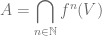
\displaystyle A \subseteq \bigcap_{n \in \mathbb{N}} f^n(B') \subseteq \bigcap_{n \in \mathbb{N}} f^n(B)

Since B is an attracting basin for A, all three sets are equal. Hence A = \bigcap_{n \in \mathbb{N}} f^n(B'). i.e. any attractor is intersection of foreward interates of come finite union of sets in \mathcal{U}. Since \mathcal{U} is countable, the set of all finite subset of it is coubtable.

Hence there are at most countably many different attractors. This establishes the proposition.

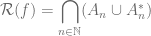
By proposition 1, we let (A_n)_{n \in \mathbb{N}} be a list of all attractors for f. Now we are going to relate the arrtactor-repeller pairs to the chain recurrent set and chain transitive components.

Proposition 2:
\mathcal{R}(f) = \displaystyle \bigcap_{n \in \mathbb{N}}(A_n \cup A^\ast_n)

Proof: i) \mathcal{R}(f) \subseteq \bigcap_{n \in \mathbb{N}}(A_n \cup A^\ast_n)

This is same as saying for any attractor A, \mathcal{R}(f) \subseteq (A \cup A^\ast).

For all x \notin (A \cup A^\ast), let B be a basin of A, then there is N \in \mathbb{N} for which x \notin (f^N(B) \cup f^{-N}(B^\ast)) (recall that B^\ast is the dual basin of B for A^\ast). Since B^\ast = X \backslash \overline{B} and f(\overline{B}) \subseteq B we conclude

X \backslash f^{-N}(B^\ast) = f^{-N}(\overline{B}) \subseteq f^{-N-1}(f(\overline{B})) \subseteq f^{-N-1}(B)

Hence x \in f^{-N-1}(B). Let M be the smallest integer for which x \in f^{-M}(B). Hence x \in f^{-M}(B) \backslash f^{-M+1}(B). Let U = f^{-M}(B) is also a basin for A.

Now we show such x cannot be chain recurrent: Since X \backslash f(U) and \overline{f^2(U)} are compact and disjoint, we may let

\varepsilon_1 = \frac{1}{2} \min\{ d(a, b) \ | \ a \in X \backslash f(U), \ b \in \overline{f^2(U)} \}

Since f(x) \in f(U), there exists some \varepsilon_2 s.t.

\overline{B(f(x), \varepsilon_2)} \subseteq f(U)

f(\overline{B(f(x), \varepsilon_2)}) \subseteq f^2(U) so there exists \varepsilon_3 s.t.

N(f(\overline{B(f(x), \varepsilon_2)}), \varepsilon_3) \subseteq f^2(U)

(Here B(p, r) denotes the ball of radius r around p and N(C, r) denotes the r-neignbourhood of compact set C)

Now set \varepsilon = \min\{ \varepsilon_1, \ \varepsilon_2, \ \varepsilon_3\}, for any \varepsilon-chain x, x_1, x_2, \cdots, we have: Since \varepsilon < \varepsilon_2 and \varepsilon_3, x_1 \in B(f(x), \varepsilon_2)\subseteq f(U) and x_2 \in B(f(x_1), \varepsilon_3) \subseteq N(f(\overline{B(f(x), \varepsilon_2)}), \varepsilon_3) \subseteq f^2(U). Hence the third term of any such chain must be in f^2(U). Since \varepsilon < \varepsilon_1, no \varepsilon-chain starting at x_2 can reach X \backslash f(U), in particular, the chain x, x_1, x_2, \cdots does not come back to x. Hence we conclude that x is not chain recurrent. ii) \bigcap_{n \in \mathbb{N}}(A_n \cup A^\ast_n) \subseteq \mathcal{R}(f) Suppose not, there is x \in \bigcap_{n \in \mathbb{N}}(A_n \cup A^\ast_n) and x \notin \mathcal{R}(f). i.e. for some \varepsilon > 0 there is no \varepsilon-chain from x to itself. Let U be the open set consisting all points that can be connected from x by an \varepsilon-chain.

We wish to generate an attractor by V, to do this all we need to check is f(\overline{V}) \subseteq V:
For any y \in \overline{V} there exists y' \in V with d(f(y), f(y')) < \varepsilon. Since y' \in V, there is \varepsilon-chain x, x_1, \cdots, x_n, y' which gives rise to \varepsilon-chain x, x_1, \cdots, x_n, y', f(y). Therefore f(\overline{V}) \subseteq V.

Hence \displaystyle A = \bigcap_{n \in \mathbb{N}} f^n(V) is an attractor with V as a basin.

By assumption, x \in A \cup A^\ast, since A \in V and there is no \varepsilon-chain from x to itself, x cannot be in A. i.e. x \in A^\ast Take any limit point y of (f^n(x))_{n\in \mathbb{N}}, since A^\ast is compact f-invariant we have y \in A^\ast. But since we can find N where d(f^N(x), y)<\varepsilon, x, f(x), \cdots, f^{N-1}(x), y gives an \varepsilon-chain from x to y, hence y \in V.

Recall that V is a basin of A hence A^\ast \cap V is empty. Contradiction. Establishes proposition 2.

This proposition says that to study the chain recurrent set is the same as studying each attractor-repeller pair of the system. But the dynamics is very simple for each such pair as all points not in the pair will move towards the attractor under foreward iterate. We can see that such property is goint to be of importantce for our purpose since the dynamical for each attractor-repeller pair is like the sourse-sink map.

5. Main ingredient

Here we are going to prove a lemma that’s going to produce for us the ‘building blocks’ of our final construction. Namely a function for each attracting-repelling pair that strickly decreases along the orbits not in the pair. In light of proposition 2, we should expect to put those functions together to get our complete Lyapunov function.

Lemma1: For each attractor-repeller pair A, A^\ast there exists continuous function g: X \rightarrow [0,1] s.t. g^{-1}(0)=A, \ g^{-1}(1)=A^\ast and g(f(p)) < g(p) for all p \notin (A\cup A^\ast).

Proof: First we define \varphi: X \rightarrow [0,1] s.t.

\varphi(x) = \frac{d(x,A)}{d(x, A)+d(x, A^\ast)}

Note that \phi takes value 0 only on A and 1 only on A^\ast. However, \phi can’t care less about orbits of f.

Define \bar\varphi(x) = \sup\{\varphi(f^n(x)) \ | \ n\in\mathbb{N} \}. Hence automatically for all x, \bar \varphi(f(x)) \leq \bar \varphi(x). Since no points accumulates to A^\ast under positive iterations, we still have the \bar \varphi^{-1}(0)=A and \bar \varphi^{-1}(1) = A^\ast.

We now show that \bar\varphi is continuous:

For x \in A^\ast and (x_i)\rightarrow x, \varphi(x_i) \leq \bar\varphi(x_i) \leq 1 and (\varphi(x_i)) \rightarrow 1 hence \bar\varphi(x_i)\rightarrow 1 i.e. \bar\varphi is continuous on A^\ast.

For x \in A we use the fact that A is attracting. Let B be a basin of A. For all (x_i) \rightarrow x, for any \varepsilon>0, there is N \in \mathbb{N} s.t. f^N(B) \subseteq N(A, \varepsilon). Therefore for some x_i \in f^N(B), all f^n(x_i) are in N(A, \varepsilon) i.e. \varphi(f^n(x_i))\leq \frac{\varepsilon}{\varepsilon+C} hence \bar\varphi(x_i)\leq \frac{\varepsilon}{\varepsilon+C}. But for some M \in \mathbb{N} and all m>M, x_m \in B. Therefore \bar\varphi(x_i) \rightarrow 0. \bar\varphi is continuous on A.

Let T = \overline{B} \backslash f(B), for any \displaystyle x \in T, \ r=\inf_{x \in T} \varphi(x), since f^n(T) \subseteq f^n(\overline{B}), there exists N>0 s.t. for all n>N \varphi(f^n(T))\subseteq [0,r/2]. i.e. \displaystyle \bar\varphi9x) = \max_{0\leq n\leq N} \varphi(f^n(x)) which is countinous. Since those ‘bands’ T partitions the whole X (by taking B_n to be f^n(B) \backslash f^{n+1}(B)), hence we have proven \bar\varphi is continuous on the whole X.

Finally, we define

\displaystyle g(x) = \sum_{n=0}^\infty \frac{\bar\varphi(f^n(x))}{2^{n+1}}

We check that g is continuous since \bar\varphi is. g takes values 0 and 1 only on A and A^\ast, respectively. For any x \notin (A \cup A^\ast),

\displaystyle g(f(x))-g(x) = \sum_{n=0}^\infty \frac{\bar\varphi(f^{n+1}(x))-g(f^n(x))}{2^{n+1}}

therefore g(f(x))-g(x) = 0 iff \bar\varphi(f^{n+1}(x)) = \bar\varphi(f^n(x)) for all n i.e. \bar\varphi is constant on the orbit of x. But this cannot be since there is a subsequence of (f^n(x)) converging to some point in A, continuity of \bar\varphi tells us this constant has to be 0 hence x \in A.

Therefore g is strictly decreasing along orbits of f not in (A \cup A^\ast).

Establishes lemma 1.

6.Proof of the main theorem

The proof of the main theorem now follows easily from what we have established so far.

First we restate the fundamental theorem of dynamical systems:

Theorem: Complete Lyapunov function exists for any homeomorphisms on compact metric spaces.

Proof: First we enumerate the countably many attractors as (A_n)_{n \in \mathbb{N}}. For each A_n, we have function g_n: X \rightarrow R where g_n is 0 on A_n, 1 on A_n^\ast and is strictly decreasing on X \backslash ( A_n \cup A_n^\ast).
Define g: X \rightarrow \mathbb{R} by

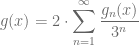
\displaystyle g(x) = 2 \cdot \sum_{n=1}^\infty \frac{g_n(x)}{3^n}

Since each g_n is bounded between 0 and 1, the sequence of partial sums converge uniformly. Hence the limit function g is continuous.

For points p \in \mathcal{R}(f), we have p \in (A_n \cup A_n^\ast) for all n \in \mathbb{N}. i.e. $latex  \ \forall n \in \N, \ g_n(p) = 0$ or g_n(p) = 1. Hence we have

g(p) = \sum_{n=1}^\infty \frac{2 \cdot g_n(p)}{3^n} = \sum_{n=1}^\infty \frac{a_n}{3^n}

where each a_n is in \{0, 2 \}. This is same as saying the base-3 expansion of g(p) only contains digits 0 and 2. We conclude g(\mathcal{R}(f)) \subseteq \mathcal{C} where \mathcal{C} is the standard middle-third Cantor set in [0, 1]. i.e. g(\mathcal{R}(f)) is compact and nowhere dense in \mathbb{R}.

For p \notin \mathcal{R}(f), there exists n \in \mathbb{N} such that p \notin (A_n \cup A_n^\ast), hence g_n(f(p)) < g_n(p). This implies g(f(p)) < g(p) since g_i(f(p)) \leq g_i(p) for all i \in \mathbb{N}. i.e. g is strictly decreasing along orbits that are not chain recurrent.

To show g is constant only on the chain-transitive components, we need the following lemma:

Claim: p, \ q \in \mathcal{R}(f) are in the same chain-transitive component iff there is no attracting-repelling pair A, \ A^\ast where one of p, \ q is in A while the other in A^\ast.

Proof (of claim):\Rightarrow” Suppose x, y \in \mathcal{R}(f) and x \sim y, for any attractor A, if x \notin A and y \notin A, then x, y are both in A^\ast and we are done. Hence suppose at least one of x, y is in A. W.L.O.G. suppose x \in A. Let B be a basin of A. Since \overline{f(B)}, \ X\backslash B are closed and disjoint, we may choose \varepsilon<\min\{ d(a, b) \ | \ a \in (X\backslash B), \ b \in \overline{f(B)} \}. By the same arguement as in proposition 2, there are no \varepsilon/2-chain (with length >1) from any point in f{B} to any point in X \backslash B. Hence there is also no \varepsilon/2-chain from any point in A to any point in A^\ast. Hence y \notin A^\ast i.e. y \in A.

\Leftarrow” Suppose for any attractor A, x \in A iff y \in A. For any \varepsilon>0, let U be the set of all points y for which there is an \varepsilon-chain from x to y, as defined in proposition 2. We have showed in proposition 2 that U is a basin of some attractor A'. Since x \in \mathcal{R}(f) \subseteq (A' \cup {A'}^\ast) and x \in U, hence x \in A'. Hence by our assumption, y must be also in A'. Hence y \in U i.e. there is an \varepsilon-chain from x to y. Since the construction is symetric, we may also show there is an \varepsilon-chain from y to x. i.e. x\sim y.

Establishes the claim.

Finally, for p, q \in \mathcal{R}(f), g(p) = g(q) means g(p) and g(q) has the same base-3 expansion in the Cantor set. This is same as saying \forall i \in \mathbb{N}, \ g_i(p) = g_i(q) \in \{0, 2\}, which is to say there is no i \in \mathbb{N} for which one of p, \ q is in A_i while the other in A_i^\ast. Hence by Lemma, we conclude that g(p) = g(q) iff p, \ q are in the same chain transitive component.

This establishes our theorem.

Fundemental Theorem of Dynamical Systems (Part 1)

This article was written as a homework of professor Wilkinson’s dynamical systems course. Since the content is expository and detailed presentation of the theorem is missing from many books, I decided to post it here. I have mostly followed a set of notes by John Franks, with additional discussions on the intuition and ideas behind the statement and the proof.

1.Introduction

So far we have discussed various different kinds of dynamical systems ranging from topological, smooth to hyperbolic and partially hyperbolic. One might wonder if there is a united theme to the subject as a whole. Indeed, as in many other subjects, there is a so-called fundamental theorem of dynamical systems. This theorem is first stated and proved by Conley in where he studies attractor and repellers. The theorem, loosely speaking, gives a universal decomposition of any systems on compact metric spaces into invariant compact sets wandering orbits that travels between such sets.

To state this more precisely we make an analogy with Morse theory: When looking at the gradient flow on a compact embedded manifold, we ‘decompose’ the manifold into critical points and orbits that originates and ends at critical points. In a similar spirit, given any homeomorphisms on a compact metric space, we may look at it’s ‘indecomposible’ compact invariant sets and how they are ‘connected’ by wandering orbits, we then ‘place’ those compact sets on different ‘heights’ and have all other point going between the minimal sets they originates and ends at. The theorem guarantees that we can ‘place’ the space in a way that all wandering orbits are going ‘down’ at all times.

In light of the theorem, we have descried the global structure of the system except for what happens on the ‘indecomposible’ sets. i.e. The problem of understanding general topological systems on compact manifolds is reduced to understanding ‘transitive’ homeomorphisms on compact sets. The latter, unfortunately, could still be quite complicated as we have seen in the Horseshoe example.

The theorem is proposed to be the Fundemental theorem of dynamical systems because of its nature in giving concise description of all possible behaviors of a system in the given setting. In some sense, dynamics is the study of limiting behrviors of all points under interation, the theorem breaks the system down into a recurrent part and a wandering part where the behavior of the wandering part is gradient-like. Since we have developped sets of different tools for studying systems that exhibits a lot of recurrence as well as for studying gradient-like systems, this allows us to connect combine the tool sets and treat any systems in the setting.

2.Background

In this section, we define \varepsilon-chains, chain recurrent sets and chain transitive components for a homeomorphism on a compact metric space. Those concepts will come up in the statement of the fundamental theorem. In fact, those are going to be the ‘minimal compact sets’ we decompose our metric space into.

Given compact metric space X and homeomorphism f: X \rightarrow X,
Definition: Given two points p, q \in X, an \varepsilon-chain from p to q is a sequence x_1, x_2, \cdots x_n, n>1 where x_1 = p, \ x_n = q and for all 1 \leq i \leq n-1, d(f(x_i), x_{i+1}) < \varepsilon.

i.e. we take a point and start applying f to it, but at each iterate, we are allowed to perturb the resulting point by \varepsilon. Such ‘pseudo-orbits’ are in general much easier to obtain than true orbits.

More generally, \varepsilon-chains can be taken infinite. i.e. if we have a (possibly infinite) subinterval I \subseteq \mathbb{Z}, an \varepsilon-chain indexed by I is a set of points (p_i)_{i \in I} s.t. d(f(p_i), p_{i+1}) < \varepsilon whenever i, i+1 are both in I.

Definition:p \in X is chain recurrent if for all \varepsilon > 0, there exists an \varepsilon-chain from p to itself. The set of all chain recurrent points in X is called the \textbf{chain recurrent set}, denoted by \mathcal{R}(f).

Note that non-wandering points are necessarily chain recurrent: If p \in X is non-wandering, we may take the neighborhood to be the \varepsilon-ball around p, since p is non-wandering, we have some n>1 where f^n(B_\varepsilon(p)) \cap B_\varepsilon(p) \neq \phi, we pick q in the intersection and define \varepsilon-chain p, f^{-n}(q), f^{-n+1}(q), \cdots, q, p.

At this point, it’s perhaps worthwhile to mention our completed ordering of different notions of recurrence:

\overline{\mbox{Per}(f)} \subseteq \mbox{Rec}(f) \subseteq \mbox{NW}(f) \subseteq \mathcal{R}(f)

Each of the above inclusion can be made strict (see Exercises). Chain recurrence is perhaps the weakest notion I’ve seen for a point to be, in any sense, recurrent. A Friendly challenge to the reader: think of a case where you feel confortable calling a point ‘recurrent’ while it’s not in the chain recurrent set of the system.

We now define equivlence relation on \mathcal{R}(f) as follows:

For p, q in \mathcal{R}(f), p \sim q iff for all \varepsilon > 0, there are \varepsilon-chains from p to q and from q to p. \sim is reflexive since all points in \mathcal{R}(f) are chain recurrent; symmetric by definition and transitive by the obvious composition of \varepsilon-chains.

Definition: The equivalence classes in \mathcal{R}(f) for \sim are called chain transitive components.

It’s easy to check that chain transitive components are compact and f-invariant. Those are components that’s transitive in a very weak sense. i.e. any two points are connected by a ‘pseudo-orbit’, or equivalently, there is a dense (infinite) pseudo-orbit. (see exercises)

As mentioned above, throughout the rest of the chapter, we will consider chain transitive components as ‘indecomposible parts’ of our system. Those are the parts for which all points are ‘recurrently’ and each component is ‘transitive’, both in a very weak sense. We further specify how does the points that are not in the chain-recurrent set iterates between those components.

3.Statement of the theorem

Given compact metric space X and homeomorphism f: X \rightarrow X,

Definition: g: X \rightarrow \mathbb{R} is a complete Lyapunov function for f if:

\forall \ p \notin \mathcal{R}(f), \ g(f(p)) < g(p)

\forall \ p, q \in \mathcal{R}(f), \ g(p) = g(q) \ \mbox{iff} \ p \sim q

g(\mathcal{R}(f)) \ \mbox{is compact and nowhere dense in} \ \mathbb{R}

Hence this is a function that stays constant only on the chain transitive components and strictly decreases along any orbit not in \mathcal{R}(f). We also require the image of \mathcal{R}(f) to be compact and nowhere dense which cooresponds to the ‘critical values’ of a gradient function being compact nowhere dense as a result of Sard’s theorem.

Fundemental theorem of dynamical systems:

Complete Lyapunov function exists for any homeomorphisms on compact metric spaces.

As a historical remark, the theorem first appeared in Charles Conley’s CBMS monograph Isolated Invariant Sets and the Morse Index in 1978 [C]. In the book he developed the theory of attractor-repeller pairs in relation to Morse decomposition and index theory. The above theorem was one of the major results. Although Conley was originally more focused on the setting where instead of a homeomorphism, we have a continuous flow on the manifold (which makes it even more similar to the gradient flow), but this discrete formulation became more popular as the theory develops. The theorem is later proposed by D. Norton as the fundamental theorem of dynamical in 1995.

The proof is going to be a specific construction: First, we define a family of partitions of the chain recurrent set, each divides the set into two pieces (i.e. a attractor-repeller pair intersected with \mathcal{R}). Then we prove the family is countable and points in the same chain transitive component are not separated by any partition in the family. Furthermore, each chain-transitive component is uniquely defined by specifying which set does it belong to in each partition. i.e. the smallest common refinement for the family exactly partitions \mathcal{R} into chain-transitive components. (section 4)

Next, for each attractor-repeller pair, we prove the existence of a function that takes value 0 on the attractor and 1 on the repeller and strictly decreases along orbits of points that’s not in \mathcal{R}(f). We should also mention the fact that all points that are contained in one of the sets in each pair must be in chain recurrent. (section 5)

The complete Lyapunov function is then constructed by taking an appropriate infinite sum of such functions. This way we get a function that separates all chain transitive components, stays constant on each component and strictly decreases along all orbits which are not in \mathcal{R}. The image of the chain recurrent set will be contained in the middle-third Cantor set. (section 6)

(see part 2 for sections 4-6)