Cutting the Knot

Recently I came across a paper by John Pardon – a senior undergrad here at Princeton; in which he answered a question by Gromov regarding “knot distortion”. I found the paper being pretty cool, hence I wish to highlight the ideas here and perhaps give a more pictorial exposition.

This version is a bit different from one in the paper and is the improved version he had after taking some suggestions from professor Gabai. (and the bound was improved to a linear one)

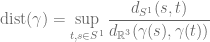
Definition: Given a rectifiable Jordan curve \gamma: S^1 \rightarrow \mathbb{R}^3, the distortion of \gamma is defined as

\displaystyle \mbox{dist}(\gamma) = \sup_{t,s \in S^1} \frac{d_{S^1}(s,t)}{d_{\mathbb{R}^3}(\gamma(s), \gamma(t))}.

i.e. the maximum ratio between distance on the curve and the distance after embedding. Indeed one should think of this as measuring how much the embedding ‘distort’ the metric.

Given knot \kappa, define the distortion of \kappa to be the infimum of distortion over all possible embedding of \gamma:

\mbox{dist}(\kappa) = \inf\{ \mbox{dist}(\gamma) \ | \ \gamma \ \mbox{is an embedding of} \ \kappa \ \mbox{in} \ \mathbb{R}^3 \}

It was (somewhat surprisingly) an open problem whether there exists knots with arbitrarily large distortion.

Question: (Gromov ’83) Does there exist a sequence of knots (\kappa_n) where \lim_{n \rightarrow \infty} \mbox{dist}(\kappa_n) = \infty?

Now comes the main result in the paper: (In fact he proved a more general version with knots on genus g surfaces, for simplicity of notation I would focus only on torus knots)

Theorem: (Pardon) For the torus knot T_{p,q}, we have

\mbox{dist}(T_{p,q}) \geq \frac{1}{100} \min \{p,q \}

.

To prove this, let’s make a few observations first:

First, fix a standard embedding of \mathbb{T}^2 in \mathbb{R}^3 (say the surface obtained by rotating the unit circle centered at (2, 0, 0) around the z-axis:

and we shall consider the knot that evenly warps around the standard torus the ‘standard T_{p,q} knot’ (here’s what the ‘standard T_{5,3} knot looks like:

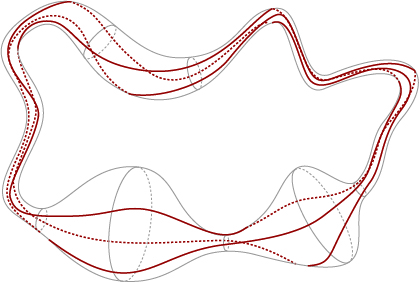
By definition, an ’embedding of the knot’, is a homeomorphism \varphi:\mathbb{R}^3 \rightarrow \mathbb{R}^3 that carries the standard T_{p,q} to the ‘distorted knot’. Hence the knot will lie on the image of the torus (perhaps badly distorted):

For the rest of the post, we denote \varphi(T_{p,q}) by \kappa and \varphi(\mathbb{T}^2) by T^2, w.l.o.g. we also suppose p<q.

Definition: A set S \in T^2 is inessential if it contains no homotopically non-trivial loop on T^2.

Some important facts:

Fact 1: Any homotopically non-trivial loop on \mathbb{T}^2 that bounds a disc disjoint from T^2 intersects T_{p,q} at least p times. (hence the same holds for the embedded copy (T^2, \kappa)).

As an example, here’s what happens to the two generators of \pi_1(\mathbb{T}^2) (they have at least p and q intersections with T_{p,q} respectively:

From there we should expect all loops to have at least that many intersections.

Fact 2: For any curve \gamma and any cylinder set C = U \times [z_1, z_2] where U is in the (x,y)-plane, let U_z = U \times \{z\} we have:

\ell(\gamma \cap C) \geq \int_{z_1}^{z_2} | \gamma \cap U_z | dz

i.e. The length of a curve in the cylinder set is at least the integral over z-axis of the intersection number with the level-discs.

This is merely saying the curve is longer than its ‘vertical variation’:

Similarly, by considering variation in the radial direction, we also have

\ell(\gamma \cap B(\bar{0}, R) \geq \int_0^{R} | \gamma \cap \partial B(\bar{0}, r) | dr

Proof of the theorem

Now suppose \mbox{dist}(T_{p,q})<\frac{1}{100}p, we find an embedding (T^2, \kappa) with \mbox{dist}(\kappa)<\frac{1}{100}p.

For any point x \in \mathbb{R}^3, let

\rho(x) = \inf \{ r \ | \ T^2 \cap (B(x, r))^c is inessential \}

i.e. one should consider \rho(x) as the smallest radius around x so that the whole ‘genus’ of T^2 lies in B(x,\rho(x)).

It’s easy to see that \rho is a positive Lipschitz function on \mathbb{R}^3 that blows up at infinity. Hence the minimum value is achieved. Pick x_0 \in \mathbb{R}^3 where \rho is minimized.

Rescale the whole (T^2, \kappa) so that x_0 is at the origin and \rho(x_0) = 1.

Since \mbox{dist}(\kappa) < \frac{1}{100}p (and note distortion is invariant under scaling), we have

\ell(\kappa \cap B(\bar{0}, 1) < \frac{1}{100}p \times 2 = \frac{1}{50}p

Hence by fact 2, \int_1^{\frac{11}{10}} | \kappa \cap \partial B( \bar{0}, r)| dr \leq \ell(\kappa \cap B(\bar{0}, 1)) < \frac{1}{40}p

i.e. There exists R \in [1, \frac{11}{10}] where the intersection number is less or equal to the average. i.e. | \kappa \cap \partial B(\bar{0}, R) | \leq \frac{1}{4}p

We will drive a contradiction by showing there exists x with \rho(x) < 1.

Let C_z = B(\bar{0},R) \cap \{z \in [-\frac{1}{10}, \frac{1}{10}] \}, since

\int_{-\frac{1}{10}}^{\frac{1}{10}} | U_t \cap \kappa | dt \leq \ell(\kappa \cap B(\bar{0},1) ) < \frac{1}{50}p

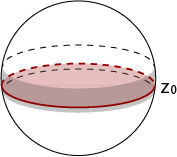
By fact 2, there exists z_0 \in [-\frac{1}{10}, \frac{1}{10}] s.t. | \kappa \cap B(\bar{0},1) \times \{z_0\} | < \frac{1}{10}p. As in the pervious post, we call B(\bar{0},1) \times \{z_0\} a ‘neck’ and the solid upper and lower ‘hemispheres’ separated by the neck are U_N, U_S.

Claim: One of U_N^c \cap T^2, \ U_S^c \cap T^2 is inessential.

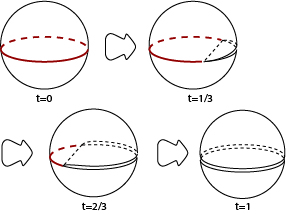
Proof: We now construct a ‘cutting homotopy’ h_t of the sphere S^2 = \partial B(\bar{0}, R):

i.e. for each t \in [0,1), \ h_t(S^2) is a sphere; at t=1 it splits to two spheres. (the space between the upper and lower halves is only there for easier visualization)

Note that during the whole process the intersection number h_t(S^2) \cap \kappa is monotonically increasing. Since | \kappa \cap B(\bar{0},R) \times \{z_0\} | < \frac{1}{10}p, it increases no more than \frac{1}{5}p.

Observe that under such ‘cutting homotopy’, \mbox{ext}(S^2) \cap T^2 is inessential then \mbox{ext}(h_1(S^2)) \cap T^2 is also inessential. (to ‘cut through the genus’ requires at least p many intersections at some stage of the cutting process, but we have less than \frac{p}{4}+\frac{p}{5} < \frac{p}{2} many interesections)

Since h_1(S^2) is disconnected, the ‘genus’ can only lie in one of the spheres, we have one of U_N^c \cap T^2, \ U_S^c \cap T^2 is inessential. Establishes the claim.

We now apply the process again to the ‘essential’ hemisphere to find a neck in the ydirection, i.e.cutting the hemisphere in half in (x,z) direction, then the (y,z)-direction:

The last cutting homotopy has at most \frac{p}{5} + 3 \times \frac{p}{4} < p many intersections, hence has inessential complement.

Hence at the end we have an approximate \frac{1}{8} ball with each side having length at most \frac{6}{5}, this shape certainly lies inside some ball of radius \frac{9}{10}.

Let the center of the \frac{9}{10}-ball be x. Since the complement of the \frac{1}{8} ball intersects T^2 in an inessential set, we have B(x, \frac{9}{10})^c \cap T^2 is inessential. i.e.

\rho(x) \leq \frac{9}{10} <1

Contradiction.

Systolic inequality on the 2-torus

Starting last summer with professor Guth, I’ve been interested in the systolic inequality for Riemannian manifolds. As a starting point of a sequence of short posts I plan to write on little observations I had related to the subject, here I’ll talk about the baby case where we find the lower bound of the systole on the 2-torus in terms of the area of the torus.

Given a Riemannian manifold (M, g) where g is the Riemannian metric.

Definition: The systole of M is the length of smallest homotopically nontrivial loop in M.

We are interested in bounding the systole in terms of the n-th root of the volume of the manifold ( where n is the dimension of M ).

Note that the systole is only defined when our manifold has non-trivial fundamental group. I wish to remark that for the case of n-torus, having an inequality of the form (\mbox{Sys}(\mathbb{T}^n))^n \leq C \cdot \mbox{Vol}(\mathbb{T}^n) is intuitive as we can see in the case of an embedded 2-torus in \mathbb{R}^3, we may deform the metric (hence the embedding) to make a non-contactable loop as small as we want while keep the volume constant, however when we attempt to make the smallest such loop large when not changing the volume, we can see that we will run into trouble. Hence it’s expected that there is an upper bound for the length of the smallest loop.

Since if only one loop in some homotopy class achieves that minimal length, we should be able to enlarge it and contract some other loops in that class to enlarge the systole and keep the volume constant. Hence it’s tempting to assume that all loops in the same class are of the same length. In the 2-torus case, such thing is the flat torus. Since any flat torus has systole proportional to (\mbox{Vol}(\mathbb{T}^2))^{\frac{1}{2}}, we have reasons to expect the optimal case fall inside this family. i.e.

(\mbox{Sys}(\mathbb{T}^2))^2 \leq C \cdot \mbox{Vol}(\mathbb{T}^2).

This is indeed the case. The result was given in an early unpublished result by Loewner.

Let’s first optimize in the class of flat torus:

My first guess was that C cannot be made less than 1 i.e. the torus \mathbb{R}^2/ \mathbb{Z}^2 is the optimum case. However, this is not true. Let’s be more careful:

\mathbb{T}^2 = \mathbb{R}^2 / (0,c)\mathbb{Z} \times (a, b)\mathbb{Z}

Since by scaling does not change ratio between (\mbox{Vol}(\mathbb{T}^2)) and (\mbox{Sys}(\mathbb{T}^2))^2, we may normalize and let c=1

Let \alpha, \beta be generators of the fundamental group of \mathbb{T}^2 length of all geodesic loops in class [\alpha], \ [\beta] are the side lengths of the parallelepiped i.e. 1 and ||(a,b)||. W.L.O.G we suppose a, b > 0. \alpha \beta^{-1} has length ||((1-a),b)|| and all geodesics in other classes are at least twice as long as one of the above three.

Hence the systole is maximized when those three are equal, we get a=1/2, b=\sqrt{3}/2. The systole in this case is 1 and the volume is \sqrt{3}/2. Hence for any flat torus, we have

(\mbox{Sys}(\mathbb{T}^2))^2 \leq \frac{2}{\sqrt{3}} \cdot \mbox{Vol}(\mathbb{T}^2).

Theorem (Loewner): This bound holds for any metric g on \mathbb{T}^2.

Proof: We will show this by reducing the case to flat metric.

g induced an almost complex structure on \mathbb{T}^2, on surfaces, any almost complex structure is integrable. Hence there exists f:\mathbb{T}^2 \rightarrow \mathbb{R}^+ and g= f \dot g_0 where (\mathbb{T}^2, g_0) is a Riemann surface.

By uniformization theorem, (\mathbb{T}^2, g_0) is the quotient of \mathbb{C} by a discrete lattice. i.e. (\mathbb{T}^2, g_0) is a flat torus \mathbb{R}^2 / (0,c)\mathbb{Z} \times (a, b)\mathbb{Z}.

By scaling of the torus, we may assume the volume of the manifold is 1 i.e.

\displaystyle \int_{\mathbb{T}^2} f \ dV_{g_0} = 1 = \mbox{Vol}(\mathbb{T}^2, g_0)

Any nontrivial homotopy class of loops on (\mathbb{T}^2, g) can be represented by a straight loop on the flat torus. The length of such a loop in (\mathbb{T}^2, g) is merely integration of f along the segment.

Here we have a family of loops in the homotopy class that is straight, by taking a segment of appropriate length orthogonal to the loops, we have the one-parameter family of parallel loops foliate the torus. Hence integrating over the segment of the length of the loops gives us the total volume of the torus. By Fubini, we have at least one loop is longer than volume of the torus over length of the segment we integrated on, which is the length of the straight loop in the flat torus.

Therefore the systole of (\mathbb{T}^2, g) is smaller than the minimum length of straight loops which is smaller than that of the flat torus. While the volume are the same. Hence it suffice to optimize the ratio in the class of flat tori. Establishes the theorem.

Combining the pervious statement, we get

(\mbox{Sys}(\mathbb{T}^2))^2 \leq \frac{2}{\sqrt{3}} \cdot \mbox{Vol}(\mathbb{T}^2)

for any metric on the torus.