A report of my Princeton generals exam

Well, some people might be wondering why I haven’t updated my blog since two weeks ago…Here’s the answer: I have been preparing for this generals exam — perhaps the last exam in my life.

For those who don’t know the game rules: The exam consists of 3 professors (proposed by the kid taking the exam, approved by the department), 5 topics (real, complex, algebra + 2 specialized topics chosen by the student). One of the committee member acts as the chair of the exam.

The exam consists of the three committee members sitting in the chair’s office, the student stands in front of the board. The professors ask questions ranging in those 5 topics for however long they want, the kid is in charge of explaining them on the board.

I was tortured for 4.5 hours (I guess it sets a new record?)
I have perhaps missed some questions in my recollection (it’s hard to remember all 4.5 hours of questions).

Conan Wu’s generals

Commitee: David Gabai (Chair), Larry Guth, John Mather

Topics: Metric Geometry, Dynamical Systems

Real analysis:

Mather: Construct a first category but full measure set.

(I gave the intersection of decreasing balls around the rationals)

Guth: F:S^1 \rightarrow \mathbb{R} 1-Lipschitz, what can one say about its Fourier coefficients.

(Decreasing faster than c*1/n via integration by parts)

Mather: Does integration by parts work for Lipschitz functions?

(Lip imply absolutely continuous then Lebesgue’s differentiation theorem)

Mather: If one only has bounded variation, what can we say?

(f(x) \geq f(0) + \int_0^x f'(t) dt)

Mather: If f:S^1 \rightarrow \mathbb{R} is smooth, what can you say about it’s Fourier coefficients?

(Prove it’s rapidly decreasing)

Mather: Given a smooth g: S^1 \rightarrow \mathbb{R}, given a \alpha \in S^1, when can you find a f: S^1 \rightarrow \mathbb{R} such that
g(\theta) = f(\theta+\alpha)-f(\theta) ?

(A necessary condition is the integral of g needs to vanish,
I had to expand everything in Fourier coefficients, show that if \hat{g}(n) is rapidly decreasing, compute the Diophantine set \alpha should be in to guarantee \hat{f}(n) being rapidly decreasing.

Gabai: Write down a smooth function from f:\mathbb{R}^2 \rightarrow \mathbb{R} with no critical points.

(I wrote f(x,y) = x+y) Draw its level curves (straight lines parallel to x=-y)

Gabai: Can you find a such function with the level curves form a different foliation from this one?

(I think he meant that two foliations are different if there is no homeo on \mathbb{R}^2 carrying one to the other,
After playing around with it for a while, I came up with an example where the level sets form a Reeb foliation, and that’s not same as the lines!)

We moved on to complex.

Complex analysis:

Guth: Given a holomorphic f:\mathbb{D} \rightarrow \mathbb{D}, if f has 50 0s inside the ball B_{1/3}(\bar{0}), what can you say about f(0)?

(with a bunch of hints/suggestions, I finally got f(0) \leq (1/2)^{50} — construct polynomial vanishing at those roots, quotient and maximal modulus)

Guth: State maximal modulus principal.

Gabai: Define the Mobius group and how does it act on \mathbb{H}.

Gabai: What do the Mobius group preserve?

(Poincare metric)

Mather: Write down the Poincare metric, what’s the distance from \bar{0} to 1? (infinity)

(I don’t remember the exact distance form, so I tried to guess the denominator being \sqrt{1-|z|}, but then integrating from 0 to 1 does not “barely diverge”. Turns out it should be (1-|z|^2)^2.)

Gabai: Suppose I have a finite subgroup with the group of Mobius transformations acting on \mathbb{D}, show it has a global fixed point.

(I sketched an argument based on each element having finite order must have a unique fixed point in the interior of \mathbb{D}, if two element has different fixed points, then one can construct a sequence of elements where the fixed point tends to the boundary, so the group can’t be finite.)

I think that’s pretty much all for the complex.

Algebra:

Gabai: State Eisenstein’s criteria

(I stated it with rings and prime ideals, which leaded to a small discussion about for which rings it work)

Gabai: State Sylow’s theorem

(It’s strange that after stating Sylow, he didn’t ask me do anything such as classify finite groups of order xx)

Gabai: What’s a Galois extension? State the fundamental theorem of Galois theory.

(Again, no computing Galois group…)

Gabai: Given a finite abelian group, if it has at most n elements of order divisible by n, prove it’s cyclic.

(classification of abelian groups, induction, each Sylow is cyclic)

Gabai: Prove multiplicative group of a finite field is cyclic.

(It’s embarrassing that I was actually stuck on this for a little bit before being reminded of using the previous question)

Gabai: What’s SL_2(\mathbb{Z})? What are all possible orders of elements of it?

(I said linear automorphisms on the torus. I thought it can only be 1,2,4,\infty, but turns out there is elements of order 6. Then I had to draw the torus as a hexagon and so on…)

Gabai: What’s \pi_3(S^2)?

(\mathbb{Z}, via Hopf fibration)

Gabai: For any closed orientable n-manifold M, why is H_{n-1}(M) torsion free?

(Poincare duality + universal coefficient)

We then moved on to special topics:

Metric Geometry:

Guth: What’s the systolic inequality?

(the term ‘aspherical’ comes up)

Gabai: What’s aspherical? What if the manifold is unbounded?

(I guessed it still works if the manifold is unbounded, Guth ‘seem to’ agree)

Guth: Sketch a proof of the systolic inequality for the n-torus.

(I sketched Gromov’s proof via filling radius)

Guth: Give an isoperimetric inequality for filling loops in the 3-manifold S^2 \times \mathbb{R} where S^2 has the round unit sphere metric.

(My guess is for any 2-chain we should have

\mbox{vol}_1(\partial c) \geq C \mbox{vol}_2(c)

then I tried to prove that using some kind of random cone and grid-pushing argument, but soon realized the method only prove

\mbox{vol}_1(\partial c) \geq C \sqrt{\mbox{vol}_2(c)}.)

Guth: Given two loops of length L_1, L_2, the distance between the closest points on two loops is \geq 1, what’s the maximum linking number?

(it can be as large as c L_1 L_2)

Dynamical Systems:

Mather: Define Anosov diffeomorphisms.

Mather: Prove the definition is independent of the metric.

(Then he asked what properties does Anosov have, I should have said stable/unstable manifolds, and ergodic if it’s more than C^{1+\varepsilon}…or anything I’m familiar with, for some reason the first word I pulled out was structurally stable…well then it leaded to and immediate question)

Mather: Prove structural stability of Anosov diffeomorphisms.

(This is quite long, so I proposed to prove Anosov that’s Lipschitz close to the linear one in \mathbb{R}^n is structurally stable. i.e. the Hartman-Grobman Theorem, using Moser’s method, some details still missing)

Mather: Define Anosov flow, what can you say about geodesic flow for negatively curved manifold?

(They are Anosov, I tried to draw a picture to showing the stable and unstable and finished with some help)

Mather: Define rotation number, what can you say if rotation numbers are irrational?

(They are semi-conjugate to a rotation with a map that perhaps collapse some intervals to points.)

Mather: When are they actually conjugate to the irrational rotation?

(I said when f is C^2, C^1 is not enough. Actually C^1 with derivative having bounded variation suffice)

I do not know why, but at this point he wanted me to talk about the fixed point problem of non-separating plane continua (which I once mentioned in his class).

After that they decided to set me free~ So I wandered in the hallway for a few minutes and the three of them came out to shake my hand.

The Carnot-Carathéodory metric

I remember looking at Gromov’s notes “Carnot-Carathéodory spaces seen from within” a long time ago and didn’t get anywhere. Recently I encountered it again through professor Guth. This time, with his effort in explaining, I did get some ideas. This thing is indeed pretty cool~ So I decided to write an elementary introduction about it here. We will construct a such metric in \mathbb{R}^3.

In general, if we have a Riemannian manifold, the Riemannian distance between two given points p, q is defined as

\inf_\Gamma(p,q) \int_0^1||\gamma'(t)||dt

where \Gamma is the collection of all differentiable curves \gamma connecting the two points.

However, if we have a lower dimensional sub-bundle E(M) of the tangent bundle (depending continuously on the base point). We may attempt to define the metric

d(p,q) = \inf_{\Gamma'} \int_0^1||\gamma'(t)||dt

where \Gamma' is the collection of curves connecting p, q with \gamma'(t) \in E(M) for all t. (i.e. we are only allowed to go along directions in the sub-bundle.

Now if we attempt to do this in \mathbb{R}^3, the first thing we may try is let the sub-bundle be the say, xy-plane at all points. It’s easy to realize that now we are ‘stuck’ in the same height: any two points with different z coordinate will have no curve connecting them (hence the distance is infinite). The resulting metric space is real number many discrete copies of \mathbb{R}^2. Of course that’s no longer homeomorphic to \mathbb{R}^3.

Hence for the metric to be finite, we have to require accessibility of the sub-bundle: Any point is connected to any other point by a curve with derivatives in the E(M).

For the metric to be equivalent to our original Riemannian metric (meaning generate the same topology), we need E(M) to be locally accessible: Any point less than \delta away from the original point p can be connected to p by a curve of length < \varepsilon going along E(M).

At the first glance the existence of a (non-trivial) such metric may not seem obvious. Let’s construct one on \mathbb{R}^3 that generates the same topology:

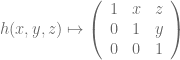
To start, we first identify our \mathbb{R}^3 with the 3 \times 3 real entry Heisenberg group H^3 (all 3 \times 3 upper triangular matrices with “1”s on the diagonal). i.e. we have homeomorphism

h(x,y,z) \mapsto \left( \begin{array}{ccc}  1 & x & z \\  0 & 1 & y \\  0 & 0 & 1 \end{array} \right)

Let g be a left-invariant metric on H_3.

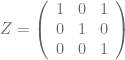
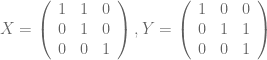
In the Lie algebra T_e(H_3) (tangent space of the identity element), the elements X = \left( \begin{array}{ccc}  1 & 1 & 0 \\  0 & 1 & 0 \\  0 & 0 & 1 \end{array} \right) , Y = \left( \begin{array}{ccc}  1 & 0 & 0 \\  0 & 1 & 1 \\  0 & 0 & 1 \end{array} \right) and Z = \left( \begin{array}{ccc}  1 & 0 & 1 \\  0 & 1 & 0 \\  0 & 0 & 1 \end{array} \right) form a basis.
At each point, we take the two dimensional sub-bundle E(H_3) of the tangent bundle generated by infinitesimal left translations by X, Y. Since the metric g is left invariant, we are free to restrict the metric to E(M) i.e. we have ||X_p|| = ||Y_p|| = 1 for each p \in M.

The interesting thing about H_3 is that all points are accessible from the origin via curves everywhere tangent to E(H_3). In other words, any points can be obtained by left translating any other point by multiples of elements X and Y.

The “unit grid” in \mathbb{R}^3 under this sub-Riemannian metric looks something like:

Since we have

\left( \begin{array}{ccc}  1 & x & z \\  0 & 1 & y \\  0 & 0 & 1 \end{array} \right) \left( \begin{array}{ccc}  1 & 1 & 0 \\  0 & 1 & 0 \\  0 & 0 & 1 \end{array} \right) = \left( \begin{array}{ccc}  1 & x+1 & z \\  0 & 1 & y \\  0 & 0 & 1 \end{array} \right) ,

the original x-direction stay the same, i.e. a bunch of horizontal lines connecting the original yz planes orthogonally.

However, if we look at a translation by Y, we have

\left( \begin{array}{ccc}  1 & x & z \\  0 & 1 & y \\  0 & 0 & 1 \end{array} \right) \left( \begin{array}{ccc}  1 & 0 & 0 \\  0 & 1 & 1 \\  0 & 0 & 1 \end{array} \right) = \left( \begin{array}{ccc}  1 & x & z+x \\  0 & 1 & y+1 \\  0 & 0 & 1 \end{array} \right)

i.e. a unit length Y-vector not only add a 1 to the y-direction but also adds a height x to z, hence the grid of unit Y vectors in the above three yz planes look like:

We can now try to see the rough shape of balls by only allowing ourselves to go along the unit grid formed by X and Y lines constructed above. This corresponds to accessing all matrices with integer entry by words in X and Y.

The first question to ask is perhaps how to go from (0,0,0) to (0,0,1). –since going along the z axis is disabled. Observe that going through the following loop works:

We conclude that d_C((0,0,0), (0,0,1)) \leq 4 in fact up to a constant going along such loop gives the actual distance.

At this point one might feel that going along z axis in the C-C metric is always takes longer than the ordinary distance. Giving it a bit more thought, we will find this is NOT the case: Imagine what happens if we want to go from (0,0,0) to (0,0,10000)?

One way to do this is to go along X for 100 steps, then along Y for 100 steps (at this point each step in Y will raise 100 in z-coordinate, then Y^{-100} X^{-100}. This gives d_C((0,0,0), (0,0,10000)) \leq 400.

To illustrate, let’s first see the loop from (0,0,0) to (0,0,4):

The loop has length 8. (A lot shorter compare to length 4 for going 1 unit in z-direction)

i.e. for large Z, it’s much more efficient to travel in the C-C metric. d_C( (0,0,0), (0,0,N^2)) = 4N

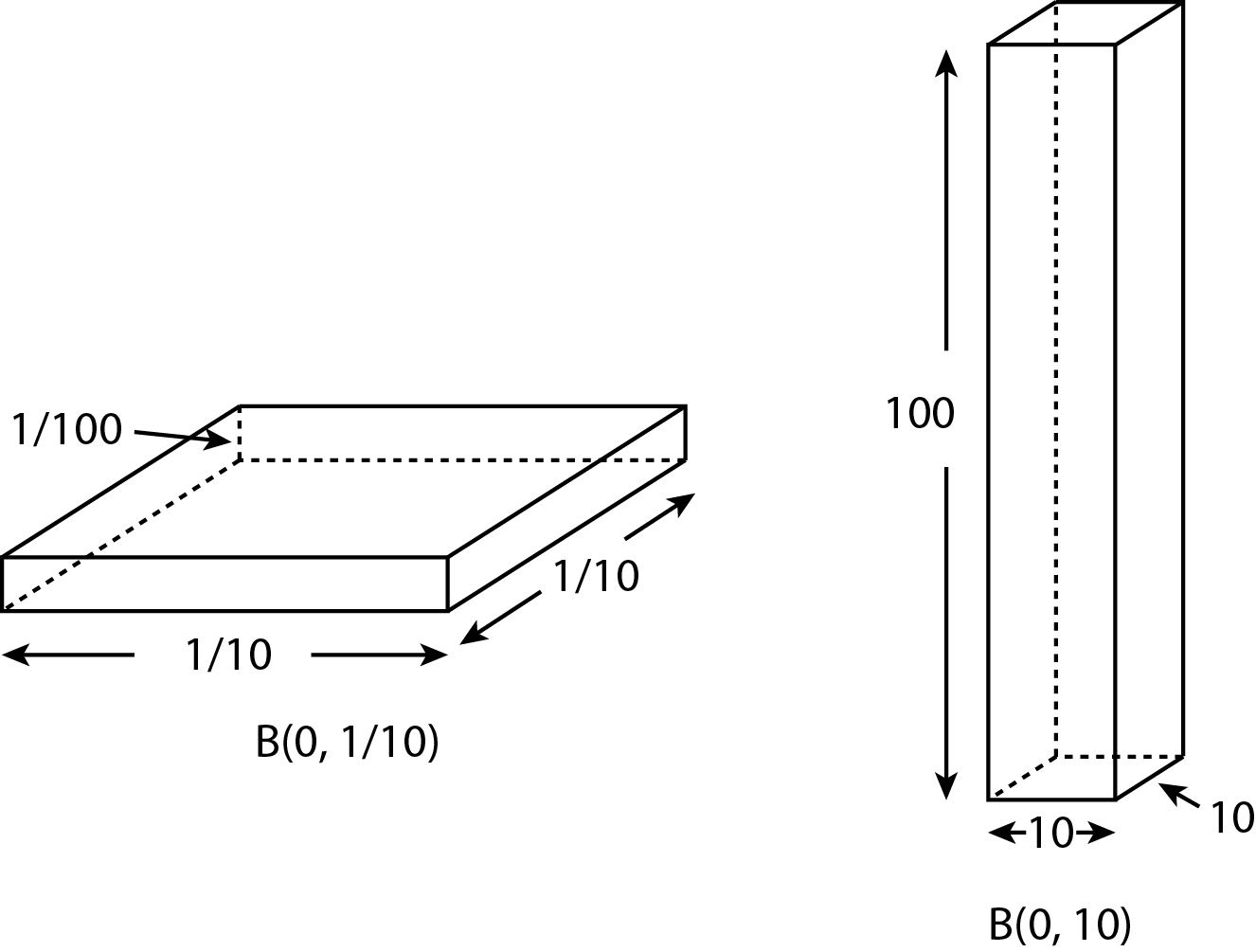
In fact, we can see the ball of radius N is roughly an rectangle with dimension R \times R \times R^2 (meaning bounded from both inside and outside with a constant factor). Hence the volume of balls grow like R^4.

Balls are very “flat” when they are small and very “long” when they are large.

Isoperimetric inequality on groups

Back in high school, we have all learned and loved the isoperimetric inequality: “If one wants to enclose a region of area \pi on the plane, one needs a rope of length at least 2 \pi.” or equivalently, given U \subseteq \mathbb{R}^2 bounded open, we always have

\ell(\partial U) \geq 2 \sqrt{\pi} \sqrt{\mbox{Area}(U)}

Of course this generalizes to \mathbb{R}^n:

Theorem: Given any open set U \subseteq \mathbb{R}^n, we have

\mbox{vol}_{n-1}\partial (U) \geq n\cdot \omega_n^{1/n} \mbox{vol}_n(U)^{\frac{n-1}{n}}

Here \omega_n is the volume of the unit n-ball. Note that the inequality is sharp for balls in \mathbb{R}^n.

One nature question to ask should be: for which other kind of spaces do we have such an inequality. i.e. when can we lower bound the volume of the boundary by in terms of the volume of the open set? If such inequality exists, how does the lower bound depend on the volume of the set?

I recently learned to produce such bounds on groups:
Let G be a discrete group, fix a set of generators and let C_G be its Cayley graph, equipped with the word metric d.

Let N(R) = |B_R(e)| be the cardinality of the ball of radius R around the identity.

For any set U \subseteq G, we define \partial U = \{g \in G \ | \ d(g, U) = 1 \} i.e. points that’s not in U but there is an edge in the Cayley graph connecting it to some point in U.

Theorem:For any group with the property that N(R) \geq c_n R^n, then for any set U \subseteq G with |U| \leq \frac{1}{2}|G|,

|\partial U| \geq c_n |U|^{\frac{n-1}{n}}.

i.e. If the volume of balls grow (w.r.t. radius) as fast as what we have in \mathbb{R}^n, then we can lower bound the size of boundary any open set in terms of its volume just like what we have in \mathbb{R}^n.

Proof: We make use of the fact that right multiplications by elements of the group are isometries on Cayley graph.

Let R = (\frac{2}{c_n}|U|)^\frac{1}{n}, so we have |B_R(e)| \geq 2|U|.

For each element g \in B_R(e), we look at how many elements of U went outside of U i.e. | Ug \backslash U|. (Here the idea being the size of the boundary can be lower bounded in terms of the length of the translation vector and the volume shifted outside the set. Hence we are interested in finding an element that’s not too far away from the identity but shifts a large volume of U outside of U.)

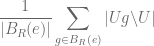
The average value of |Ug \backslash U| as g varies in the ball B_R(e) is:

\displaystyle \frac{1}{|B_R(e)|} \sum_{g\in B_R(e)} |Ug \backslash U|

The sum part is counting the elements of U that’s translated outside U by g then sum over all g \in B_R(e), this is same as first fixing any u \in U, count how many g sends u outside U, and sum over all u \in U ( In fact this is just Fubini, where we exchange the order of two summations ). “how mant g \in B_R(e) sends u outside of U” is merely |uB_R(e) \backslash U|.

Hence the average is

\displaystyle \frac{1}{|B_R(e)|} \sum_{u\in U}|uB_R(e) \backslash U|.

But we know |B_R(e)| \geq 2 \cdot |U|, hence |uB_R(e) \backslash U| is at least \frac{1}{2}|B_R(e)|.

Hence

\displaystyle \frac{1}{|B_R(e)|} \sum_{u\in U}|uB_R(e) \backslash U|

\geq \frac{1}{|B_R(e)|} \cdot |U| \cdot \frac{1}{2} |B_R(e)| = \frac{1}{2} |U|

Now we can pick some g \in B_R(e) where |Ug \backslash U| \geq \frac{1}{2}|U| (at least as large as average).

Since g has norm at most R, we can find a word g_1 g_2 \cdots g_k = g, \ k \leq R.

For any ug \in (Ug \backslash U), since u \in U and ug \notin U, there must be some 1\leq i\leq k s.t. u(g_1\cdots g_{i-1}) \in U and u(g_1\cdots g_i) \notin U.

Hence u g_1 \cdots g_i \in \partial U, ug \in \partial U \cdot g_{i+1} \cdots g_k.

We deduce that \displaystyle Ug \backslash U \subseteq \partial U \cup \partial U g_k \cup \cdots \cup \partial U g_2 \cdots g_k i.e. a union of k copies of \partial U.

Hence R |\partial U| \geq k |\partial U| \geq |Ug \backslash U| \geq \frac{1}{2}|U|

|\partial U| \geq \frac{|U|}{2R}

Since |B_R(e)| \geq c_n R^n, we have R \leq c_n |B_R(e)|^{\frac{1}{n}}. R = (\frac{2}{c_n}|U|)^\frac{1}{n} = c_n |U|^\frac{1}{n}, hence we have

|\partial U| \geq c_n |U|^\frac{n-1}{n}

Establishes the claim.

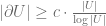
Remark: The same argument carries through as long as we have a lower bound on the volume of balls, not necessarily polynomial. For example, on expander graphs, the volume of balls grow exponentially: B_R(e) \geq c \cdot e^R, then trancing through the argument we get bound
|\partial U| \geq c \cdot \frac{|U|}{\log{|U|}}

Which is a very strong isoperimetric inequality. However in fact the sharp bound for expanders is |\partial U| \geq c \cdot |U|. But to get that one needs to use more information of the expander than merely the volume of balls.

On the same vein, we can also prove a version on Lie groups:

Theorem:Let G be a Lie group, g be a left invariant metric on G. If \mbox{vol}_n(B_R) \geq c_n R^n then for any open set U with no more than half of the volume of G,

\mbox{vol}_{n-1}(\partial U) \geq c_n \mbox{vol}_n(U)^\frac{n-1}{n}.

Note that to satisfy the condition \mbox{vol}_n(B_R) \geq c_n R^n, our Lie group must be at least n-dimensional since if not the condition would fail for small balls. n might be strictly larger than the dimension of the manifold depending on how ‘neigatively curved’ the manifold is in large scale.

Sketch of proof: As above, take a ball twice the size of the set U around the identity, say it’s B_R(e). Now we consider all left translates of the set U by element in B_R(e). In average an element shifts at least half of U outside of U. Pick element g where \mbox{vol}(gU \backslash U) is above average.

Let \gamma: [0, ||g||] be a unit speed geodesic connecting e to g. Consider the union of left translates of \partial U by elements in \gamma([0, ||g||]), this must contain all of gU \backslash U since for any gu \notin U the segment \gamma([0,||g||]) \cdot u must cross the boundary of U, i.e. there is c \in [0,||g||] where \gamma(c) u \in \partial U, hence

g\cdot u = \gamma(||g||) \cdot u = \gamma(||g||-c)\gamma(c) u \in \gamma(||g||-c) \cdot \partial U

But since the geodesic has derivative 1, the n-dimensional volume of the union of those translates is at most \mbox{vol}_{n-1}(\partial U) \cdot ||g||.

We have \mbox{vol}_{n-1}(\partial U) \cdot R \geq \mbox{vol}_n(gU \backslash U) \geq \mbox{vol}_n(U)/2

Now since we have growth condition

2\mbox{vol}_n(U) = \mbox{vol}_n(B_R) \geq c_n R^n

i.e. R \leq c_n \mbox{vol}_n(U)^\frac{1}{n}.

Conbine the two inequalities we obtain

\mbox{vol}_{n-1}(\partial U) \geq c_n \mbox{vol}_n(U)^\frac{n-1}{n}.

Establishes the theorem.

Remark: In general, this argument produces a lower bound on the size of the boundary in terms of the volume of the set as long as:
1. There is a way to ‘continuously translate’ the set by elements in the space.
2. We have a lower bound on the growth of balls in terms of radius.

The key observation is that the translated set minus the original set is always contained in a ‘flattened cylinder’ of the boundary in direction of the translate, which then has volume controlled by the boundary size and the length of the translating element. Because of this, the constant is almost never strict as the difference (translate subtract original) can never be the whole cylinder (in case of a ball, this difference is a bit more than half of the cylinder).

On Uryson widths

This is a note on parts of Gromov’s paper ‘width and related invariants of Riemannian manifolds’ (1988).

For a compact subset C of \mathbb{R}^n, we define the k-codimensional width (or simply k-width) to be the smallest possible number w where there exists a k-dimensional affine subspace P_k \subseteq \mathbb{R}^n s.t. all points of C is no more than w away from P_k.

i.e.

\displaystyle{W}_k(C) = \inf_{P_k \subseteq \mathbb{R}^n} \sup_{p\in C} \mbox{dist}(p, P_k)
where \mbox{dist}(p, P_k) is the length of the orthogonal segment from p to P_k.

It’s easy to see that, for any C,

\mathcal{W}_0(C) \geq  \mathcal{W}_1(C) \geq \cdots \geq \mathcal{W}_n(C) = 0.

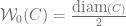
At the first glance it may seems that \mathcal{W}_0(C) = \frac{\mbox{diam}(C)}{2}. However it is not the case since for example the equilateral triangle of side length 1 in \mathbb{R}^2 has diameter 1 but 0-width \frac{1}{\sqrt{3}}. In fact, by a theorem of Jung, this is indeed the optimum case, i.e. we have:

\frac{1}{2}\mbox{diam}(C) \leq \mathcal{W}_0(C) \leq \sqrt{\frac{n}{2(n+1)}}\mbox{diam}(C)

At this point one might wonder (at least I did), if we want to invent a notion that captures the ‘diameter’ after we ‘forget the longest k-dimensions’, a more direct way seem to be taking the smallest possible number w' where there is an orthogonal projection of C onto a k dimensional subspace P_k where any point p \in P_k has pre-image with diameter \leq w'.

i.e.

\displaystyle \widetilde{\mathcal{W}_k}(X) = \inf_{P_k \subseteq \mathbb{R}^n} \sup_{p \in P_k} \mbox{diam}(\pi^{-1}_{P_k}(p))

Now we easily have \mbox{diam}(C) = \widetilde{\mathcal{W}_0}(C) \geq  \widetilde{\mathcal{W}_1}(C) \geq \cdots \geq \widetilde{\mathcal{W}_n}(C) = 0.

However, the disadvantage of this notion is, for example, there is no reason for a semicircle arc to have 1-width 0 but a three-quarters circular arc having positive 1-width.

Since we are measuring how far is the set from being linear, taking convex hull should not make the set ‘wider’ \widetilde{\mathcal{W}_k}, unlike \widetilde{\mathcal{W}_k} is not invariant under taking convex hulls. Note that for convex sets we do have

\frac{1}{2}\widetilde{\mathcal{W}_k}(C) \leq \mathcal{W}_k(C) \leq \sqrt{\frac{n-k}{2(n-k+1)}}\widetilde{\mathcal{W}_k}(C)

\mathcal{W}_k(C) = 0 iff C is contained in a k-plane.

We now generalize this notion to general metric spaces:

Definition: The Uryson k-width of a compact metric space M is the smallest number w where there exists k dimensional topological space X and a continuous map \pi: M \rightarrow X where any point x \in X has pre-image with diameter \leq w.

i.e. \displaystyle UW_k(M) = \inf \{ \ \sup_{x \in X} \mbox{diam}(\pi^{-1}(x)) \ |

\dim{X} = k, \pi:M \rightarrow X \ \mbox{is continuous} \}

Note: Here dimension is the usual covering dimension for topological spaces: i.e. a topological space X is n dimensional if any finite cover of X has a finite refinement s.t. no point of X is contained in more than n_1 sets in the cover and n is the smallest number with this property.

For compact subsets C of \mathbb{R}^n with induced metric, we obviously we have UW_k(C) \leq \widetilde{\mathcal{W}_k}(C) since the pair (P_k, \pi_{p_k}) is clearly among the pairs we are minimizing over.

Speaking of topological dimensions, one of the classical results is the following:

Lebesgue’s lemma: Let M=[0,1]^n be the solid n-dimensional cube, then for any topological space X with \dim(X)<n and any continuous map p: M \rightarrow X, we have image of at least one pair of opposite (n-1)-faces intersect.

Since the conclusion is purely topological, this applies equally well to rectangles. i.e. for M = [0, L_1] \times [0, L_2] \times \cdots \times [0, L_n], L_1 \geq L_2 \geq \cdots \geq L_n, we have UW_{n-1}(M) \geq L_n; furthermore, UW_k(M) \geq L_{k+1} for all k.

(If the later statement does not hold, we write M as M_1 \times M_2, M_1 being the product of the first (k+1) coordinates. Now UW_k(M) \geq UW_k(M_1) \geq L_{k+1}).

In light of the earlier post about minimax inequality, we should note that if we restrict X to be a homeomorphic copy of \mathbb{R}^k then the notion is the same as the minimax length of fibres. In particular as proved in the post the minimax length of the unit disc to \mathbb{R} is 2.

Exercise: Check that for the unit 2-disk, UW_1(D^2) = \sqrt{3}, i.e. the optimum is obtained by contracting the disc onto a triod.

Hence it can indeed be strictly smaller than merely taking \mathbb{R}^k as the targeting space, even for simply connected sets. This gives a better measurement of ‘width’ in the sense that, for example, the \varepsilon neighborhood of a tree will have 1-width about 2 \varepsilon.

Intergal geometry and the minimax inequality in a nutshell

The goal for most of the posts in this blog has been to take out some very simple parts of certain papers/subjects and “blow them up” to a point where anybody (myself included) can understand. Ideally the simple parts should give some inspirations and ideas towards the more general subject. This one is on the same vein. This one is based on parts of professor Guth’s minimax paper.

In an earlier post, we talked about the extremal length where one is able to bound the “largest possible minimum length” (i.e. the “maximum minimum length“) of a family of rectifiable curves under conformal transformation. When combined with the uniformization theorem in for surfaces, this becomes a powerful tool for understanding arbitrary Riemannian metrics (and for conformal classes of metrics in higher dimensions).

However, in ‘real life’ we often find what we really want to bound is, instead, the “minimum maximum length” of a family of curves, for example:

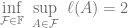
Question: Let \mathbb{D} \subseteq \mathbb{R}^2 be the unit disc. Given any family \mathcal{F} of arcs with endpoints on \partial \ \mathbb{D} and \mathcal{F} foliates \mathbb{D}, then how short can the logest arc in \mathcal{F} possibly be?

In other words, let \mathbb{F} be the collection of all possible such foliations \mathcal{F} as above, what is

\displaystyle \inf_{\mathcal{F} \in \mathbb{F}} \ \sup_{A \in \mathcal{F}} \ \ell(A)?

After playing around a little bit with those foliations, we should expect one of the fibres to be at least as long as the diameter ( i.e. no foliation has smaller maximum length leaf than foliating by straight lines ). Hence we should have

\displaystyle \inf_{\mathcal{F} \in \mathbb{F}} \ \sup_{A \in \mathcal{F}} \ \ell(A) = 2.

This is indeed easy to prove:

Proof: Consider the map f: S^1 \rightarrow S^1 where S^1 = \partial \ \mathbb{D}, f switches the end-points of each arc in \mathcal{F}. It is easy to check that f is a continuous, orientation reversing homeomorphism of the circle (conjugate to a reflection). Let p, q be its fixed points, L_1, L_2 be the two arcs in S^1 connecting p to q.

Let

g: z \mapsto -z

be the antipodal map on S^1.

Suppose p \neq g(q) then one of L_1, L_2 is longer than \pi, say it’s L_1.

Then we have

f \circ g (L_1) \subseteq L_1.

Hence f \circ g has a fixed point m in L_1, i.e. f(m) = -m.

There is a fibre A in \mathcal{F} with endpoints m, -m, the fibre must have length

\ell(A) \geq d(-m,m) = 2.

The remaining case is trivial: if p = g(q) then both L_1 and L_2 gets mapped into themselves orientation-reversingly, hence fixed points still exists.

Establishes the claim.

Instead of the disc, we may look at circles that sweep out the sphere (hence to avoid the end-point complications):

Theorem: Any one-parameter family of circles that foliates S^2 (except two points) must have the largest circle being longer than the equator.

This is merely applying the same argument, i.e. one of the circles needs to contain a pair of antipodal points hence must be longer than the equator.

In order for easier generalization to higher dimensions, with slight modifications, this can be formulated as:

Theorem: For any f: T^2 \rightarrow S^2 having non-zero degree, there is \theta \in S^1 where \ell(f(S^1 \times \{ \theta \}) is larger than the equator.

Hence in higher dimensions we can try to prove the same statement for largest image of a lever k-sphere under f: S^k \times S^{n-k} \rightarrow S^n. However before we do that I would like to highlight some intergal geometry machineries that are new to me but seemingly constantly used in proving those kinds of estimates. We shall get some idea of the method by showing:

Theorem: Let \mathbb{R}P^n be equipped with the round metric. p^k \subseteq  \mathbb{R}P^n be a ‘flat’ k-dimensional plane. Then any k-chain z^k \subseteq \mathbb{R}P^n in the same k dimensional homology class as p^k must have volume at least as large as p^k.

Proof: Let Gr(\mathbb{R}P^n, n-k) be the set of all (n-k)-planes in \mathbb{R}P^n (i.e. the Grassmannian).

There is a standard way to associate a measure \mu on Gr(\mathbb{R}P^n, n-k):

Let \lambda be the Haar measure on SO(n+1), fix some Q \in Gr(\mathbb{R}P^n, n-k).

Since SO(n+1) acts on \mathbb{R}P^n, for open set S \subseteq Gr(\mathbb{R}P^n, n-k), we set

\mu(S) = \lambda( \{ T \in SO(n+1) \ | \ T(Q) \in S \}).

–The measure of a collection of planes is the measure of linear transformations that takes the given plane to an element of the set.

Now we are able to integrate over all (n-k)-planes!

For almost all Q \in Gr(\mathbb{R}P^n, n-k), since P is k-plane, we have | Q \cap P | = 1. ( not 1 only when they are ‘parallel’ )

Since [z] = [p] in H_k(\mathbb{R}P^n, \mathbb{Z}_2), for almost all Q, z intersects Q at least as much as P does. We conclude that for almost all Q, \ | z \cap Q | \geq 1.

Fact: There exists constant C such that for any k-chain \Sigma^k \in \mathbb{R}P^N,

\mbox{Vol}_k(\Sigma^k) = \mathbb{E}(|\Sigma \cap Q |).

The fact is obtained by diving the chain into fine cubes, observe that both volume and expectation are additive and translation invariant. Therefore we only need to show this for infinitesimal cubes (or balls) near 0. We won’t work out the details here.

Hence in our case, since for almost all Q we have | z \cap Q | \geq 1, the expectation \mathbb{E}(|z \cap Q |) \geq 1.

We therefore deduce

\mbox{Vol}_k(z) = \mathbb{E}(|z \cap Q |) \geq 1.

Establishes the theorem.

Remark: I found this intergal geometry method used here being very handy: in the old days I always try to give lower bounds on volume of stuff by intersecting it with planes and then pretend the ‘stuff’ were orthogonal to the plane, which is the worst case in terms of having small volume. An example of such bound can be found in the knot distorsion post where in order to lower bound the length we look at its intersection number with a family of parallel planes and then integrate the intersection.

This is like looking from one particular direction and record how many times did a curve go through each height, of course one would never get the exact length if we know the curve already. What if we are allowed to look from all directions?

I always wondered if we know the intersection number with not only a set of parallel planes but planes in all directions, then are there anything we can do to better bound the volume? Here I found the perfect answer to my question: by integrating over the Grassmannian, we are able to get the exact volume from how much it intersect each plane!

We get some systolic estimates as direct corollaries of the above theorem, for example:

Corollary: \mbox{Sys}_1(\mathbb{R}P^2) = \sqrt{\pi/2} where \mathbb{R}P^2 carries the round metric with total volume 1.

Back to our minimax problems, we state the higher dimensional version:

Wish: For any C^1 map f: S^k \times S^{n-k} \rightarrow S^n where S^n carries the standard round metric, there exists some \theta \in S^{n-k} with

\mbox{Vol}_k(f(S^k\times \{\theta\})) \geq \mbox{Vol}_k(E^k)

where E^k \subseteq S^n is the k-dimensional equator.

But what we have is that there is a (small) positive constant c(n,k) s.t. \mbox{deg}(f) \neq 0 implies

\displaystyle \sup_{\theta \in S^{n-k}} \mbox{Vol}_k(f(S^k \times \{\theta\})) \geq c(n,k) \mbox{Vol}_k(E^k)

(shown by an inductive application of the isomperimetric inequality on S^N, which is obtained from applying intergal geometry methods)