On length and volume

About a year ago, I came up with an simple argument for the following simple theorem that appeared in a paper of professor Guth’s:

Theorem: If U is an open set in the plane with area 1, then there is a continuous function f from U to the reals, so that each level set of f has length at most 10.

Recently a question of somewhat similar spirit came up in a talk of his:

Question: Let \langle \mathbb{T}^2, g \rangle be a Riemannian metric on the torus with total volume 1, does there always exist a function f: \mathbb{T}^2 \rightarrow \mathbb{R} s.t. each level set of f has length at most 10?

I have some rough thoughts about how might a similar argument on the torus look like, hence I guess it would be a good idea to review and (somewhat carefully) write down the original argument. Since our final goal now is to see how things work on a torus (or other manifolds), here I would only present the less tedious version where U is bounded and all boundary components of U are smooth Jordan curves. Here it goes:

Proof: Note that if a projection of U in any direction has length (one-dimensional measure) \leq 10, then by taking f to be the projection in the orthogonal direction, all level sets are straight with length \leq 10 (see image below).

Hence we can assume any 1-dimensional projection of U has length \geq 10. A typically bad set would ‘span’ a long range in all directions with small area, it can contain ‘holes’ and being not connected:

Project U onto x and y-axis, by translating U, we assume \inf \pi_x(U) = \inf \pi_y(U) = 0. Look at the measure 1 set S in the middle of \pi_y(U) (i.e. a measure 1 set [a,b] \cap \pi_y(U) with the property m_1(\pi_y(U) \cap [0,a]) = m_1(\pi_y(U) \cap [b, \infty])

By Fubini, since the volume \pi_y^{-1}(S) is at most 1, there must be a point p\in S with m_1(\pi_y^{-1}(p))\leq 1:

Since the boundary of U is smooth, we may find a very small neighborhood B_\delta(p) \subseteq \mathbb{R} where for each q \in B_\delta(p), m_1(\pi_y^{-1}(q) \leq 1+\epsilon. (we will call this pink region a ‘neck’ of the set for it has small width and is roughly in the middle)

Now we define a \varphi_1: U \rightarrow \mathbb{R}^2 that straches the neck to fit in a long thin tube (note that in general \pi_y(U) may not be connected, but everything is still well-defined and the argument does go through.) and then bend the neck to make the top chunk vertically disjoint from the bottom chunk.

We can take \varphi so that \varphi^{-1} sends the vertical foliation of \varphi(U) to the following foliation in U (note that here we drew the neck wider for easier viewing, in fact the horizontal lines are VERY dense in the neck).

If the y-projection of the top or bottom chunk is larger than 2, we repeat the above process t the chunks. i.e. Finding a neck in the middle measure 1 set in the chunk, starch the neck and shift the top chunk, this process is guaranteed to terminate in at most m_1(\pi_y(U)) steps. The final \varphi sends U to something like:

Where each chunk has y-width L between 1 and 2.

Define f = \pi_x \circ \phi.

Claim: For any c \in \mathbb{R}, m_1(f^{-1}(c)) \leq 5.

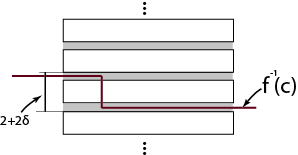
The vertical line x=c intersects \varphi(U) in at most one chunk and two necks, taking \varphi^{-1} of the intersection, this is a PL curve C with one vertical segment and two horizontal segment in U:

The total length of f^{-1}(c) = C \cap U is less than 2+2\delta (length of U on the vertical segment) + 2 \times (1+\epsilon) (length of U on each horizontal segment). Pick \epsilon, \delta both less than 1/4, we conclude m_1(f^{-1}(c)) < 5.

Establishes the theorem.

Remark:More generally,any open set of volume V has such function with fibers having length \leq 5 \sqrt{V}. T he argument generalizes by looking at the middle set length \sqrt{V} set of each chunk.

Moving to the torus

Now let’s look at the problem on \langle \mathbb{T}^2, g \rangle, by the uniformization theorem we have a flat torus T^2 = \mathbb{R}^2/\Gamma where \Gamma is a lattice, \mbox{vol}(T^2) = 1 and a function h: T^2 \rightarrow \mathbb{R}^{+} s.t. \langle T^2, h g_0 \rangle is isometric to \langle \mathbb{T}^2, g \rangle. g_0 is the flat metric. Hence we only need to find a map on T^2 with short fibers.

Note that

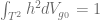
\int_{T^2} h^2 d V_{g_0} = 1

and the length of the curve \gamma from p to q in \langle T^2, h \dot{g_0} \rangle is

\int_I h |\gamma'(t)| dt.


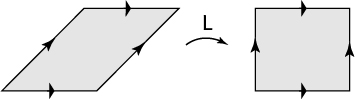
Consider T^2 as the parallelogram given by \Gamma with sides identified. w.l.o.g. assume one side is parallel to the x-axis. Let L be a linear transformation preserving the horizontal foliation and sends the parallelogram to a rectangle.

Let F be a piece-wise isometry that “folds” the rectangle:

(note that F is four-to-one except for on the edges and the two medians)
Since all corresponding edges are identified, $lates F$ is continuous not only on the rectangle but on the rectangular torus.

Now we consider F \circ L, pre-image of typical horizontal and vertical lines in the small rectangle are union of two parallel loops:

Note that vertical loops might be very long in the flat T^2 due to the shear while the horizontal is always the width.

(to be continued)

Systoles and the generalized Geroch conjecture

Almost a year ago, I said here that I would write a sequence of posts on some simple facts and observations related to the systolic inequality but got distracted and didn’t manage to do much of that…

I was reminded last week as I heard professor Guth’s talk on systoles for the 4th time (Yes, the same talk! –in Toronto, Northwestern, India and here at the IAS). It’s interesting that I’m often thinking about different things each time I hear the same talk. This one is about the generalized Geroch conjecture.

Geroch conjecture: \mathbb{T}^n (the n-torus) does not admit a metric of positive scalar curvature.

The conjecture is proved by Schoen and Yau (1979).

Now, scalar curvature can be seen as a limit of volume of balls:

Definition: The scalar curvature of M at p is

\displaystyle \mbox{Sc}(p) = c_n \lim_{r\rightarrow 0} \frac{\mbox{Vol}_E (B(\bar{0},r)) - \mbox{Vol}_g(B(p,r))}{r^{n+2}}

where \mbox{Vol}_E is the Euclidian volume and c_n is a positive constant only depending on the dimension n.

Note that since our manifold does not have any cone points,

\displaystyle \lim_{r\rightarrow 0} \frac{\mbox{Vol}_E (B(\bar{0},r)) - \mbox{Vol}_g(B(p,r))}{r^n}

must vanish. Further more, the Riemannian structure on M forces the r^{n+1} term to vanish.

Since for this context we only care about is whether the scalar curvature is larger or smaller than 0, we can be even more simple-minded: M has positive scalar curvature at p all small enough balls around p has smaller volume than their Euclidean cousins (with a difference of order propositional to r^{n+2}). In light of this definition, we have:

Restatement of the Geroch conjecture: For all g on \mathbb{T}^n, there exists some point p s.t. \mbox{Sc}(p) \leq 0.

This is to say, small enough balls around some point $p$ are not small enough for it to have positive scalar curvature. What if instead we look at balls of a fixed radius instead of those infinitesimal balls? This naturally leads to

Generalized Geroch conjecture: For any (\mathbb{T}^n, g), for all r, there exists p s.t. \mbox{Vol}_g(B(p, r)) \geq \mbox{Vol}_E(B(\bar{0}, r)).

(For those r larger than the injectivity radius, we lift M to its universal cover so that all homotopically non-trival loops are ‘unfolded’)

Let’s take a look at the 2-torus to get a feel of the conjecture:

The flat torus, of course, has 0 r-scalar curvature at all points.

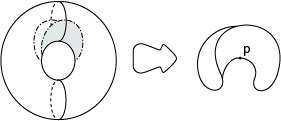
For the regular rotational torus, we take the ball around the saddle point of the gradient flow, the ball look like a saddle, as shown below.

To see that this has area larger than the analogous Euclidean ball, we can cut it along radial rays into thin triangles, each triangle can be ‘almost flattened’ to a Euclidean triangle, but we have a more triangles than in the Euclidean case.

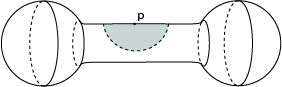
What if we try to make the surface spherical for most of the area and having those negative scalar curvature points taking up a very small potion. One of my first attempts would be to connect a few spheres with cylinders:

We have a few parameters here: the number of balls n, the width of the connecting cylinders w, the length of the connecting cylinders l and the radius of each sphere R.

If cylinders are too long (longer than 2r), then we can just take the ball in the middle of the cylinder, the volume when lifted to universal cover would be equal to Euclidean.

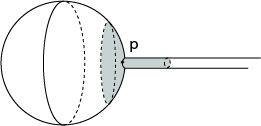
If the width of cylinders are much smaller than r, then the ball around a point in the gluing line would have volume almost a full spherical ball plus a half Euclidean ball, which would obviously be larger than a full Euclidean ball.

Hence the more interesting case is to have very short, wide tubes and as a consequence, have many balls forming a loop. In this case, the ‘worst’ ball would be centered at the middle of the tube, it intersects the two spheres connected by the tube in something a bit larger than a spherical half-ball.

I haven’t figured out an estimate yet. i.e. can the advantage taken from the fact that spherical ball are smaller than Euclidean balls cancel out the ‘a bit larger than half’? I think that would be interesting to work out.

Finally, let’s say what does this has to do with systoles:

Theorem: Generalized Geroch conjecture \Rightarrow \mbox{Sys}(\mathbb{T}^n, g) \leq \frac{2}{\omega_n^{\frac{1}{n}}} \mbox{Vol}_g(\mathbb{T}^n)^{\frac{1}{n}} (which is the systolic inequality with a constant better than what we have so far)

Proof: Suppose not,

\mbox{Sys}(\mathbb{T}^n, g) > 2 (\frac{\mbox{Vol}_g(\mathbb{T}^n)}{\omega_n})^{\frac{1}{n}}

Let r = (\frac{\mbox{Vol}_g(\mathbb{T}^n)}{\omega_n})^{\frac{1}{n}}, by the generalized Geroch conjecture we have some B(p, r) larger than the Euclidean ball. i.e.

\mbox{Vol}_g(B(p, r))>\omega_n r^n = \omega_n \frac{\mbox{Vol}_g(\mathbb{T}^n)}{\omega_n} = \mbox{Vol}_g(\mathbb{T}^n)

Since the systole is at least 2r, hence B(p, r) cannot contain any homotopically non-trival loop i.e. it does not “warp around” and get unfolded when passing to the universal cover. Hence volume of a ball with radius r cannot be larger than the volume of the whole manifold. Contradiction

Systolic inequality on the 2-torus

Starting last summer with professor Guth, I’ve been interested in the systolic inequality for Riemannian manifolds. As a starting point of a sequence of short posts I plan to write on little observations I had related to the subject, here I’ll talk about the baby case where we find the lower bound of the systole on the 2-torus in terms of the area of the torus.

Given a Riemannian manifold (M, g) where g is the Riemannian metric.

Definition: The systole of M is the length of smallest homotopically nontrivial loop in M.

We are interested in bounding the systole in terms of the n-th root of the volume of the manifold ( where n is the dimension of M ).

Note that the systole is only defined when our manifold has non-trivial fundamental group. I wish to remark that for the case of n-torus, having an inequality of the form (\mbox{Sys}(\mathbb{T}^n))^n \leq C \cdot \mbox{Vol}(\mathbb{T}^n) is intuitive as we can see in the case of an embedded 2-torus in \mathbb{R}^3, we may deform the metric (hence the embedding) to make a non-contactable loop as small as we want while keep the volume constant, however when we attempt to make the smallest such loop large when not changing the volume, we can see that we will run into trouble. Hence it’s expected that there is an upper bound for the length of the smallest loop.

Since if only one loop in some homotopy class achieves that minimal length, we should be able to enlarge it and contract some other loops in that class to enlarge the systole and keep the volume constant. Hence it’s tempting to assume that all loops in the same class are of the same length. In the 2-torus case, such thing is the flat torus. Since any flat torus has systole proportional to (\mbox{Vol}(\mathbb{T}^2))^{\frac{1}{2}}, we have reasons to expect the optimal case fall inside this family. i.e.

(\mbox{Sys}(\mathbb{T}^2))^2 \leq C \cdot \mbox{Vol}(\mathbb{T}^2).

This is indeed the case. The result was given in an early unpublished result by Loewner.

Let’s first optimize in the class of flat torus:

My first guess was that C cannot be made less than 1 i.e. the torus \mathbb{R}^2/ \mathbb{Z}^2 is the optimum case. However, this is not true. Let’s be more careful:

\mathbb{T}^2 = \mathbb{R}^2 / (0,c)\mathbb{Z} \times (a, b)\mathbb{Z}

Since by scaling does not change ratio between (\mbox{Vol}(\mathbb{T}^2)) and (\mbox{Sys}(\mathbb{T}^2))^2, we may normalize and let c=1

Let \alpha, \beta be generators of the fundamental group of \mathbb{T}^2 length of all geodesic loops in class [\alpha], \ [\beta] are the side lengths of the parallelepiped i.e. 1 and ||(a,b)||. W.L.O.G we suppose a, b > 0. \alpha \beta^{-1} has length ||((1-a),b)|| and all geodesics in other classes are at least twice as long as one of the above three.

Hence the systole is maximized when those three are equal, we get a=1/2, b=\sqrt{3}/2. The systole in this case is 1 and the volume is \sqrt{3}/2. Hence for any flat torus, we have

(\mbox{Sys}(\mathbb{T}^2))^2 \leq \frac{2}{\sqrt{3}} \cdot \mbox{Vol}(\mathbb{T}^2).

Theorem (Loewner): This bound holds for any metric g on \mathbb{T}^2.

Proof: We will show this by reducing the case to flat metric.

g induced an almost complex structure on \mathbb{T}^2, on surfaces, any almost complex structure is integrable. Hence there exists f:\mathbb{T}^2 \rightarrow \mathbb{R}^+ and g= f \dot g_0 where (\mathbb{T}^2, g_0) is a Riemann surface.

By uniformization theorem, (\mathbb{T}^2, g_0) is the quotient of \mathbb{C} by a discrete lattice. i.e. (\mathbb{T}^2, g_0) is a flat torus \mathbb{R}^2 / (0,c)\mathbb{Z} \times (a, b)\mathbb{Z}.

By scaling of the torus, we may assume the volume of the manifold is 1 i.e.

\displaystyle \int_{\mathbb{T}^2} f \ dV_{g_0} = 1 = \mbox{Vol}(\mathbb{T}^2, g_0)

Any nontrivial homotopy class of loops on (\mathbb{T}^2, g) can be represented by a straight loop on the flat torus. The length of such a loop in (\mathbb{T}^2, g) is merely integration of f along the segment.

Here we have a family of loops in the homotopy class that is straight, by taking a segment of appropriate length orthogonal to the loops, we have the one-parameter family of parallel loops foliate the torus. Hence integrating over the segment of the length of the loops gives us the total volume of the torus. By Fubini, we have at least one loop is longer than volume of the torus over length of the segment we integrated on, which is the length of the straight loop in the flat torus.

Therefore the systole of (\mathbb{T}^2, g) is smaller than the minimum length of straight loops which is smaller than that of the flat torus. While the volume are the same. Hence it suffice to optimize the ratio in the class of flat tori. Establishes the theorem.

Combining the pervious statement, we get

(\mbox{Sys}(\mathbb{T}^2))^2 \leq \frac{2}{\sqrt{3}} \cdot \mbox{Vol}(\mathbb{T}^2)

for any metric on the torus.

Counterexamples to Isosystolic Inequality

This is a note on Mikhail Katz’s paper (1995) in which he constructed a sequence of Riemannian metrics g_i on S^n \times S^n s.t. \lim_{i \rightarrow \infty} \mbox{Vol}_{2n}(S^n \times S^n, g_i) / (\mbox{\mbox{Sys}}_n(S^n \times S^n, g_i))^2 = 0 for n \geq 3. Where \mbox{Sys}_k(M) denotes the k-systole which is the infimum of volumes of k-dimensional integer cycles representing non-trivial homology classes. To find out more about systoles, here’s a nice 60-second introduction by Katz.

We are interested in whether there is a uniform lower bound for \mbox{Vol}_{2n}(M) / (\mbox{Sys}_n(M))^2 for M being S^n \times S^n equipped with any Riemann metric. For n=1, it is known that \mbox{Vol}_2( \mathbb{T}, g)/(\mbox{Sys}_1(\mathbb{T})^2 \geq \sqrt{3}/2. Hence the construction gave counterexamples for all n \geq 3. An counterexample for n=2 is constructed later using different techniques.

The construction breaks into three parts:

1) Construction a sequence of metrics (g_i) on S^1 \times S^n s.t. \mbox{Vol}_{1+n}(S^1 \times S^n, g_i) / (\mbox{Sys}_1(S^1 \times S^n, g_i)\mbox{Sys}_n(S^1 \times S^n, g_i)) approaches 0 as i \rightarrow \infty.

2) Choose an appropriate metric q on S^{n-1} s.t. M_i = S^1 \times S^n \times S^{n-1} equipped with the product metric g_i \times q satisfy the property \lim_{i \rightarrow \infty} \mbox{Vol}_{2n}(M_i) / (\mbox{Sys}_n(M_i))^2 = 0

3) By surgery on M_i = S^1 \times S^n \times S^{n-1} to obtain a sequence of metrics on S^n \times S^n, denote the resulting manifolds by M_i', having the property that \lim_{i \rightarrow \infty} \mbox{Vol}_{2n}(M_i') / (\mbox{Sys}_n(M_i'))^2 = 0

The first two parts are done in previous notes (which are not published on this blog). Here I will talk about how is part 3) done given that we have constructed manifolds M_i as in part 2).

Let V_i = S^1 \times S^n equipped with metric g_i as constructed in 1), M_i be as constructed in 2).

Standard surgery: Let B^{n-1} \subseteq S^{n-1} and let U = S^1 \times B^{n-1}, U' = B^2 \times S^{n-2}. \partial B^2 = S^1, \partial B^{n-1} = S^{n-2}. The resulting manifold from standard surgery along S^1 in S^1 \times S^{n-1} is defined to be C = S^1 \times S^{n-1} \setminus U \cup U' = S^1 \times S^{n-1} \setminus S^1 \times B^{n-1} \cup B^2 \times S^{n-2} which is homeomorphic to S^n.

We perform the standard surgery on the S^1 \times S^{n-1} component of M_i, denote the resulting manifold by M_i'. Hence M_i' = S^n \times C = S^n \times S^n equipped with some metric.

Note that the metric depends on the surgery and so far we have only specified the surgery in the topological sense. Now we are going to construct the surgery taking the metric g_i into account.

First we pick B^{n-1} \subseteq S^{n-1} to be a small ball of radius \varepsilon, call it B_\varepsilon^{n-1}. Pick B^2 that fills S^1 to be a cylinder of length L for some large l with a cap \Sigma on the top. i.e. B_L^2 = S^1 \times [0,L] \cup \Sigma and \partial \Sigma = S^1 \times \{1\}. Hence the standard surgery can be performed with U = S^1 \times B_\varepsilon^{n-1} and U' = B_L^2 \times S_\varepsilon^{n-2}, \ S_\varepsilon^{n-2} = \partial B_\varepsilon^{n-1}. The resulting manifold M'_i (\varepsilon, L) is homeomorphic to S^n \times S^n and has a metric on it that depends on g_i, \varepsilon and L.

Let H =  B_L^2 \times S^n \times S_\varepsilon^{n-2} i.e. the part that’s glued in during the surgery, call it the ‘handle’.

The following properties hold:
i) For any fixed L, for \varepsilon sufficiently small, \mbox{Vol}(M'_i (\varepsilon, L)) \leq 2 \mbox{Vol}(M_i)

Since \mbox{Vol}(H) =\mbox{Vol}(B_L^2) \times \mbox{Vol}(S^n) \times \mbox{Vol}(S_\varepsilon^{n-2})
\mbox{Vol}(B_L^2) \sim L \times \mbox{Vol}(S^1), \ \mbox{Vol}(S_\varepsilon^{n-2}) \sim \varepsilon^{n-2}
\therefore \forall n \geq 3, n-2 > 0 implies \mbox{Vol}(H) can be made small by taking \varepsilon small.

ii) The projection of H to its S^n factor is distance-decreasing.

iii) If we remove the the cap part \Sigma \times S^n \times S_\varepsilon^{n-2} from M'_i(\varepsilon, L) (infact from H), then the remaining part admits a distance-decreasing retraction to M_i.

i.e. project the long cylinder onto its base on M_i which is S^1 \times \{0\}.

iv) Both ii) and iii) remain true if we fill in the last component of H i.e. replace it with B_L^2 \times S^n \times B_\varepsilon^{n-1} and get a 2n+1-dimensional polyhedron P.

Since all we did in ii) and iii) is to project along the first and third component simultaneously or to project only the first component, filling in the third component does not effect the distance decreasing in both cases.

We wish to choose an appropriate sequence of \varepsilon and L so that \lim_{i \rightarrow \infty} \mbox{Vol}(M'_i(\varepsilon_i, L_i))/(\mbox{Sys}_n(M'_i(\varepsilon_i, L_i))^2=0.

In the next part we first fix any i, \ \varepsilon_i and L_i so that property i) from above holds and write M'_i for M'_i( \varepsilon_i, L_i).

We are first going to bound all cycles with a nonzero [S^n] component and then consider the special case when the cycle is some power of C and this will cover all possible non-trivial cycles.

Claim 1: \forall n-cycle z \subseteq M'_i belonging to a class with nonzero [S^n]-component, we have \mbox{Vol}(z) \geq 1/2 \ \mbox{Sys}_n(V_i).

Note that since \mbox{Sys}_n(V_i) \geq \mbox{Sys}_n(M_i) and by part 2), \lim_{i \rightarrow \infty} \mbox{Vol}_{2n}(M_i) / (\mbox{Sys}_n(M_i))^2 = 0 and by property i), \mbox{Vol}(M'_i) \leq 2 \ \mbox{Vol}(M_i). Let \delta_i = \mbox{Vol}_{2n}(M_i) / (\mbox{Sys}_n(M_i))^2, hence \delta_i \rightarrow 0. Therefore the bound in claim 1 would imply \mbox{Vol}(M'_i)/(\mbox{Vol}(z))^2 \leq 2 \ \mbox{Vol}(M_i)/(1/2 \ \mbox{Sys}_n(M_i))^2 \leq 8 \delta_i \rightarrow 0 which is what we wanted.

Proof:
a) If z does not intersect \Sigma \subseteq B_L^2 \times S^n \times S_\varepsilon^{n-1}

In this case the cycle can be “pushed off” the handle to lie in M_i without increasing the volume. i.e. we apply the retraction from proposition iii).

b) If z \subseteq H then by proposition ii), z projects to its $S^n$ component by a distance-decreasing map and \mbox{Vol}_n(S^n) \geq \mbox{Sys}_n(V_i) by construction in part 2).

Now suppose \exists z with \mbox{Vol}(z) < 1/2 \ \mbox{Sys}_n(V_i).
Define f: {M_i}' \rightarrow \mathbb{R}^+ s.t. f(p) = d(p, {M_i}' \setminus H).

Let L_i \geq \mbox{Sys}_n(V_i), then by the coarea inequality, we have \exists t \in (0, L) s.t. \mbox{Vol}(z \cap f^{-1}(t)) < \mbox{Vol}(z) / L < 1/2 \ \mbox{Sys}_n(V_i) / \mbox{Sys}_n(V_i) = 1/2.

By our results in Gromov[83] and the previous paper of Larry Guth or Wenger’s paper, \exists C(k) s.t. \forall k-cycle c with \mbox{Vol}(c) \leq 1, \mbox{FillVol}(c) \leq C(k) \ \mbox{Vol}(c)^(k+1)/k. Hence \mbox{Vol}(z \cap f^{-1}(t)) \leq 1/2 \Rightarrow \ \exists c_t \subseteq P with \mbox{Vol}(c_t) \leq C(n-1) (\mbox{Vol}_{n-1}(z \cap f^{-1}(t)))^{n/(n-1)}. By picking L_i \geq 2^i \mbox{Sys}_n(V_i), we have \mbox{Vol}(c_t) / \mbox{Sys}_n(V_i) \rightarrow 0 as i \rightarrow \infty.

Recall that f^{-1}(t) = S^1 \times S^n \times S_\varepsilon^{n-2}; by construction \mbox{Vol} (S^1) \geq 2 and \mbox{Vol}(S^n) \geq 2.

Let z_t = z \cap f^{-1}([0,t]),

(1) If the cycle z_t \cup c_t has non-trivial homology in P, then by proposition iv), the analog of proposition iii) for P implies we may retract z_t \cup c_t to M_i without decreasing its volume. Then apply case a) to the cycle after retraction we obtain \mbox{Vol}(z_t \cup c_t) \geq \mbox{Sys}_n(V_i).

\therefore \mbox{Vol}(z) \geq \mbox{Vol}(z_t) \geq \mbox{Sys}_n(V_i) - \mbox{Vol}(c_t) \sim \mbox{Sys}_n(V_i)

Contradicting the assumption that \mbox{Vol}(z) \leq 1/2 \ \mbox{Sys}_n(V_i).

(2) If z_t \cup c_t has trivial homology in P, then z - z_t + c_t is a cycle with volume smaller than z that’s contained entirely in H. By case b), z - z_t + c_t projects to its S^n factor by a distance decreasing map, and \mbox{Vol}(S^n) \geq \mbox{Sys}_n(V_i). As above, \mbox{Vol}(z) \geq \mbox{Sys}_n(V_i) - \mbox{Vol}(c_t) \sim \mbox{Sys}_n(V_i), contradiction.