Proving the tameness conjecture

I have recently went through professor Gabai’s wonderful paper that gives a proof of the tameness conjecture. (This one is a simplified version of the argument given in Gabai and Calegari, where everything is done in the smooth category instead of PL). It’s been a quite exciting reading with many amazing ideas, hence I decided to write a summary from my childish viewpoint (as someone who knew nothing about the subject beforehand).

We say a manifold is tame if it an be embedded in a compact manifold s.t. the closure of the embedding is the whole compact manifold.

To motivate the concept, let’s look at surfaces: Any compact surface is, of course, tame. However, if we “shoot out” a few points of the surface to infinity, as the figure below, it become non-compact but still tame, as we can embed the infinite tube to a disk without a point.

Of course, we can also make a surface non-compact by shooting any closed subset to infinity (e.g. a Cantor set), but such construction will always result in a tame surface. (This can be realized using similar embeddings as above, we may embed the resulting surface into the original surface with image being the original surface subtract the closed set. If the closed set has interior, we further contract each interior components.)

On the other hand, any surface with infinite genus would be non-tame since if there is an embedding into a compact set, the image of ‘genesis’ would have limit points, which will force the compact space fail to be a manifold at that point.

Hence in spirit, being tame means that although the manifold may not be compact itself, but all topology happens in bounded regions (we can think of a complete embedding of the manifold into some \mathbb{R}^N so bounded make sense)

As usual, life gets more complicated for three-manifolds.

Tameness conjecture: Every complete hyperbolic 3-manifold with finitely generated fundamental group is tame.

A bubble chart for capturing the structure of the proof:

A few highlights of the proof: The key idea here is shrinkwrapping, very roughly speaking, to prove an geometrically infinite end is tame one needs to find a sequence of simplicial hyperbolic surfaces exiting at the end. Bonahon’s theorem gives us a sequence of closed geodesics exiting the end. By various pervious results, one is able to produce (topological) surfaces that are ‘in between’ those geodesics. Shrinkwrapping takes the given surface and shrinks it until it’s ‘tightly wrapped’ around the given sequence of geodesics. The fact that each of the curve the surface is wrapping around is a geodesic guarantees the resulting surface simplicial hyperbolic. (think of this as folding a piece of paper along a curve would effect its curvature, but alone a straight line would not; geodesics are like straight lines).

Once we have that, the remaining part would be showing the position of the surfaces are under control so that they would exit the end. Since simplicial hyperbolic surfaces has curvature \leq -1, by Gauss-Bonnet they have uniformly bounded area (given our surfaces also has bounded genus). By passing to a subsequence, we may choose the sequence of geodesics to be separated by some uniform constant, which will guarantee the wrapped surfaces are not too thin in the thick parts of the manifold, hence we have control over the diameter of the surface, from which we can conclude that the surfaces must exit the manifold.

Remark: Note that in general, unlike in two dimensions, a three manifold with finitely generated fundamental group does not need to be tame as the Whitehead manifold is homotopic to \mathbb{R}^3 (hence trivial fundamental group) but is not tame. On the other hand, if we have infinitely generated fundamental group, then the manifold can never be tame. The theorem says all examples of non-tame manifolds with finitely generated fundamental group does not admit hyperbolic structure.

Fibering the figure-8 knot complement over the circle

As I was making some false statements about how I think geometrically finite ends of a hyperbolic three manifold would look like, professor Gabai pointed out this super cool fact (proved by Cannon and Thurston, 2007) that the figure-eight knot complement admits a hyperbolic structure and fibers over the circle, but if we lift any fiber (which would be a surface) into the hyperbolic 3-space, the resulting surface would be an embedded topological disc with limit set being the whole limit 2-sphere (!) i.e. if we see \mathbb{H}^3 as a Euclidean open ball, then the boundary of such a disc is a Peano curve that covers the whole 2-sphere bounding \mathbb{H}^3.

I have read about the hyperbolic structure on the figure-8 knot complement in Thurston’s notes (4.3) (A similar construction can be found in my pervious post about hyperbolic structure on the Whitehead link complement), but I didn’t know the fibering over circle part, so I decided to figure out what this fibration would look like.

After playing with chicken wire and playdo for a few days, I am finally able to visualize the fibration. Here I want to point out a few simple points discovered in the process.

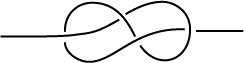
Start with the classical position of the figure-8 knot (two ends extends to infinity and meet at the point infinity in \mathbb{S}^3):

To find a fibration over the circle, we need to give a surface that spans the knot (such surface is called a Seifert surface) and a homotopy of the surface \varphi: S \times [0,1] \rightarrow \mathbb{S}^3 \backslash K which restricts to a bijection from S \times [0,1) to \mathbb{S}^3 \backslash K and \varphi(S\times\{1\}) = \varphi(S\times\{0\}).

For quite some time, I tried with the following surface:

Since it’s perfectly symmetric (via a rotation by \pi), we only need to produce a homotopy that sends S to the symmetric Seifert surface in the upper half plane. I was not able to find one. (I’m still curious if there is such homotopy, if so, then there are more than one way the knot complement can fiber)

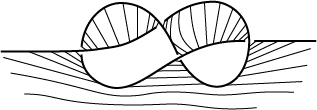
It turns out that there are in fact non-homeomorphic (hence of course non-homotopic) Seifert surfaces spanning the knot, the one I end up using for the fibration is the following surface:

Or equivlently, we may connect the two ends at a finite point.

To see the boundary is indeed the figure-8 knot:

Note that this surface is not homeomorphic to the pervious one because this one is orientable and the pervious is not.

Now I’ll leave it as a brain exercise to see the homotopy. (well…this is largely because it takes forever to draw enough pictures for expressing that) A hint on how the it goes: think of the homotopy as a continuous family of disjoint Seifert surfaces that ‘swipes through’ the whole \mathbb{S}^3 \backslash K and returns to the initial one. As in the picture above, our surface is like a disc with two intertwined stripe handles on it, each handle is two twists in it. The major step is to see that one can ‘pass’ the disc through a double-twisted handle by making the interior of the old disc to become the interior of the new handle. i.e. we can homotope the bowl from under the strap to above the strap with a family of disjoint surfaces with same boundary.

In in figure-8 knot case, the disc would need to pass through both straps and return to itself.

A hyperbolic structure on the Whitehead link completement

I’ve been going through Thurston’s book ‘The Geometry and Topology of Three-Manifolds‘ in a reading course with Amie Wilkinson. In Chapter 3, p32, when he’s constructing a hyperbolic structure on the Whitehead link complement, there is a picture on how to glue the 2-cells to the knot, to quite Thurston, ‘the attaching map for the two-cells are indicated by the dotted lines.’ However, for me it’s impossible to see where are the dotted lines going. So I reconstruct it here with some more clear pictures. The construction itself was a cool reading that I wish to share.

First, we have the Whitehead link, looking like the first figure below:

We attach three 1-cells (line segments) as in the second figure, note that the ‘x’ in the middle represents a line segment orthogonal to the screen, connecting the top and bottom line in the figure ‘8’ loop.

Now we will start to attach four 2-cells to the 1-complex above: First, we attach a 2-cell spanning the top part of the figure ‘8’ loop, spanning one side of the middle segment and two sides of the top segment (denote this by cell A):

Do the same with the bottom half (cell B). Note that each cell is attached to three edges, hence they are triangles without vertices in the knot complement with three one-cells attached.

For the other two cells, we attach as follows (cells C and D):

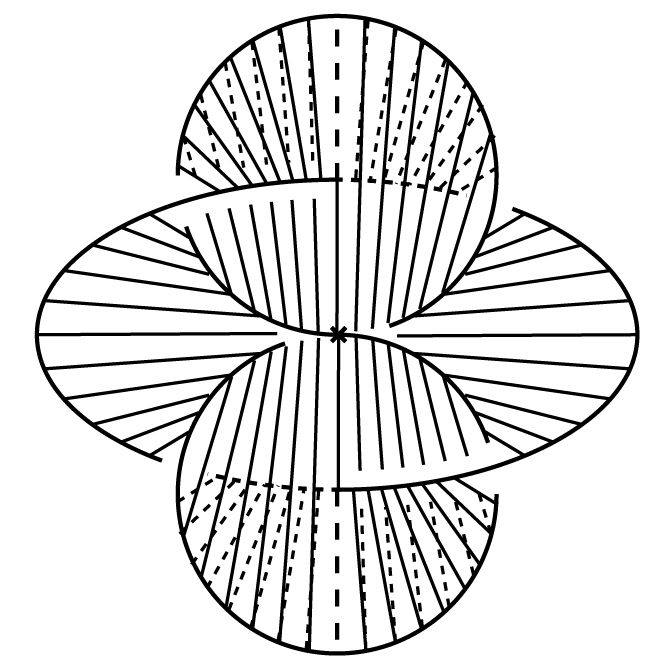
Combining the four 2-cells, we get something like the figure showed below. Note that at the top, cell A is under cell C in the left, intersecting the surface spanned by cells C and D at the edge, and comes above cell D to the right of the edge.

It’s easy to see that the complement of the above 2-complex does not separate \mathbb{R}^3, hence it’s a 3-cell with eight faces (i.e. it has to go through both sides of each 2-cell in order to fill the 3-space) each of its face has three edges. Hence we may glue an octahedron to the 2-complex after the gluing, pairs of faces of the octahedron will be identified groups of four edges will be identified to single edges. Hence to put a hyperbolic structure on the link complement, it suffice to put an hyperbolic structure to the octahedron with vertices deleted.

Since each edge is glued up by four edges of the octahedron, it suffice to find an octahedron (without vertices) in the hyperbolic 3-space that has all adjacent faces intersect in dihedral angle 2 \pi / 4 i.e. all adjecent faces are orthogonal in the hyperbolic space. But this is achieved if we inscribe the regular octahedron into the Klein model (also called projective model of hyperbolic 3-space.

The gluing map for the faces are merely rotations and reflections of the ball which are certainly hyperbolic isometries. Hence this gives a hyperbolic structure to the link complement.