Year of 2015 – life in the strange world of consulting

I am surprised and touched after logging into here after more than a year tans found continuously high traffic volume…so much so that I’m thinking of picking this back up…no promises, though. =P

In any case, I have to say that it has been one of the most exciting periods of my life since I last posted (which, I guess, contributed to my not posting here).

Trajectory: t \in (\mbox{Dec 2014},\mbox{July 2015})

iternary.001.jpg

During this time, I:

  • left the prop painting job in Disneyland;
  • signed an offer with consulting firm McKinsey & Co.;
  • got my advanced scuba diving license and dived for a month in Thailand and the Philippines;
  • went to study representational painting in Florence;
  • climbed in China’s top rock climbing spot Yangshuo;
  • went to a ‘mini-MBA’ organized by McKinsey in Amsterdam;
  • backpacked from Holland to Poland;
  • got back to Princeton and defended my PhD thesis (yes, I finally did that);
  • volunteered in a wildlife conservation area in Kenya;
  • came back to Shanghai and settled down to start consulting;

Life.jpg

The above took us from November 2014 to July 15th, 2015. Since July 15th I have been role-playing as a consultant in the strange corporate world. According to Fortune magazine, I am officially working for  “the most well-known, most secretive, most high-priced, most prestigious, most envied, most trusted, most disliked management consulting firm on earth,” it’s understandable that no client or content related to work can be mentioned here, so I’ll just talk about cool stuff I do outside of work, or life in general = )

Consultant costume:

consultant

Let’s pick up where we left off: I was painting props in Disneyland, moving from a sub-contractor to a general contractor, then hopefully to Imagineering (i.e. moving along the path described in ). All looking pretty promising in October 2014, until I hit a brick wall called internal politics >.< (won’t go into details) The result is that I decided to leave and find another way.

By some completely random sequence of events, I learned about this thing called consulting, in which I heard one can move around the world and across industries to solve problems. I decided that it sounds pretty cool and went for an interview, then two more follow-up interviews, then I signed the offer.

McKinsey turns out to be, umm, not much like what I imagined (for example, the ‘traveling around the world’ part have not happened yet; in fact I have been completely stuck in Shanghai since July >.<). But one thing I am very grateful for is that they let me pick when to join, given a window of one year since the contract. I picked July 2015 to have 7 months to complete many things I’ve always wanted to do, planned and budgeted with the aim of using up the whatever small amount of saving I had. You’ve already seen the results above ^_^

A few things I learned from the 7 months pre-consulting:

  • It’s important to make time and systematically complete things one wants to do, so that they don’t accumulate
  • Spending all of one’s money on cool stuff feels great, I’ll aim for doing this periodically
  • Going out and do things often unlocks next levels for pursuing the interest (a lot like video games)

A few things I learned from the 5 months with McKinsey:

  • Unlike in mathematics where I stare at a blank paper for weeks before putting down a stroke, people here start ‘doing’ things immediately; This takes a lot of pressure away and wish I have done things more like this in academia
  • The corporate world is not very creative, but strangely spending time on manual tasks satisfying and increases my urge to be creative during personal time
  • When things are not ideal (e.g. being stuck in China) one should: 1) try as hard as one can to move within the orginazation in the right direction 2) do things outside of work to completement what’s non-ideal

Plans going forward (laundry list, mostly for myself to check back when I get bored and can’t think of things to do) – it goes roughly from shorter term to longer and more involved items which I have less clue about how to proceed:

  • Do interesting side-projects on weekends, such as:
    • Design and build a working Turing machine with my recently obtained LEGO Mindstorm EV3 (I would need some help on this from my mathematical blog readers: Anyone have a good set of turing machine notes? I remember spending lots of time writing the states back in my undergrad days, need to refresh those memories but lost the notes)
    • Re-start improving my digital painting with my new iPad pro and apple pencil (so far I believe it’s going to totally substitute Wacom!)
    • Think about topology – sometimes I feel the need to read/think math in order to verify that I’m not becoming more stupid in this job =P 
  • Climb Kilimajaro in February 2016 – this was originally part of my African trip this June, but due to lost passport in Kenya it didn’t happen. Just booked the flight
  • Oil painting – follow up with connections built in Florence, possible next painting workshop in Rome, Venice, Paris or Sweden
  • Sculpture – would be great to start that at some point, ideally marble, in Florence or London
  • Flying – Go to Arizona and actually complete my pilot license (did’t get very far at all in Princeton due to weather and the fact that Airport is 30 min biking away from school >.<), can be done in a month with good weather and intensive flying
  • Diving – Need to do more boat diving in interesting spots, see whales, sharks and shipwreck
  • Rock climbing – Back to Yangshuo, follow up with connections built there with the rock climbing community, improve ratings, eventually move to large walls and climb El-Captain
  • Wildlife conservation – 1) Follow up with LUMO in Kenya, re-visit, try to fund my cattle program to prevent locals to kill Lions  2) Good NGOs to try connecting with: WildAid in China for stopping Ivory and shark fin demand and Save the Elephant in Kenya  3) explore how might I get McKinsey involved
  • Industrial design – Potentially get a masters in that, either ArtCenter or Europe
  • Disney (Imagineering or PIXAR) – Remains a huge void and question mark I need to figure out… Have to get there at some point in life… Ideally through building a portfolio and reputation in  visual development

Hopefully that would keep me occupied for some time =P

I would aim to write here whenever there is any thing intellectually interesting going on. Let me know if you have any suggestions for bits of things I can think of/write about!

Best regards,

“Dr.” Conan Wu

Recent progress on the Imagineering quest

As we all know, I set my life goal of doing this Disney/Pixar stuff 2.5 years ago during that epic vacation in Walt Disney World. So after learning that they are building a park in my hometown Shanghai, I had this idea of coming back and start from there which got realized half a year ago after I had an injure trying to renovate the studio space in LA. (well…that’s another story >.< I one just needs to know that I'm fully recovered and am jumping around again, as you can tell from below)

After arrival I didn't really know how to proceed, so I spent some time catching up on academic drawings:

2014-03-25 21.31.53

2014-04-02 18.21.28

2014-03-30 21.32.57

and paintings:

2014-04-06 22.41.45

2014-04-12 21.57.35

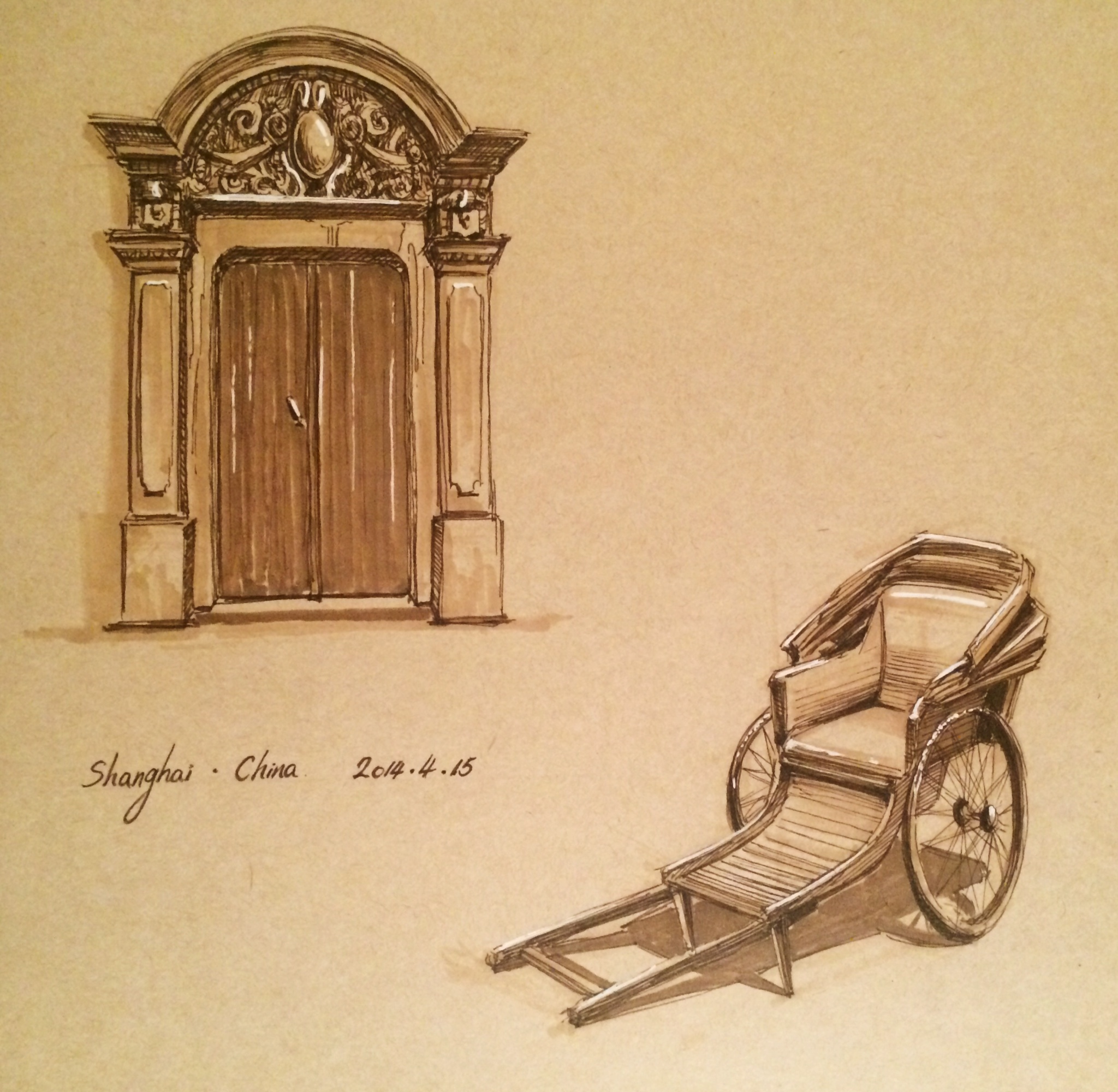
Then I spent most of the Spring wandering the roads of Shanghai:

image

2014-04-15 01.32.02

2014-04-15 01.29.17

Hanging out in coffee shops:

image_1

and did some domestic traveling:

photo

photo

Finally in May, I was recovered and ready to head to the park (ok…plus start road biking…):

2014-05-12 18.24.33

I started off by finding a random job painting props (such as rocks, wood, and sculptures that are made of fiberglass) with a local sub-sub-subcontractor under Disney. This was quite an adventure, I got to live in the construction worker’s dorm inside the park and worked 6 days a week, it was FUN:

2014-05-22 07.39.27

(Note: everything in the painting shop are top secrets and cannot be taken photos of =P)

So I went to paint items in the Shanghai version of the classical Pirates of the Caribbean ride.

After a few weeks they somehow discovered I’m pretty good at this and decided to make me an art supervisor (oh, and I received a salary multiplier of 2.5). After another few weeks I got an offer from a not-too-sub contractor I dealt with on the site (with another salary multiplier of 2.5, now let’s see, what will happen if one keeps this exponential growth… =P Ok just joking…But I decided to turn them down and went for a job interview with Disney (finally!)

That’s pretty much where I am right now. Hopefully I’ll soon be calling myself an Imagineer, if not I’ll just keep trying until that happens =P. Wish me luck!

A posthumous paper: Random Methods in 3-manifolds

Hi all, life has taken some dramatic turns since I last posted: I did not get to teach topology in Art Center, so I took a different approach in job-finding and ended up making pastries in a local bakery overnight (11pm-7am) for two months until some (very complicated) personal affairs arise, due to an irreversible influence from certain individual, I decided that I should forget about applied/digital art and just paint classically instead; So I think I’ll start by become a painter who also works in random jobs (such as dishwashing). Oh, and I’m getting married sometime this year~

Ok, enough random things about me…I’m here to give a little teaser of a posthumous paper of mine in mathematics before it goes on the ArXiv, which I finally received a complete draft from my wonderful co-authors Alex Lubotzky and Joseph Maher. I hope this summary from my point of view could serve as my tribute to this interesting piece of work.

***********************************************

Let’s start with an ‘unrelated’ piece of history: Once upon a time, many standard or number-theoretically significant graphs (such as Ramanujan graphs, as I might have mentioned when talking about expanders before) were not known to exist, then there comes Paul Erdos, after whom they were known to exist and is literally ‘everywhere’, but we still didn’t manage to ‘catch’ any particular one of them, at least not for another twenty something years. So we know that in mathematics it’s sometimes easier to prove ‘most’ objects satisfy some properties than to pick one out, for establishing existence.

While in Israel, Alex presented to me this fascinating idea he had about proving existential results in topology using random methods:

(crush-course for those who don’t know topology)
1. All closed 3-manifolds can be written as two many-holed solid donuts glued together along their surface.

WHY?

It’s easy to believe all smooth manifolds can be chopped into tiny tetrahedrons.
Take the triangulation -> take it’s 1-skeleton -> take a small neighborhood of the 1-skeleton This is a neighborhood of a graph, hence a handlebody. Now what’s the complement of that 1-skeleton neighborhood?
…also a neighborhood of a graph~! …hence another handlebody…(note that the two donuts must have same number of holes since the gluing is clearly a homeomorphism)

This is called a Heegaard splitting of the 3-manifold.

OK, we now know all 3-manifolds arise from such gluings when we use some (probably large) genus donuts. We can fix a genus and ask what are all possible gluings occurring in that genus.

Now two homotopic homeomorphisms clearly give the same 3-manifold, hence we only need to consider the homotopy classes of surface homeomorphisms, which forms the infamous mapping class group of the surface.

To summarize, we have in hand a discrete group in hand whose elements parametrize (with repetitions) all 3-manifolds given by gluing donuts of that genus.

What can we do on infinite discrete groups? Well, actually many things, but in particular we may put a probability measure on its generators and random walk!

Now we can ask all sorts of things regarding what happens after walking for a long time, such as:

After taking N steps,

How likely are we landing on a gluing map that gives a hyperbolic 3-manifold? (property 1)

How likely is the resulting gluing a Heegaard splitting with minimal genus? (property 2)

Topologists might have the intuition that ‘most’ 3-manifold should be hyperbolic and guess that ‘most’ Heegaard splittings are minimal genus; if so, I’m glad to tell you that…your intuition is correct!

At this point I would like to sidetrack a little bit and point out that, many of those traditional combinatorics/number theory/graph theory random method arguments goes like this: take a smartly chosen class of objects, put a carefully constructed probability distribution on it, and Boom~ ‘most’ (asymptotic probability one) many objects are our desired objects! so they exist!

Now of course we already know that hyperbolic 3-manifolds exist in every Heegaard genus…but we figured that this random implying existence method can be pushed much further than merely most imply exist. After all, it is a group which we are walking on~

First of all, property 1 and 2 are not only generic in the sense of having asymptotic probability 1, but actually the set that does not satisfy property 1 and 2 decreases exponentially, i.e. the exceptional set for both properties have size O(e^{-cN}) for some c>0 after $N$ steps.

The above leads one to think of the possibility of estimating decay rates of various 3-manifold properties under this random walk and thus drew conclusions such as “if property A decays exponentially, property B decays polynomially but not faster, then even if ‘most’ objects satisfy neither A now B, we can still conclude that there exist objects that’s B but not A.

Now this is all very nice but useless unless we can find and prove some manifold properties with interesting, non-exponential decay rates. For that we may take advantage of the group structure: homomorphisms between groups project random walks, hence invariants that take value in a (hopefully simpler) group would have level sets in the mapping class group having decay rates given by return probabilities of the projected Markov processes on the simpler group, which can be polynomial.

In that spirit, we apply our random method to find hyperbolic genus g homology 3-spheres with particular Casson invariants. (I will not get into Casson invariants here, let’s just keep in mind that it’s a classical integer invariant of homology 3-spheres, it is generally pretty hard to construct non-trivial examples with particular Casson invariants) Namely we prove:

Theorem: For any integers g, n with g \leq 2, there exists hyperbolic homology 3-spheres with Heegaard genus g and Casson invariant n.

The subgroup of the mapping class group consisting of all elements that give raise to homology 3-spheres is called the Torelli group. So Casson invariant assigns integers to Torelli group elements. With some work one can show that this is somewhat close to a homomorphism to \mathbb{Z}. More precisely, it’s a homomorphism on what’s called the Johnson kernel, which is a normal subgroup of the Torelli.

Unfortunately little is known about the Johnson kernel, in particular we don’t know if it’s finitely generated. But for our purpose we can pick out three elements from the group and consider the subgroup H generated by them. (two Pseudo Anosov elements with distinct stable and unstable laminations, plus a third element that guarantees Casson homomorphism is surjective.)

Now the two Pseudo Anosov elements makes the argument of exponential decay carry through (i.e. property 1 and 2 still holds outside of an exponentially small set in H); The Casson invariant is a homomorphism hence projects the random walk in H to a Markov process on \mathbb{Z}. Asymptotically such process hits returns to 0 with probability \sim 1/N^2; making all integers achieved with a quadratic asymptotic decay rate. i.e. all level sets of the Casson homomorphism has decays only quadratically in H.

From the above we can conclude there are manifolds with any Casson invariant which falls outside both the exception set of hyperbolic and Heegaard genus g.

Some slightly more recent results =P:

2013-12-02 06.18.47

Progress update: Painting, drawing etc. 11/25/2013

A life painting~ (this time I got a longer pose)

2013-10-10 19.01.19

Newest unfinished master copy:
2013-11-23 18.15.06

Rembrandt head, finished (compare to the last version in this post)
2013-10-01 13.01.46

Some plants from the LA Arboretum:

2 (7 of 7)

2 (6 of 7)

2 (4 of 7)

2 (3 of 7)

Turning sphere inside out~ (well…still gotta have some nerdy stuff, right?)

2 (5 of 7)

Composition: Kids found an abandoned boat and stolen stuff from home to decorate it as a pirate ship =P

2013-10-20 15.19.38

Mathematics, with Imagination – a course proposal

Since this summer I have been secretly working on pitching a course, in fact, something that has been growing in my mind throughout my time in mathematics. This is a course that presents mathematics, especially geometry and topology, as artistic inspiration rather than a practical tool. I finally decided to write about it in this post. I would be more than happy to hear your response and suggestions on both the course itself and its topic selections!

The current state of this is that I have finally found the perfect home for the course: The Art Center in Pasadena. After a few month of poking around I made it into the administration and attracted quite some interest from various people. Two days ago I was asked to speak about curvature for half an hour in the faculty meeting. So I might start teaching there this spring and will find out soon~ Wish me luck!

Overview

`The best mathematics uses the whole mind, embraces human sensibility, and is not at all limited to the small portion of our brains that calculates and manipulates symbols. Through pursuing beauty we find truth, and where we find truth we discover incredible beauty.’ — William Thurston

Much like art, mathematics is all about idealizing and simplifying the real world. I have always believed that, when exposed to the right set of topics, artists in all disciplines can get inspiration from mathematics. The objective of this course is to present a set of visually interesting topics from a wide range of advanced mathematics in a fashion that would be appealing to artistically creative minds.

Structure

The first half of the semester will consist of lectures on one topic per week, the topics are typically at advanced undergraduate to graduate level, but presented in a way that’s tailored especially for artists (i.e. lots of imagination required, absolutely no numbers and formulas). Some rigorous proofs will be presented followed by discussions. Every week there will be some interesting homework problems related to the topic in order to solidify student’s understanding, as well as some more creative homework that helps generating ideas for art inspired by the topic. Starting from week 7 we will develop a final project in which students can pick one of the thumbnail ideas from the pervious weeks and develop it into a project. I will present some inspirational projects (such as hyperbolic geometry inspired fashion design, 3D printings, fine art sculptures, digital fractal art, screen prints and film/animation projects).

In the eighth week we will talk about individual projects, make sure they are scientifically sound and meaningful as well as resolving practical difficulties. The remaining part of the semester will consist of lecture and discussion sessions on some more abstract topics which would serve as exposition rather than demanding precise understanding, no problem sets will be given on those. We will touch base on the progress of projects at the end of each class. Many potential in-class activities could be included, for example one could spend a class having students collaborate on building a human sized four-dimensional polytope out of the geometric construction tool `Zome’, or play teamwork games on knots and links. The last class will be a presentation and review of projects.

Weekly plan

Week 1: Surfaces from an ant’s perspective

Week 2: From peeling orange to metric structures

Week 3: Knots and links

Week 4: Fractals, natural and man-made

Week 5: Geometry of paper folding

Week 6: Pathological spaces

Week 7: Inspirations for final project

Week 8: Project planning

Week 9: Cubes and polytopes, in all dimensions

Week 10: Collaborative Zome tool construction

Week 11: Shapes of Universes

Week 12: Real estate in hyperbolic space

Week 13: Infinity and beyond

Week 14: Project presentation and discussion

Outcome

This course will develop student’s skills in imagining abstract spaces and visual problem-solving as well as giving them a brief tour into the fascinating world of contemporary mathematics. The final project would ideally serve as a demonstration of student’s ability to integrate sophisticated scientific ideas into a piece of beautiful artwork which we will submit to the annual Joint Mathematics Meeting art exhibit, and the International Bridges Conference which links mathematics with Music, Art, Architecture and Culture. A successful project would make an excellent portfolio piece.